George Anjay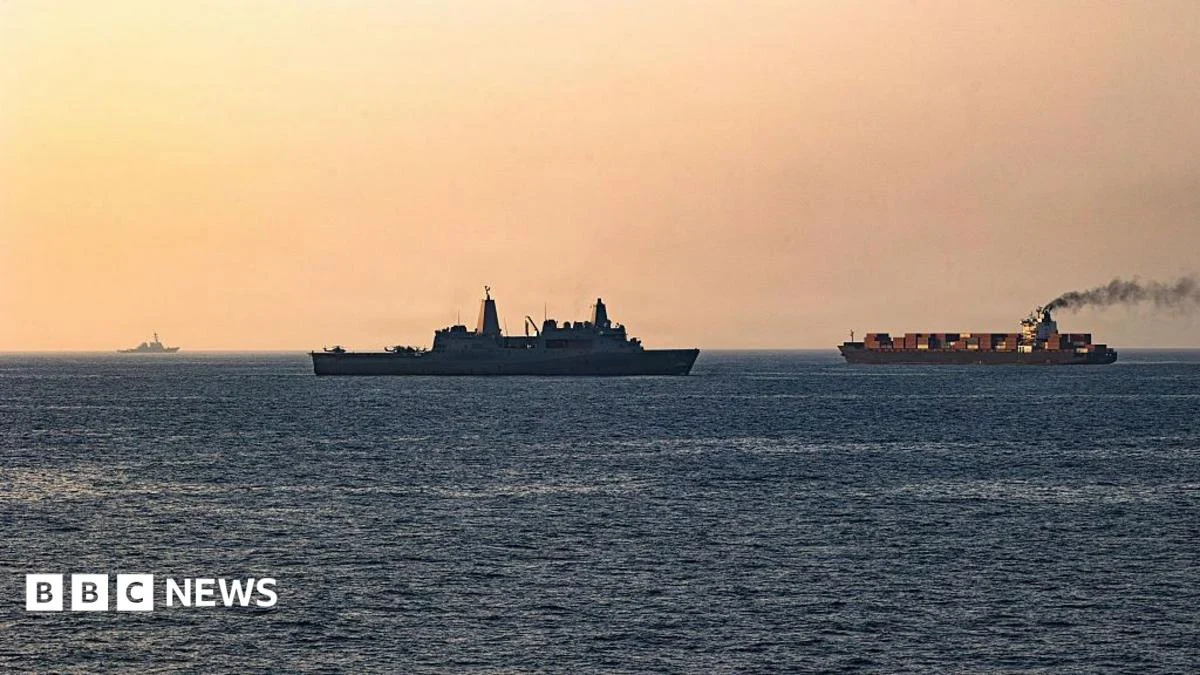
The United States military has unleashed a "heavy wave" of strikes against Iran, a significant escalation in the ongoing conflict that has gripped the Middle East for months. This decisive action comes in direct retaliation for Iran’s attempted ballistic missile attacks on American forces and naval assets earlier this week. U.S. Central Command (Centcom) confirmed it struck "dozens" of Islamic Revolutionary Guard Corps (IRGC) targets, a broad response to Iran’s firing on U.S. bases in Jordan and at commercial shipping in the crucial Strait of Hormuz.
The human cost of the latest hostilities is stark. Iranian state media has reported that the retaliatory strikes have tragically killed three individuals, including a two-year-old child, on the island of Qeshm. Further strikes were reported in other locations across the southern and western regions of Iran. This latest volley of violence marks a significant expansion of the conflict, following a week that has already seen the first publicly announced joint U.S.-Saudi strikes targeting Iranian proxies operating in Iraq.
The protracted nature of this conflict is a sobering reality. What began earlier this year with military strikes by the U.S. and Israel against Iran, initially predicted by President Donald Trump to last only a few weeks, has now endured for five months with no discernible end in sight. Amidst this escalating tension, news outlet Axios reported on Wednesday that President Trump met with Saudi Defense Minister Prince Khalid bin Salman. According to an unnamed U.S. official cited by Axios, Prince Khalid conveyed Saudi Arabia’s desire to de-escalate the prevailing tensions. The White House has been contacted by the BBC for comment on this development.
The U.S.-Iran conflict, which had seen a period of relative calm in recent days, has been reignited with a renewed ferocity. For several days, both sides had seemingly halted offensive operations, with reports suggesting that talks aimed at achieving a diplomatic solution were underway. President Trump had characterized these discussions as "very friendly negotiations," although Tehran had officially denied any such dialogue was occurring. However, the Iranian missile attack on a U.S. base in Jordan on Tuesday proved to be a significant turning point. Following this aggression, President Trump vowed a strong response, telling reporters at the White House, "We’re going to be hitting them very hard because it’s our turn to hit them. They know it’s coming. They asked us not to do it."
The latest wave of U.S. strikes commenced at 20:00 ET on Wednesday, lasting for approximately one hour. Centcom described these operations as a "powerful response to yesterday’s attempted Iranian attacks on U.S. forces based in the Middle East." The command further stated that all Iranian missiles launched in the prior attack were successfully intercepted. The targets of the U.S. retaliatory strikes were meticulously selected, encompassing "military command centers, missile and drone facilities, coastal surveillance and defense sites, and maritime capabilities," according to Centcom’s post-strike assessment.
The Iranian state media agency Irib corroborated the reports of strikes, identifying the islands of Qeshm and Abadan as among the areas hit. Both islands hold significant strategic and economic importance, particularly in relation to the oil industry. The heartbreaking report from Fars news agency, citing the Hormozgan University of Medical Sciences, detailed the tragic loss of life on Qeshm. "A U.S. attack on a residential home in the Chah Tangu neighbourhood of Qeshm killed three members of a family: the father, the mother, and their 2-year-old child," the report stated.
Meanwhile, Jordan’s armed forces confirmed that its air defense systems had successfully intercepted and shot down five Iranian missiles that were targeting the Kingdom’s territory on Thursday. This incident underscores the widespread regional threat posed by Iran’s ballistic missile program. On Tuesday, the IRGC had claimed responsibility for targeting a U.S. air base and a command center in Jordan, explicitly stating it was in "response to the acts of aggression of the American child-killing army."
The IRGC’s actions extended beyond land-based targets. The organization also announced that its naval forces had struck three oil tankers in the Strait of Hormuz. This maritime action was justified by the IRGC by claiming the tankers had "ignored warnings" and proceeded along what they described as an "unsafe and illegal route" through the vital Gulf waterway, a critical chokepoint for global oil trade.
This recent escalation follows a period of intense military activity. Last Friday, President Trump had suspended an intensive bombing campaign that had been ongoing for 13 consecutive nights. During that campaign, the U.S. had targeted Iranian weapons and military sites, with reports indicating scores of casualties.
The broadening scope of the conflict was further highlighted on Tuesday with the joint U.S.-Saudi strikes in Iraq. Centcom announced that these operations hit "multiple terrorist logistics and weapons sites across eastern Iraq in a strong response to over 30 IRGC-directed aerial drone attacks in the last 72 hours." The impact of these strikes on Iraq’s paramilitary forces was significant. The Iraqi Popular Mobilisation Forces (PMF), a coalition largely dominated by Iran-backed Shia militias, reported that at least 20 of its members were killed in the U.S.-Saudi strikes on its bases. The Iraqi presidency swiftly denounced the bombing of the PMF bases, labeling it "an unacceptable attack and a blatant violation of Iraq’s sovereignty." However, President Trump, speaking to Fox News, asserted that these strikes had been "co-ordinated with the Iraqi government," a claim that has been met with skepticism by some observers.
The underlying geopolitical dynamics fueling this conflict are rooted in a long-standing struggle for regional dominance between Saudi Arabia, the leading Sunni Muslim power, and Iran, the largest Shia Muslim country. This decades-long rivalry has now manifested in a direct confrontation involving the United States, drawing in regional allies and threatening to destabilize the entire Middle East. The cycle of retaliation and counter-retaliation, marked by significant human suffering and the potential for wider conflagration, continues to unfold with grave implications for global security.


 Nakalama John
 Ramos Leo
 Nana Banana