George Anjay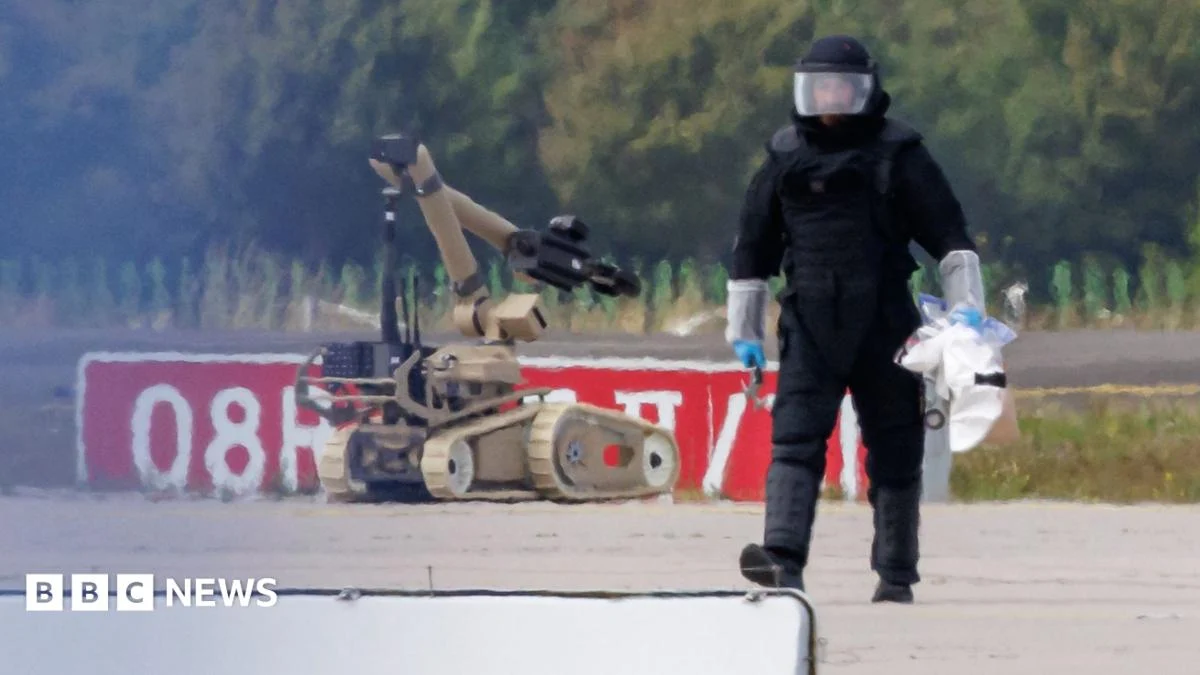
A chilling echo of a previous Russian-backed plot involving Leipzig airport has surfaced, potentially illuminating the murky origins of the recent drone-bomb incident and raising grave questions about Russian intelligence agency involvement in destabilizing European security. The 2024 incident, where a sophisticated incendiary device, concealed within a parcel, ignited at the airport’s DHL hub moments before being loaded onto an aircraft, bears striking similarities to a broader network of attacks that subsequently plagued the United Kingdom and Poland, causing extensive damage. The ongoing trials in Lithuania and Poland of a group of men, who prosecutors allege were part of a vast network of proxies recruited by Russian military intelligence, offer a disturbing glimpse into the methods and reach of such operations.
However, a significant subplot within this unfolding investigation, largely overshadowed until now, reveals an even more alarming dimension: the seizure of substantial quantities of RDX explosives in Lithuania last September, intended for "other terrorist attacks." Lithuanian prosecutors disclosed that the recovered explosives were equivalent to 6 kilograms of TNT, with some devices specifically manufactured to "intensify the blast." Recent access to case documents by the BBC has unveiled the insidious logistical framework of this operation. Several of the men currently on trial were allegedly paid handsomely to transport these potent explosives across Europe, ingeniously concealed within everyday items such as cans of sweetcorn and chopped tomatoes. The detonators, the critical components for unleashing destruction, were cunningly hidden inside common headphone sets, a testament to the perpetrators’ meticulous planning and their ability to exploit mundane goods for nefarious purposes.
Crucially, these suspects also handled drone parts, with case files specifically detailing attachments designed for carrying explosive payloads. Prosecutors allege that a significant portion of these sinister materials were infiltrated into the European Union from the Russian exclave of Kaliningrad, a strategically positioned territory bordering Poland and Lithuania. While nearly two dozen suspects have been indicted on terror-related offenses, the handlers of these operatives, believed to be operating from within Russia, remain at large. This leaves a disquieting uncertainty regarding the complete dismantling of the network and the recovery of all hidden materials. Although no direct evidence currently links the 2024 Leipzig drone bomb to this specific network, the chilling parallels undeniably highlight the profound potential for such sophisticated attacks.
One of the accused in Poland, a Ukrainian national identified as Vladyslav D., provided investigators with a detailed account of his multiple long car journeys undertaken in July 2024, meticulously following instructions from an individual he knew only as "Warrior." While Vladyslav D. has since pleaded not guilty in court, his statements paint a vivid picture of clandestine operations. He described receiving instructions to travel to the edge of a Lithuanian forest, where he discovered a carrier bag containing "three or four packs of headphones," ominously damp from the rain. Earlier, he had collected two cans of corn, "lightly covered with soil," from another location, professing ignorance about their contents. His orders were to transport the headphones a considerable distance to Poland, where he observed a "guy on a bicycle" collecting them from the roadside.
For another assignment, Vladyslav D. was directed to a specific location within a Lithuanian cemetery, marked by a GPS pin, where he was instructed to dig beneath plastic flowers. His efforts unearthed a bin bag wrapped in brown tape. "Inside were drone components: small plastic propellers, I think four pieces," Vladyslav told investigators. These components were then to be left by a road in central Poland for collection. His final directive led him to Germany, where he was given a code to access a hostel room in Dusseldorf, with instructions to leave the drones and other items inside. The intended targets of these meticulously orchestrated operations were never revealed.
In his statements to investigators, Vladyslav D. admitted to receiving over $2,000 (£1,487) in cryptocurrency for his participation, underscoring a clear financial motive for his involvement. The Leipzig case, while still largely shrouded in secrecy, offers further disquieting connections. German sources suggest that the explosive used in the drone bomb was Semtex, a composition that contains RDX, the same explosive found concealed in the food cans within the Lithuanian cemetery. The precise quantity of explosives carried by the drone at Leipzig remains unknown, and the physical damage inflicted may have been limited. Professor Jackie Akhavan, an explosives expert at Cranfield University, explained that while a metal drone casing could potentially pierce an aircraft, a mere blast wave would likely only cause superficial damage unless fragmentation was incorporated.
However, the true objective of such an operation, if indeed orchestrated by Russia, was likely the sowing of fear and the disruption of vital logistical chains. Andrei Soldatov, a leading expert on Russia’s intelligence agencies, stated that suspecting Moscow in this instance "makes sense," pointing to a discernible pattern of sabotage and hostile activities, ranging from arson attacks on facilities supporting Ukraine to the deployment of drones over sensitive European sites. Germany, a significant supplier of military aid to Kyiv, becomes a particularly attractive target for such disruptive actions.
"It’s a message," Soldatov explained. "You get something like that [a bomb] into one of the biggest European airports and you send the message that, ‘Guys, we can do that. Remember.’ You hint to the adversary that you might cause a really big problem: that tomorrow might be more serious." The potential motive, he suggests, stems from the intense pressure Moscow faces from Ukraine’s prolonged drone attacks and the repeated humiliations suffered by Russian President Vladimir Putin on the international stage.
A NATO official, responding to inquiries, stated, "We are aware of the incident, which the German authorities continue to investigate." Antonov Airlines, the firm that supplies aircraft for certain NATO operations, has maintained a cautious stance, declining to specify whether their services include military support for Ukraine. A spokeswoman in Kyiv, when asked about the possibility of Ukrainian aircraft being targeted, responded, "We are not making any such assumptions… We don’t know what this drone was or why it was there."
However, Russia watchers remain unequivocal in their assessment. John Lough of the New Eurasian Strategies (NEST) Centre asserts, "This is Russian interference. It’s all part of undermining support for Ukraine by pointing to the dangers of escalation and, frankly, scaring the German authorities." He perceives a heightened potential for a surge in such hybrid attacks, attributing this to Ukraine’s recent shifts in the balance of the war. "My expectation is that such activity will increase quite sharply over the coming months. I think it’s a dangerous moment." The Leipzig drone-bomb incident, viewed through the lens of the broader Russian-backed plot, serves as a stark and unsettling reminder of the evolving nature of hybrid warfare and the persistent threats to European security.



 Nakalama John
 Ramos Leo
 Nana Banana