
 George Anjay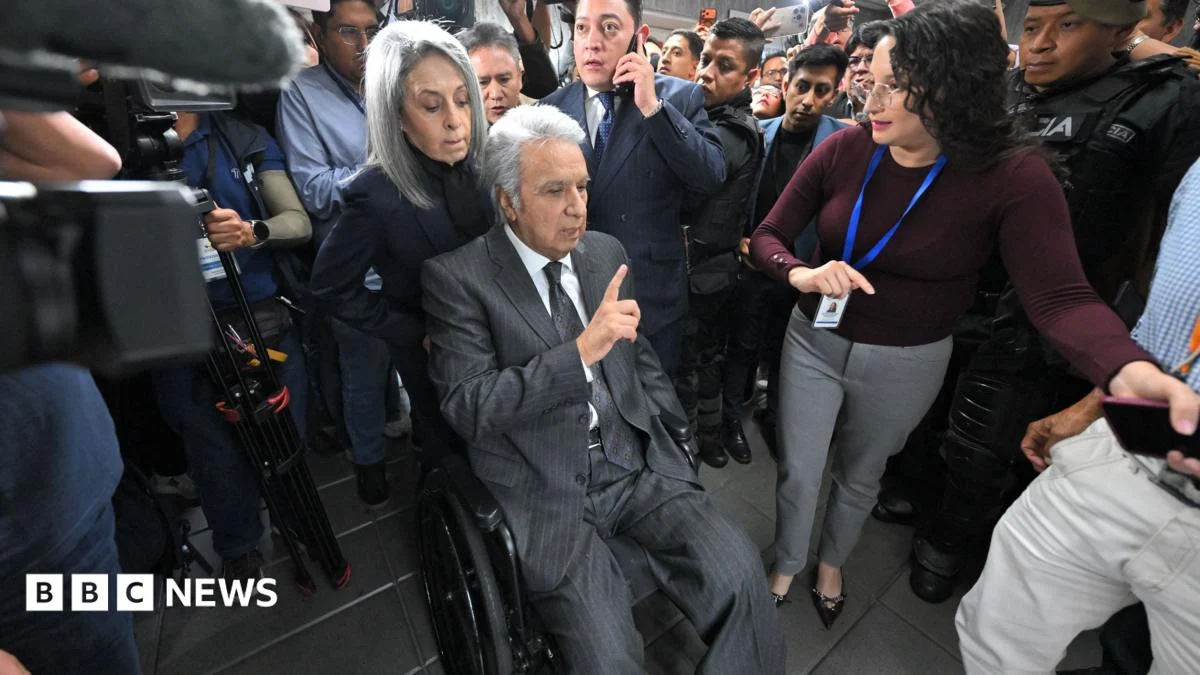
A former president of Ecuador, Lenín Moreno, has been handed a five-year prison sentence after a court found him guilty of corruption charges related to alleged bribery in a multi-million dollar hydroelectric dam project. The 73-year-old, who led the South American nation from 2017 to 2021, will serve his time under house arrest due to his advanced age and a pre-existing disability, a concession that has drawn scrutiny. Moreno has vehemently denied any wrongdoing, asserting his innocence and indicating his immediate intention to appeal the verdict delivered by a court in the capital city of Quito. This conviction marks a significant moment in Ecuadorian political history, as Moreno becomes the third former head of state to face imprisonment for corruption, underscoring a persistent challenge of accountability in the country.
The cornerstone of the prosecution’s case revolved around the controversial Coca Codo Sinclair hydroelectric dam, a massive infrastructure project awarded to the state-owned Chinese firm, Sinohydro. Prosecutors alleged that Sinohydro, through a complex network of shell companies, funneled approximately $76.1 million (equivalent to £56.2 million at the time of the alleged transactions) to individuals implicated in the deal. These payments, the court found, were intended to secure and maintain the lucrative contract for the dam’s construction. The verdict implicated not only Moreno but also 19 other individuals, painting a broad picture of systemic corruption involving various stakeholders.
Among those convicted and sentenced to prison were individuals closely connected to Lenín Moreno, including his wife, daughter, and brother. Their involvement, while potentially less financially significant than other figures, was crucial to the prosecution’s argument that the bribery scheme extended into the highest levels of Moreno’s family. The court also found guilty former plant managers, representatives of Sinohydro, and even a former Chinese ambassador to Ecuador, highlighting the international dimension of the alleged illicit activities. While the precise amount Moreno himself was accused of directly receiving was reportedly minimal, the prosecution argued that his family members benefited from tens of thousands of dollars, thereby implicating him in the overarching corrupt enterprise.
The repercussions of the convictions extend beyond imprisonment. Those found guilty of bribery will be compelled to repay three times the amount they received, a punitive measure aimed at stripping them of illicit gains. For Lenín Moreno, the sentence carries an additional significant penalty: disqualification from holding public office. This effectively ends any potential for future political involvement, a stark consequence for a former president.
Moreno, in his defense, has consistently maintained his innocence, choosing to deflect blame and point fingers at his predecessor, Rafael Correa. Correa, under whom Moreno served as vice-president, was himself convicted in a separate bribery case in 2020 and sentenced to eight years in prison. Moreno argued that the Coca Codo Sinclair project was initially approved by Correa, and that upon assuming the presidency, he had initiated an investigation into reported issues with the dam’s construction. This counter-narrative suggests a political struggle for accountability, with each former leader attempting to distance themselves from corruption and attribute it to the other.
The genesis of the legal proceedings against Sinohydro can be traced back to 2021, when the Ecuadorian government formally launched legal action. This was prompted by the emergence of significant structural problems with the Coca Codo Sinclair dam, including visible cracks and other technical malfunctions. These failures raised serious questions about the quality of construction and the integrity of the contracting process. The government’s efforts to seek redress eventually led to a substantial settlement of $400 million with the owner of Sinohydro earlier this year, a financial resolution that runs parallel to the criminal proceedings against individuals.
The allegations surrounding the Coca Codo Sinclair dam are deeply troubling, raising concerns about the potential compromise of national infrastructure projects due to corruption. The dam, intended to be a significant source of hydroelectric power for Ecuador, has been plagued by technical issues since its inauguration. Reports of cracks appearing in its structure and other operational deficiencies have cast a long shadow over its viability and the substantial investment made. The ongoing investigations and legal battles underscore the challenges Ecuador faces in ensuring transparency and accountability in large-scale public works.
The involvement of a Chinese state-owned enterprise, Sinohydro, in this corruption scandal also brings to the fore the complexities of international economic relations and the potential for corruption in cross-border investments. China has been a significant investor in Latin America, and projects like the Coca Codo Sinclair dam represent a substantial portion of its Belt and Road Initiative. While such investments can bring economic benefits, they also necessitate robust oversight mechanisms to prevent illicit practices. The prosecution’s focus on Sinohydro’s alleged role in bribery highlights the need for vigilance and due diligence in all international contracts.
The court’s decision to sentence Moreno to house arrest, rather than immediate incarceration, has sparked debate. While the rationale of his age and disability is cited, critics argue that it represents a form of preferential treatment, a common concern in cases involving high-profile individuals. The principle of equal justice under the law is paramount, and any perception of leniency towards former leaders can erode public trust in the judiciary. The appeal process will likely be closely watched, as it could potentially overturn or uphold the current verdict.
The conviction of Lenín Moreno is a significant development in Ecuador’s ongoing fight against corruption. It sends a strong message that no one, regardless of their former position of power, is above the law. However, the path to true accountability and systemic reform remains long and arduous. The deep-rooted nature of corruption in Ecuador requires sustained efforts to strengthen institutions, promote transparency, and ensure the effective enforcement of laws. The legacy of the Coca Codo Sinclair dam, marred by controversy and alleged corruption, will undoubtedly serve as a stark reminder of the challenges that lie ahead.
The BBC has reached out to Sinohydro and the Chinese embassy in Ecuador for official comment on the verdict and the allegations. Their responses, or lack thereof, will be crucial in understanding the broader implications of this case and the international dimension of the alleged corruption. The pursuit of justice in such complex cases often involves navigating intricate legal frameworks and diplomatic considerations, making the outcomes of these investigations pivotal for both domestic and international perceptions of transparency and governance in Ecuador.



 Roy Suryo

 Nakalama John
 atisusanti
 Ramos Leo
