George Anjay
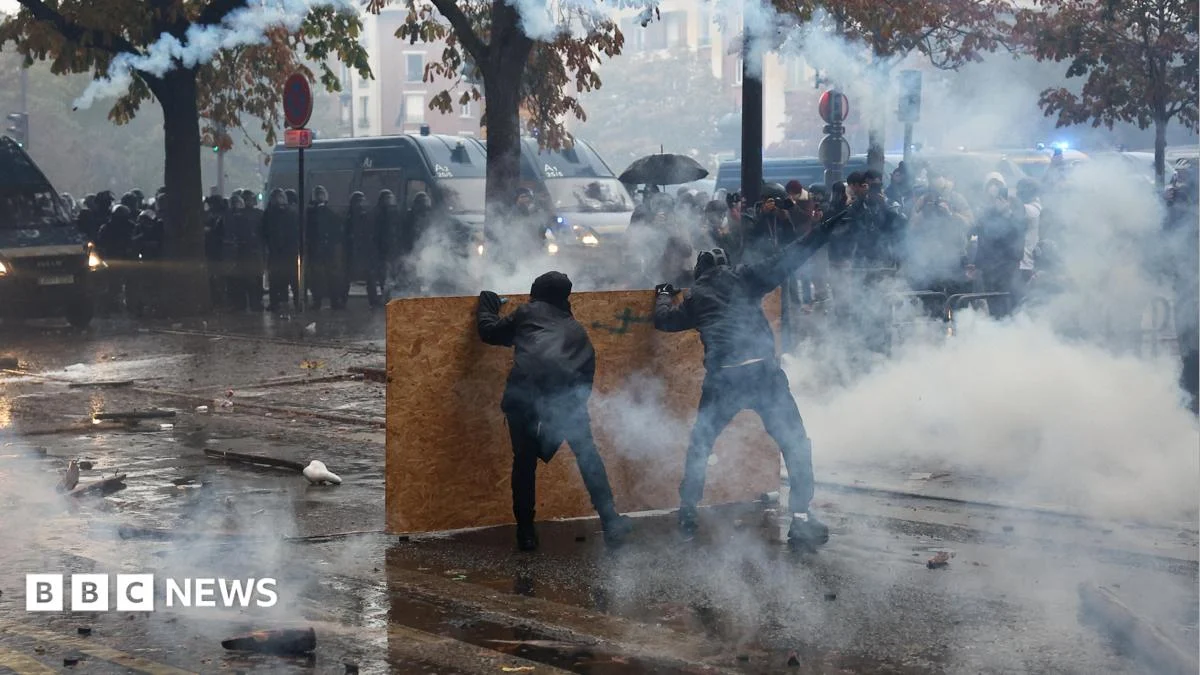
A surge of nearly 1,000 arrests marked another tumultuous day of mass protests across France, as demonstrations against the escalating cost of living and dire school conditions erupted into widespread clashes. In a bid to contain the unrest that has seen hundreds of businesses looted and buildings torched in recent weeks, an imposing force of approximately 70,000 police officers was deployed nationwide. Restrictions were imposed in several key cities, a stark indicator of the government’s concern that the latest wave of public anger could spiral into the same level of chaos that previously saw law enforcement outnumbered.
The current wave of demonstrations follows a presidential decree earlier in the week by President Emmanuel Macron, which stipulated that only protests organized by recognized trade unions would be permitted. This measure, intended to channel dissent through official channels, has done little to quell the widespread public frustration. In the wake of previous violent outbreaks, hundreds of individuals have already been processed through fast-track court hearings and subsequently jailed for offenses including vandalism, arson, and looting.
In the heart of Paris, the capital experienced a dramatic turn as a previously peaceful march, originating from Porte d’Italie and heading towards Porte de Vincennes, devolved into violent confrontations between protesters and riot police. The police response in Paris was particularly robust, featuring the deployment of an elite unit typically tasked with combating organized crime and counter-terrorism operations, underscoring the severity of the situation. Amidst the escalating tensions, some protesters were observed constructing makeshift barricades and hurling projectiles at officers. In response, police forces employed baton charges to disperse groups of masked youths who were actively engaged in smashing the windows of a car dealership, highlighting the destructive element that has infiltrated the protests.
The scale of radical involvement was further emphasized by French Interior Minister Laurent Nuñez, who, as reported by the AFP news agency, stated that "several thousand radical activists gathered at the rear of the march, including around 500 individuals identified as rioters." This assertion points to a significant presence of individuals intent on causing disruption, distinct from the broader, more peaceful demonstrators.
The unrest was not confined to the capital. In the southern port city of Marseille, the scene was one of considerable disruption, with rubbish bins set ablaze and metal sheets erected to obstruct streets. A dramatic image emerged of a law enforcement vehicle being forced to drive through a burning barricade, a vivid illustration of the challenges faced by authorities in France’s second-largest city. Similarly, in Bordeaux, another southern city, protesters clad in dark clothing and with their faces obscured were seen dismantling boards from a building to construct a street barricade, signaling a deliberate and organized effort to impede movement and create obstacles.
Lyon, France’s third-largest city, also witnessed significant confrontations. Police were compelled to deploy tear gas grenades to disperse a crowd that had reportedly congregated in an area previously designated as off-limits by the local prefecture. One protester in Lyon, a secondary school and university student who wished to remain anonymous, described the scene, stating, "There were around 150 of us, mostly secondary school and university students. Then the tear gas came almost immediately. You could barely see anything in the street." This firsthand account provides a visceral glimpse into the immediate and disorienting impact of police crowd control measures on protesters.
As the day drew to a close, Interior Minister Nuñez announced that nearly 1,000 individuals had been arrested, and he cautioned that this number was likely to increase as authorities continued their operations. The minister also provided a somber update on casualties, reporting that two people had sustained "serious injuries": one in the southwestern city of Toulouse and another in Clermont-Ferrand, located in central France. These injuries underscore the potential dangers faced by both protesters and law enforcement during these volatile events.
Earlier in the day, a peaceful protester in Paris, who identified herself only as Zelie, spoke to the BBC, articulating the deep-seated frustrations driving people to the streets. She described a pervasive sense of being "really frustrated" and having "suffered a lot" since President Macron assumed office. Zelie’s words painted a picture of a populace feeling unheard and overburdened: "They keep us quiet. They take our money, they tax us a lot and we can’t say anything. Today we are in the streets because it’s been too long, it’s been too much." Her sentiments resonated with many who feel alienated by the current political and economic climate.
This feeling of despair was echoed by two masked teenage protesters, who also chose to remain anonymous. They expressed that their generation felt abandoned by the government and was living in a state of hopelessness. Addressing the issue of looting, one of the demonstrators acknowledged that such acts were "really not good" but contextualized them as a consequence of "poverty and the violence of the police." He further emphasized that the protests would only cease "when we have a response to our demands. We really want a change in France," articulating a clear call for systemic reform.
In a contrasting development, a rally against the hard-right National Rally party in Orléans, a city in north-central France, proceeded peacefully, drawing an estimated 13,000 participants. This demonstration highlights the diverse spectrum of public engagement and the possibility of organized, non-violent dissent.
The unrest in France was not an isolated phenomenon; mass protests fueled by similar grievances also reverberated across several other European cities on the same Saturday. In Tirana, the capital of Albania, riot police deployed tear gas to disperse thousands of anti-government demonstrators. Clashes were also reported in Brussels, the capital of Belgium, indicating a broader regional dissatisfaction with economic conditions and government policies. In Milan, northern Italy, a significant security operation, involving hundreds of soldiers alongside police, was implemented to prevent protesters from gathering. This precautionary measure was a direct response to fears of a repeat of the violent scenes witnessed the previous week, which included instances of arson, smashed windows, and looting.
The scale of the protests in France in the preceding weeks had been substantial, with an estimated 550,000 people participating in demonstrations against rising fuel prices and the cost of living. These demonstrations had escalated in intensity following weeks of student-led protests. The ensuing chaos had resulted in over 2,500 arrests. Initially, many of the marches were largely peaceful, but they were increasingly marred by scenes of violence, looting, and destruction. According to reports, more than 2,000 shops and other businesses across France were directly impacted by the unrest. The French Chambers of Commerce and Industry (CCI) estimated the total damage to be in the "hundreds of millions of euros," underscoring the severe economic toll of the protests.
The human cost of the violence was also significant. According to the AFP news agency, one demonstrator had a hand blown off by a police crowd-control grenade, a stark reminder of the dangerous nature of the confrontations. In addition, approximately 1,000 police officers sustained injuries during the unrest, highlighting the risks faced by those tasked with maintaining order. In response to the escalating violence and the inability to contain the disturbances in certain areas, French authorities had previously resorted to imposing overnight curfews in Paris and other cities, a drastic measure indicative of the breakdown of public order.
The continuation of these widespread protests comes at a particularly sensitive time for France, with presidential elections looming in just six months. The political landscape is already highly charged, and leading contenders have been quick to assign blame, with many pointing fingers at President Macron and his ministers for the current crisis. The persistent unrest serves as a potent backdrop to the upcoming electoral contest, shaping public opinion and influencing the discourse surrounding the nation’s future.



 Nakalama John

 atisusanti
 Ramos Leo