Roy Suryo
Senior staff at Wales’ newest hospital insist it is safe – despite online claims that it is dangerous and failing. Since its opening early in the pandemic, Grange University Hospital in Cwmbran, Torfaen, has faced criticism over concerns about long delays, overcrowding, staff shortages, and the quality of its care. Social media commentary has been particularly intense, with some users even advising people to avoid the hospital altogether. Hospital bosses acknowledge that staff feel "devastated" by the dent to patient confidence but assert that the hospital outperforms many others in patient safety, including survival rates. They are urging those who are seriously unwell not to hesitate in seeking medical help.

As dawn breaks over Cwmbran on a clear autumn day, the mist lifts from the valley, revealing sunlit hills and the imposing structure of the hospital. This serene picture stands in stark contrast to the unfolding events within its walls.
The PA announcement in A&E is clear: someone’s life is in danger and they will soon be arriving by ambulance. However, all eight beds in the Emergency Department’s (ED) resuscitation unit, where the sickest patients are treated, are already occupied. Staff are faced with the immediate challenge of deciding which patient to move to make way. Compounding the pressure, two similar "crash calls" have already arrived by ambulance, alongside a patient who walked into the already-full reception experiencing a suspected heart attack. In total, over 90 patients are in the department, with the longest wait time reaching approximately 18 hours.

"We’re currently over capacity," states Dr. Zoe Morgan-Pittard, who is so overwhelmed that she has resorted to placing stickers on her arms to keep track of the patients she has assessed. "We’ve had to move three patients already who probably aren’t well enough. But the sickest patients have to take priority – we’re having to make fluid decisions. We’re putting patients in any extra space we can find… but there’s a lot of block and very little flow. Everybody is working hard, but unfortunately, the hospital isn’t big enough."
One of the designated "extra spaces" is located behind some cubicles at the rear of the A&E. Margaret Giles, an 84-year-old from nearby Croesyceiliog, has spent the past nine hours on a trolley there after slipping and injuring her hip. "It’s not satisfactory – but needs must," she remarks. Her husband, Alan, expresses frustration: "I went to see the lady at the desk [during the night] because she wanted to go to the toilet… and [the lady] said ‘can’t she walk to the toilet?’ I said ‘no! It’s a suspected broken hip’." Relief washes over them when X-rays reveal Margaret’s hip is not broken, and she will soon be able to go home. Staff explain that strict criteria mean only the least sick patients can be accommodated in these open spaces, an experience neither Margaret nor Alan wish to repeat. "We’ve never been in here before," Alan gestures, "it’s the first time for me – and hope it’s the last. I don’t think it’s the staff, it’s the system."

The use of open spaces for some patients is partly to free up ambulances arriving outside. During the visit, at least eight ambulances were observed waiting. Previously, crews could expect to spend an entire 12-hour shift waiting to hand over patients; now, the target is to release them within 45 minutes. On the day of the visit, due to pressures, 33% of ambulances were released within 45 minutes, a significant improvement compared to the 67% rate over the preceding 30 days. "We’ve seen a vast improvement," says Darren Panniers of the Welsh Ambulance Service. "We are responding to patients quicker in the community, particularly around calls which involve stroke and heart attacks."
However, the efforts to expedite ambulance releases also necessitate improving the flow of patients throughout the entire hospital. Surgical teams now attend A&E to identify patients who can be treated more rapidly, and urgent patients requiring same-day care are directed to different departments. For years, a major bottleneck has been delays in discharging patients who have completed their treatment. To address this, the Grange has constructed a portacabin facility with 10 beds and 15 chairs. Here, patients can prepare for discharge or transition to other hospitals, while staff can attend to their needs, including washing, feeding, and general care, as if they were on a ward. They also liaise with families and social services to expedite discharges. "It allows us to free up beds quickly and it’s somewhere quieter, more comfortable for patients to wait," explains senior nurse Sian Williams. "I always say even one bed makes all the difference to the ambulances outside."

Despite these and other initiatives, the Grange, which opened early in September 2020 due to the Covid-19 pandemic, has been under intense scrutiny. The £350m "super hospital" was designed on a model that centralised specialist care, including intensive care, surgery, and A&E, from existing hospitals in Newport and Abergavenny. The underlying assumption was that community services would be sufficiently robust to manage the increased demand.
Leanne Watkins, a senior executive at the health board, asserts: "Bringing our teams together – for example, in paediatrics and obs and gynae, we had very fragile services spread across the system, and when you think of the risks that are contained in maternity services, for example, in paediatrics, that’s enormous. So, I think we would have really struggled without [the Grange]. I think we could have benefited from some additional beds." Nevertheless, the health board remains under level four measures – the second-highest level of Welsh government oversight – due to concerns related to urgent and emergency care.

Furthermore, social media posts have gone further, labelling the Grange as "dangerous," "awful," and "a disgrace." Watkins refutes these criticisms: "I don’t believe that [those criticisms] are fair. We have amongst the best mortality rates in Wales, and in fact, for some procedures, things like fractured neck or femur (hip) and emergency surgery, we rate right up there with the best in the UK. If you’re unwell, critically unwell, it is a great place to be." She suggests that these criticisms stem from a small number of complaints and serve to erode public confidence. "For our staff, it is devastating to read what’s been said. We know we need to do better, we know delays are unacceptable, but the teams work incredibly hard, and I’m for one proud of them. It absolutely is a safe hospital."
The health board’s own data indicates that death rates at the hospital are lower than comparable hospitals in Wales, taking into account the population’s demographics and the severity of cases. Figures also suggest that the proportion of patients who die in the Grange’s emergency department remains below the Welsh average and has shown sustained improvement. "I just encourage people to look at the facts. I know sometimes it’s really hard, especially on social media that people can get messages that can make them feel low in confidence [but] please come and talk to us," urges Dr. Seema Srivastava. Deputy head of nursing Lorna Lear expresses her sadness: "Obviously, sometimes there are instances where the care is less than what we expect. But we always listen to the feedback… and we always want to improve our services and give our patients the best possible care. So when we do see those negative headlines, it can be quite upsetting." Consultant and director of urgent care Owain Chandler adds, "If you have been waiting excessive hours to be seen, you’re going to be frustrated and that’s okay. It’s understandable."

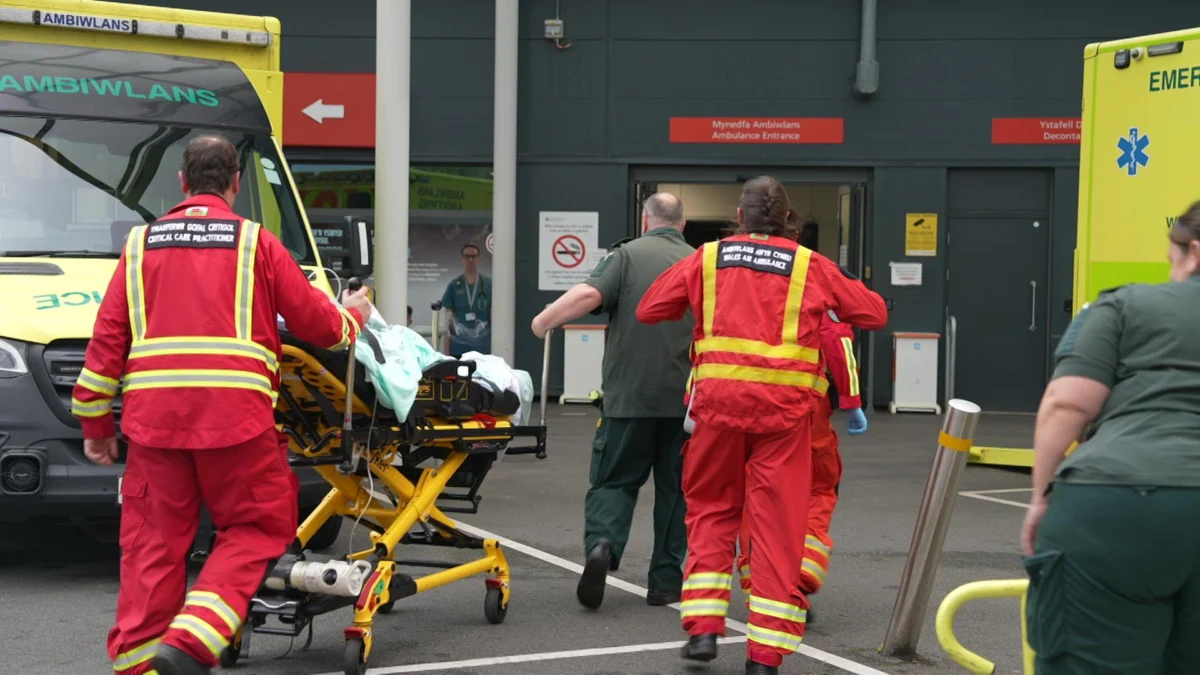
After a seven-hour tour of the hospital, we return to A&E, where staff have seen 274 patients throughout the day. The nurse in charge, Sam Taylor-Harley, reports: "We’ve had some more heart attacks, myocardial infarctions, we’ve had a couple of trauma calls, we’ve had a couple of admissions to the ITU upstairs, and we’ve also had some infection prevention control issues coming in as well." As we prepare to leave the hospital, a patient with life-threatening wounds is rushed in by air ambulance medics. More than a dozen staff from across the hospital are ready and waiting. While critically ill patients will never have to wait to be seen, this means that less serious cases are likely to experience longer wait times.
The Welsh government stated that NHS staff are "working incredibly hard" to provide compassionate care to patients, and early plans are in place to address the challenges of the upcoming winter. They acknowledged that Aneurin Bevan University Health Board, which operates the Grange hospital, still needs to improve, noting that it is "currently in Level 4 escalation for urgent and emergency care performance and must show clear improvement plans, better unscheduled care performance, a stronger grip on urgent and emergency care concerns, and clearer information for patients on how to access care."




 Nakalama John

 George Anjay

 Ramos Leo

 atisusanti