atisusanti
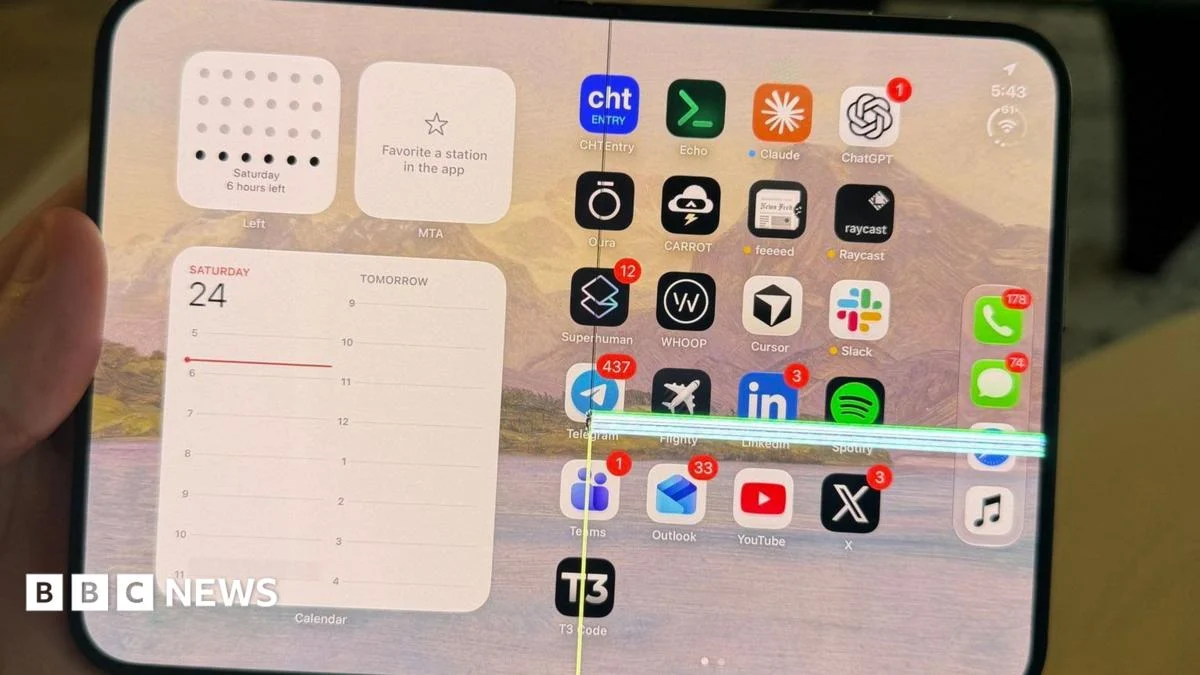
Apple has acknowledged that a segment of its highly anticipated iPhone Duo handsets are experiencing screen malfunctions, a development that has surfaced mere days after the innovative foldable device officially went on sale. Images circulating on social media platforms have vividly depicted vertical lines appearing on the displays of this technological giant’s inaugural foldable offering, a device that commands a premium starting price of £1,999 (approximately $2,668) in the United Kingdom. The company has officially stated its awareness of "an issue impacting the inner display on a small number" of these phones, and has proactively encouraged any users encountering such problems to reach out for a replacement unit.
The launch of the iPhone Duo, which generated considerable excitement and saw eager crowds gathering at Apple stores across the globe last week, represents a significant strategic move by the company. This endeavor aims to inject renewed vitality into Apple’s expansive device portfolio and directly challenge the established presence of foldable phones manufactured by its competitors. Beyond the screen line issues, some early adopters of the Duo have also shared photographic evidence online illustrating cracks that have appeared along the central crease of the foldable screen. Furthermore, other users have reported an unsettling crunching sound emanating from the device when it is opened.
One notable iPhone Duo owner, Justin Lokos, took to social media to share an image showcasing a device with prominent lines marring the right side of its display. He subsequently uploaded a follow-up picture featuring a brand-new replacement handset positioned alongside the defective unit, expressing his gratitude to an Apple store in New York for its swift and effective assistance. The precise scale of this screen issue remains an open question. Apple has not yet disclosed the exact number of devices affected, and it is important to note that some of the images depicting faulty devices circulating online could potentially have been generated using artificial intelligence, adding a layer of uncertainty to the situation.
Francisco Jeronimo, a respected technology analyst at the market research firm IDC, has advised a degree of caution when interpreting these early reports. He emphasized that it is premature to draw definitive conclusions about the entire production run of the iPhone Duo based solely on these initial incidents. However, Jeronimo did concede that these early reports of technical difficulties underscore a significant point: "that even a company with Apple’s engineering resources and supply chain discipline faces a steep learning curve in foldables." This statement highlights the inherent complexities and challenges associated with pioneering new form factors in the consumer electronics market, even for a company with Apple’s formidable track record.
In contrast to Apple’s recent entry into the foldable market, Android users have long benefited from a considerably broader and more diverse selection of foldable phones. This is despite the fact that Apple reportedly spent years meticulously developing its foldable technology before the eventual release of the iPhone Duo. The Duo has quickly established itself as Apple’s most expensive iPhone to date, with the most feature-rich configurations reaching a price point of up to £3,199. Jeronimo further elaborated on the implications of Apple’s positioning of the Duo, stating that because Apple has presented the device as a "premium alternative" to existing foldable smartphones, "how it handles this first-generation issue will shape buyer confidence in the category well beyond its own sales." This suggests that Apple’s response to these early technical challenges will have a ripple effect on the perception and adoption of foldable technology as a whole.
While Apple is renowned for its intensely loyal customer base and its extensive retail network, which is capable of facilitating on-the-spot device swaps, the company faces a critical juncture. With an additional 28 markets slated for the Duo’s launch on October 30th, Apple urgently needs to provide clarity regarding its warranty policies and procedures. The iPhone Duo represents a monumental shift for Apple, marking its first significant redesign of the iPhone in nearly two decades. The device was formally unveiled by the company’s new chief executive, John Ternus, who assumed leadership from Tim Cook in September.
In its closed state, the iPhone Duo presents itself as a wider iteration of the traditional iPhone. Upon unfolding, it transforms into a device that bears a striking resemblance to a small tablet computer. Ternus articulated this design philosophy during an address at Apple’s California headquarters last month, contrasting it with the efforts of competitors. He stated, "Others have created foldables that just feel like two phones awkwardly stuck together." He further emphasized Apple’s ambition for the Duo, asserting that it would "redefine the experience of using a foldable phone." This statement underscores Apple’s commitment to not just entering the foldable market, but to fundamentally improving and innovating within it. The company’s response to these initial screen issues will be a crucial test of its ability to deliver on this ambitious promise and maintain consumer trust in its groundbreaking new product. The swiftness and transparency of Apple’s resolution will undoubtedly be closely watched by industry observers and consumers alike, as it sets a precedent for the future of foldable technology and Apple’s role within it. The company’s ability to effectively address these early concerns will be paramount in ensuring the long-term success and adoption of the iPhone Duo and foldable devices more broadly.




 Ramos Leo

 Nana Banana

 George Anjay