
 George Anjay
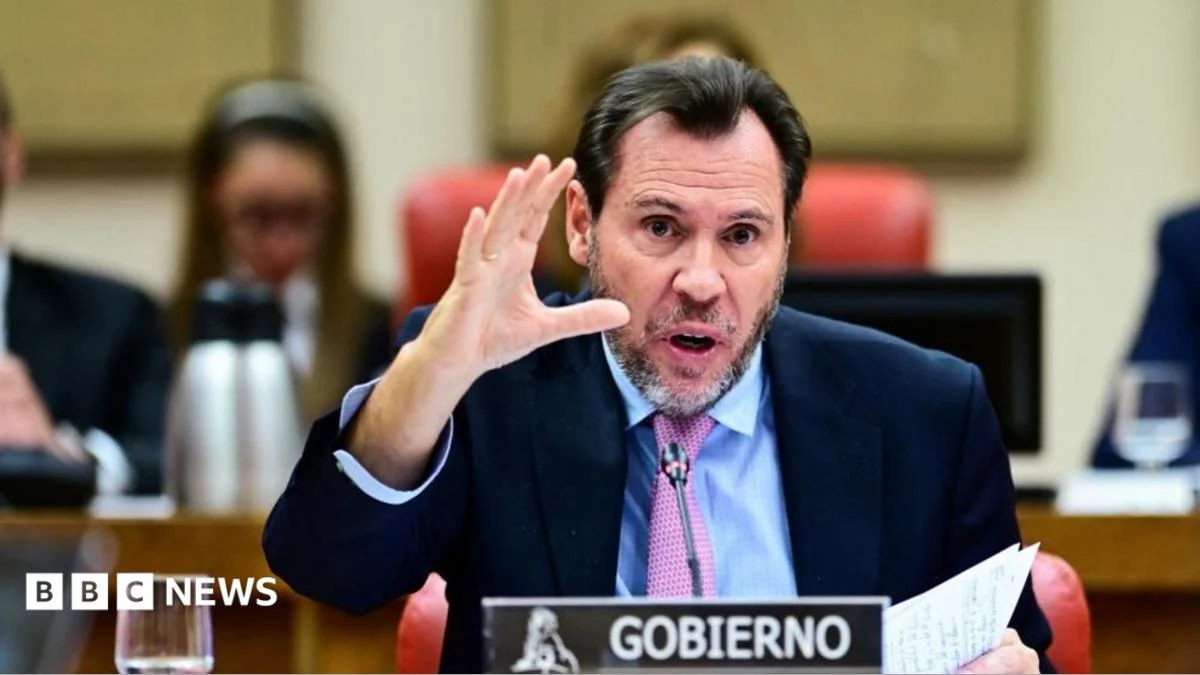
José Luis Ábalos, Spain’s Minister of Transport, Mobility and Urban Agenda, announced his resignation at the conclusion of a marathon congressional session on Tuesday evening. The announcement came after a day of intense scrutiny, during which Ábalos outlined new rail safety measures and faced a barrage of questions from opposition parties. In a statement that reverberated through the Spanish political landscape, Ábalos declared, "I am not only stepping down from my position as minister of transport, but… I am also withdrawing my name from the lists for the early legislative elections." This dramatic move signifies a significant political upheaval, directly linked to the devastating train crash that occurred on October 28th, claiming multiple lives and shattering public confidence in the nation’s high-speed rail network.
The pressure on Ábalos had been mounting relentlessly since the tragic accident. The primary opposition parties, the conservative People’s Party (PP) and the far-right Vox, had been vociferous in their calls for his resignation. Even some of the government’s own allies had joined the chorus, arguing that the minister bore ultimate responsibility for a high-speed rail system that many Spaniards now perceive as dangerously unreliable. The credibility of the entire network, it was argued, had been severely compromised, with even Socialist Prime Minister Pedro Sánchez admitting that its reputation was "broken." Further fueling the opposition’s ire was Ábalos’s initial public statements, which appeared to attribute the crash to human error. Critics accused the minister of attempting to deflect blame from his own perceived failings and the government’s oversight of the rail infrastructure.
Just days prior to his resignation, Ábalos had publicly stated his intention to remain in his post, a declaration that made his eventual departure all the more surprising to many observers. The rail accident and Ábalos’s subsequent decision to step down have arrived at a particularly sensitive juncture in Spain’s political calendar. The nation is gearing up for early general elections scheduled for November 29th, and the devastating train crash is widely seen as a significant electoral setback for the Socialist-led government. Many analysts believe the incident has severely hampered Prime Minister Sánchez’s chances of defying pre-election polls and securing victory.
Ábalos’s predicament presented a difficult dilemma for both himself and the Prime Minister. Refusing to resign in the wake of such a tragedy could have been perceived as insensitive and lacking in empathy towards the victims and their families. Conversely, stepping down could have been interpreted as an implicit admission of fault on the part of both Ábalos and the government. Ultimately, Ábalos opted for the latter, framing his decision as one driven by "political dignity." Prime Minister Sánchez, in turn, publicly praised his departing colleague, commending him for having "faced up to the situation, provided answers and solutions, and then stepped aside." Sánchez emphasized that Ábalos’s resignation was "out of dignity. Of his own accord. Out of respect for the victims."
The question now looming large in the minds of many Spaniards is whether Ábalos’s successors will be able to effectively restore faith in the country’s railway system. The tragic accident has undeniably exposed deep-seated issues within the management and safety protocols of Spain’s rail infrastructure. Recent leaked audio recordings, purportedly from the moments leading up to the crash, have provided a chilling glimpse into the operational challenges faced by train controllers and drivers.
One of the recordings features a control centre operator communicating with the driver of a Renfe train experiencing technical difficulties. After a brief exchange, the operator instructs the driver, "Continue your journey and then proceed under [Lateral Signalling Block], at normal speed with normal operation." The driver, seemingly surprised, questions, "At normal speed?" to which the controller confirms, "Yes." The "Lateral Signalling Block" is a crucial backup system, engaged when the primary automatic signalling or data transmission systems fail. Its use, while a necessary safety measure, can indicate an underlying issue with the standard operational systems.
Another audio recording captures the driver of a stationary Iryo train reporting a complete loss of communication with the train-control system, rendering the train immobile. The driver informs the control centre operator that the train is "stationary in front of the entry signal at Urda." Following further communication, the driver is also instructed to "resume the journey" normally. However, in a subsequent recording, the Iryo driver contacts the control centre again, expressing an inability to start the train. "The train won’t allow me to control the [security] system. That’s why I am still stopped in front of the entry signal," the driver states. This latter recording suggests that the control centre had been alerted to the Iryo train’s continued stationary status as the Renfe train approached, a critical piece of information that, if acted upon with sufficient urgency, might have averted the collision.
Iryo, the operator of the stationary train, later confirmed that its carriages were "struck from behind" by the approaching Renfe train. The details emerging from these audio recordings paint a picture of a complex and potentially fragile system, where communication breakdowns and reliance on backup protocols could have played a role in the catastrophic events of October 28th. The accident has thus brought to light not only administrative and political responsibilities but also the intricate technical challenges inherent in operating a modern, high-speed rail network. The resignation of Minister Ábalos, while a significant political development, is only the first step in what will likely be a long and arduous process of rebuilding trust and ensuring the safety of Spain’s vital railway infrastructure. The upcoming legislative elections will undoubtedly be shaped by the public’s perception of how effectively the government addresses these profound concerns and its commitment to a secure and reliable transportation future.



 Nakalama John
 Ramos Leo

 Nana Banana

 atisusanti
