George Anjay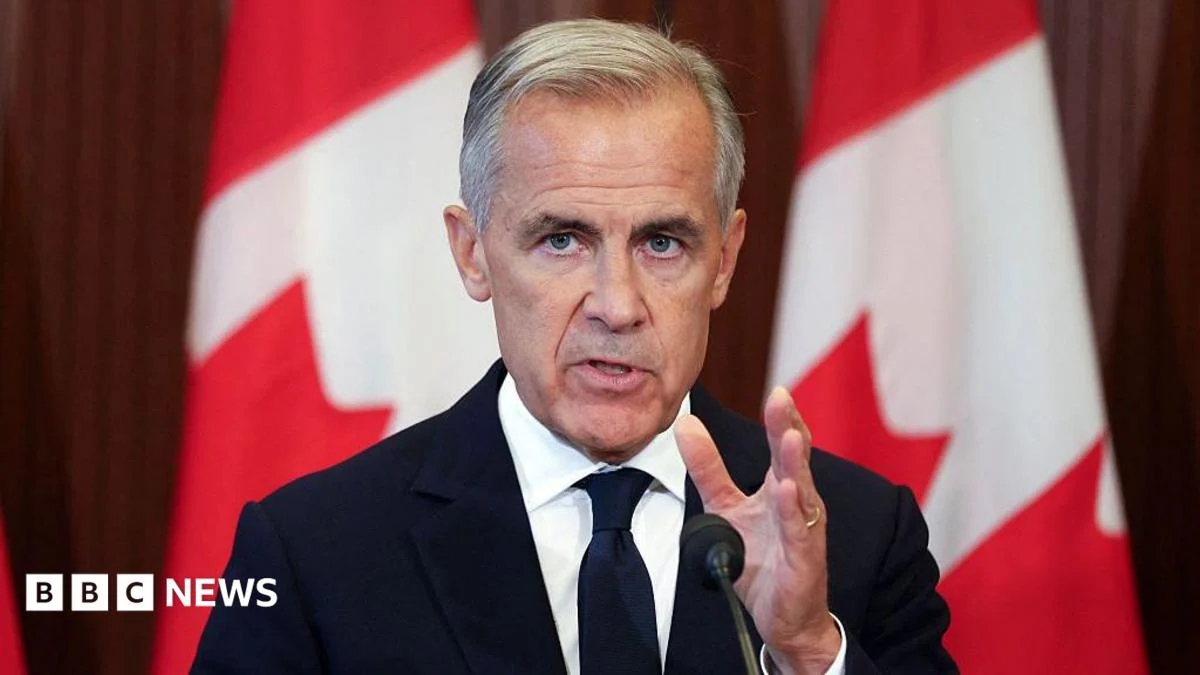
Canada’s Prime Minister Mark Carney has strongly condemned a fresh wave of United States tariffs, labeling them a "miscalculation" and an attempt to "hurt and divide us" following the dramatic collapse of high-stakes trade talks late on Friday. Carney, speaking to Canadians on Saturday morning, declared he would not "compromise Canada’s sovereignty" and expressed a palpable sense of being "attacked" by the US. The Prime Minister unequivocally stated, "They asked too much and they offered too little," confirming that Canada would retaliate with dollar-for-dollar tariffs on a range of US goods, including steel, dairy, appliances, and electronics, effective September 8th. US President Donald Trump has remained conspicuously silent on the escalating trade dispute.
Just days prior, an air of optimism had permeated the negotiations, with both nations expressing confidence in an impending deal. However, this optimism evaporated by Friday evening, with each side leveling accusations of last-minute, unfavorable alterations to the proposed terms. The breakdown has resulted in Canada being subjected to new 50% US tariffs on a broad spectrum of its goods, compounding existing levies on Canadian steel, aluminum, automobiles, and lumber. Prime Minister Carney characterized Canada’s retaliatory measures as a "reluctant" necessity to safeguard national interests, with further details of these counter-measures to be unveiled in the coming days.
Support for Carney’s firm stance has been robust across the Canadian political spectrum. Leaders of other federal parties, including the Conservative opposition, have voiced their solidarity, as have the premiers of several Canadian provinces. Tariffs, a potent tool in President Trump’s trade arsenal, are championed by the US President as a means to invigorate American manufacturing and bolster domestic job creation. Critics, however, argue that these tariffs have demonstrably increased prices for American consumers and have sown disruption and damage throughout the global economy.
Carney’s address on Saturday marked his first public statement following the late-night announcement of the failed negotiations. He reiterated his accusation that the US had introduced "unfair" and "uneconomic" "last-minute changes," effectively derailing any prospect of an agreement. Conversely, US negotiators pointed fingers at Canada, alleging "new demands and walk backs" on previously agreed-upon terms. Speaking on Fox News on Saturday, US Trade Representative Jamieson Greer indicated that there were currently no plans to re-engage in talks, adding that the US had been prepared to reduce some of its tariffs on Canada as part of the ultimately unsuccessful deal.
Prime Minister Carney, however, vehemently rejected the US assertion that Canada had made last-minute requests. He elaborated that the US presented "unacceptable" terms, characterized by excessive restrictiveness, including stipulations that would have curtailed Canada’s ability to forge independent trade agreements with other nations. "We clarified what was on offer and were continually disappointed by the answers," Carney stated, refuting the narrative of Canadian intransigence.
The repercussions of the collapsed talks have been swift and have garnered significant provincial backing. Doug Ford, the Premier of Ontario, Canada’s most populous province, unequivocally backed Carney, declaring that "Trump can’t be trusted." The Conservative opposition leader, Pierre Poilievre, also expressed apparent support for the Prime Minister, deeming the latest US levies "unjustified." Christine Fréchette, the Premier of Quebec, voiced concerns that the new US tariffs would inevitably lead to job losses. "Behind these numbers are real people," she stated, vowing to implement measures to support affected sectors. Meanwhile, Danielle Smith, the Premier of Alberta, a province heavily reliant on its oil industry and which has sought to cultivate a relationship with the Trump administration, urged both sides to resume dialogue.
This significant breakdown in negotiations occurs after more than a year of protracted, stop-and-start trade discussions. These talks had intensified in recent weeks, driven by a US-imposed deadline to finalize a deal or face further punitive tariffs. Adding another layer of complexity to the trade landscape, both countries were also engaged in a mandatory review of the existing North American free trade agreement, known as the United States-Mexico-Canada Agreement (USMCA). This pact, a cornerstone of North American commerce and signed by President Trump during his first term to supersede the 1994 North American Free Trade Agreement, underpins a staggering $1.6 trillion in annual trilateral trade across Canada, the US, and Mexico. Earlier in the summer, Canada and Mexico had formally requested an extension of the USMCA for an additional 16 years. However, the US declined to renew it in its current form. When questioned about the impact of Friday’s trade talk collapse on the North American free trade pact, Prime Minister Carney acknowledged that it was "certainly not good news." The escalating trade tensions signal a period of heightened uncertainty and potential economic disruption for all three North American nations.



 Nakalama John
 Ramos Leo
 Nana Banana