George Anjay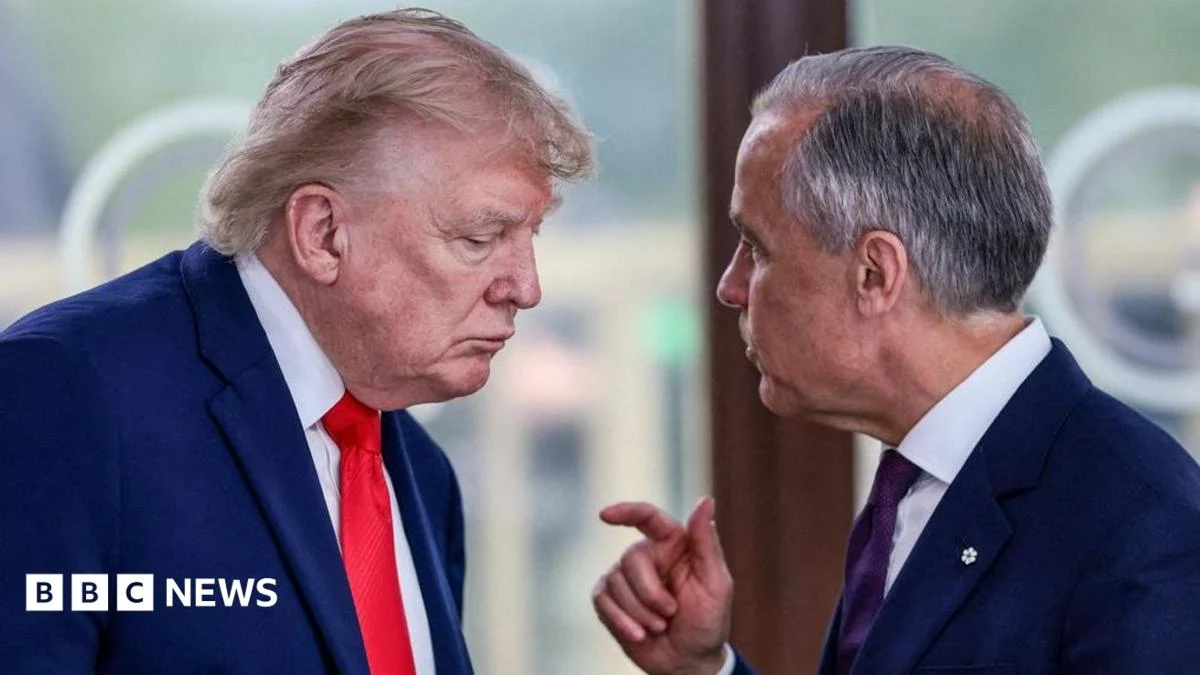
The United States and Canada have entered into uncharted, and frankly, precarious, territory. The long-standing allies and bedrock economic partners, who have for decades enjoyed the benefits of a largely unfettered free trade relationship, now find themselves ensnared in an escalating trade war with no discernible off-ramp. For Prime Minister Mark Carney, the eleventh-hour decision to abruptly suspend negotiations with President Donald Trump and opt for retaliation rather than accepting a deal that appeared to be within reach, represents a significant and potentially defining political test. He stands as one of the first world leaders to have demonstrably walked away from the negotiating table with the White House, and the ramifications of this bold move will be scrutinized globally.
Both nations have pointed fingers at last-minute alterations for the collapse of the tentative agreement. Carney, in no uncertain terms, articulated that the United States "asked too much" and "offered too little," a stark indictment of the protracted discussions. Carney’s resolute decision will undoubtedly challenge the appetite among Canadians to absorb a degree of economic hardship as Ottawa endeavors to secure more substantial concessions from the U.S. Having emphatically rejected what he perceived as President Trump’s high-pressure tactics, and by choosing to counter the imposition of new U.S. duties with retaliatory measures, Carney now shoulders the immense responsibility of convincing the Canadian populace that the economic pain endured is a justifiable cost for standing firm against the Trump administration, with the ultimate goal of forging a more equitable and sustainable agreement in the long run.
In his public remarks on Saturday, Carney stated with conviction, "we take this step confident this is in the best interest of Canada," while simultaneously characterizing the U.S. actions as a "power play" driven by demands for eleventh-hour concessions. When directly questioned by a reporter whether the United States and Canada were locked in a trade war, he responded with a pointed analogy: "You’re at war when you’re attacked – we got attacked." Switching to French for emphasis, he stressed that the spiraling trade dispute "wasn’t our choice," adding with a defiant tone, "Canada is strong, Canada is ready, Canada is united."
There is an undeniable certainty that this trade conflict will inflict economic pain on both sides of the border, with businesses on both sides bracing for increased pressure from U.S. duties and Canadian counter-tariffs. Canada’s economic lifeline is intrinsically linked to the U.S. market, with approximately 70% of its exports destined for its southern neighbor. Conversely, Canada holds the position of the top trading partner for a significant number of American states, with Michigan, Kentucky, Indiana, and Ohio identified as particularly vulnerable to economic repercussions.
Prime Minister Carney ascended to his current role with a mandate for an "elbows up" approach – an ice hockey metaphor signifying an aggressive and assertive strategy – vowing to vigorously defend Canada’s interests in the face of a Trump administration singularly focused on its "America First" agenda. Emerging data suggests a significant portion of the Canadian population supports a firm stance against U.S. trade aggression. A recent survey conducted by Abacus Data indicated that approximately 36% of Canadians would endorse retaliating against U.S. tariffs, while a separate Leger poll revealed that a commanding 56% of Canadians desire the federal government to adopt a hard-line approach, refraining from making any further concessions.
The frustration among Canadians regarding U.S. tariffs has already manifested in tangible actions, with a discernible trend of Canadians choosing to forgo travel to the United States. This self-imposed boycott has resulted in a substantial loss of approximately C$3.3 billion (equivalent to $2.35 billion USD or £1.75 billion GBP) in travel revenue for the U.S. in the past year alone. Furthermore, a decision by most Canadian provinces to systematically remove U.S. alcoholic beverages from their store shelves has delivered a significant blow to that specific sector.
Based on official U.S. government trade data, American wine exports to Canada experienced a precipitous decline of 78% year-over-year, translating into a loss of $357 million in export value. The U.S. Distillers Association has reported similarly alarming figures, indicating that provincial bans have led to a reduction of over 70% in exports of American spirits. This impactful ban swiftly became a significant point of contention and frustration for the Trump administration, highlighting the interconnectedness of these economic policies.
The Canadian Prime Minister will also face the critical task of persuading provincial governments, many of whom have been less directly impacted by the U.S. trade dispute thus far, that the decision to walk away from the negotiating table is a risk that is unequivocally worth taking. He meticulously briefed them on the current state of affairs on Saturday, and for the immediate future, they appear to be presenting a united front. British Columbia Premier David Eby articulated his commitment to the "national project we are on," while Ontario Premier Doug Ford declared, "we didn’t start this fight but I can assure you. we’re going to win this fight."
For a full week, it had seemed that a comprehensive trade deal between Washington and Ottawa was not only achievable but imminent. The precise sequence of events that led to the breakdown of talks in the final hours remains somewhat opaque, but by all accounts, the negotiations reached a critical juncture right up to the wire. Carney characterized the late-stage U.S. proposals as "unfair, uneconomic, and called into question the reliability of any deal." He further elaborated on Saturday that these terms included significant demands concerning the automobile sector and imposed "unacceptable" restrictions on Canada’s ability to forge trade agreements with other nations.
In a particularly pointed and memorable remark, he alluded to the Trump administration’s approach, stating, "We recognise sometimes its signature is written in pencil." Conversely, U.S. Trade Representative Jamieson Greer attributed the collapse to "new demands and walk backs of other commitments by Canada." In a statement issued on Friday, the Distilled Spirits Council of the United States suggested that "Canadian provinces’ continued refusal to return U.S. spirits products to store shelves has led to this outcome," implying a retaliatory motive behind the trade impasse.
Additionally, reports from Canadian media outlets indicated that U.S. Commerce Secretary Howard Lutnick expressed dissatisfaction with the terms of the tentative deal. The BBC has reached out to his office for an official comment. As details of a potential interim trade agreement with the U.S. began to surface over the preceding week, some provincial leaders, industry groups, and political opponents voiced concerns that the Prime Minister had not fully delivered on the robust fight he had promised. However, Carney vehemently denied that these criticisms swayed his decision-making process.
Doug Ford, who is typically among the most vocal Canadian politicians on the issue of U.S. tariffs, had remained conspicuously silent on the tentative deal throughout the week. However, in a letter addressed to Carney, he articulated concerns that an agreement reached under duress would "embolden the United States to seek concession after concession." The province of Ontario, with its substantial manufacturing and automotive sectors, has been among the regions most severely impacted by this ongoing trade dispute.
Conservative opposition leader Pierre Poilievre stated that any agreement that included "one-sided" tariffs on Canadian industry would constitute "a bad deal." On Saturday, he publicly backed Carney’s decision to temporarily withdraw from negotiations, asserting, "Canada cannot accept one-sided tariffs that will de-industrialise our country." The collapse of this proposed agreement casts a significant shadow over the future of ongoing trade talks, including the crucial review of the broader United States-Mexico-Canada Agreement (USMCA). Now, Prime Minister Carney, and by extension Canada, must patiently await President Trump’s response to this bold strategic maneuver.



 Nakalama John
 Ramos Leo
 Nana Banana