George Anjay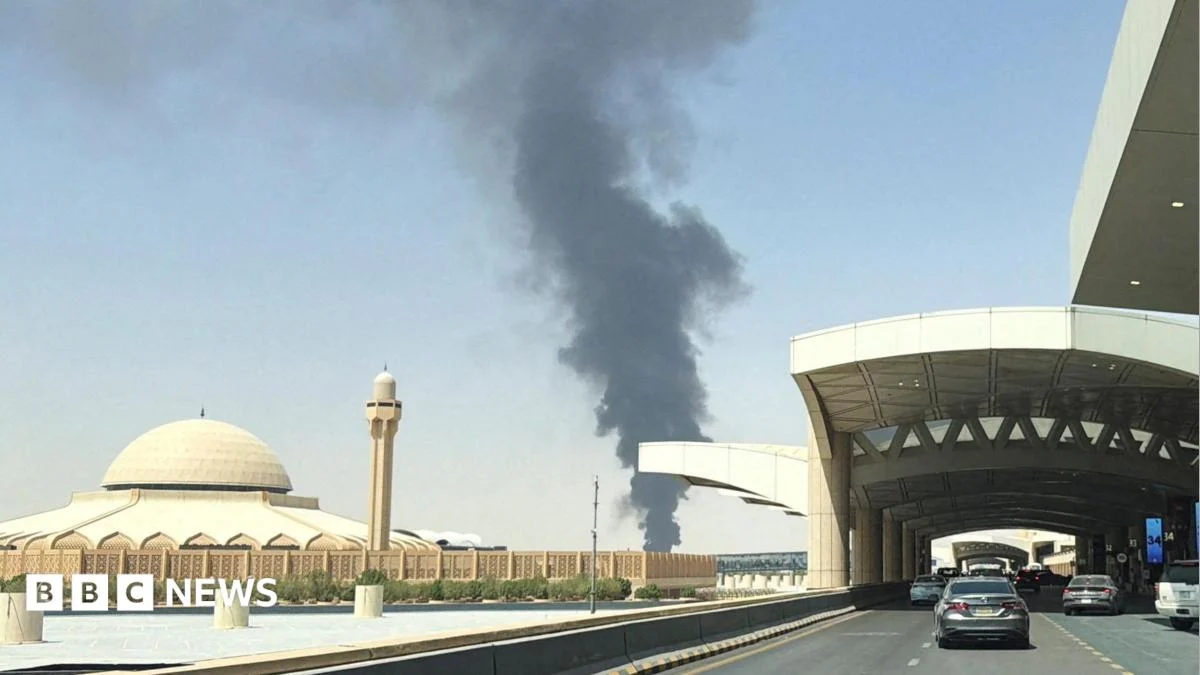
Iran-backed Houthi militants in Yemen have claimed responsibility for a significant escalation in the ongoing conflict, stating they launched a barrage of drone and ballistic missile attacks targeting not only the Saudi capital Riyadh but also vital energy infrastructure along the country’s Red Sea coast. This audacious assault, which Saudi authorities confirmed involved the interception of a ballistic missile aimed at Riyadh, marks a concerning intensification of hostilities and raises further questions about regional stability and the security of global energy supplies. While Saudi officials reported neutralizing the missile threat to the capital, they refrained from commenting on the extent of other alleged strikes or any potential casualties, leaving a degree of ambiguity surrounding the full impact of the Houthi offensive.
Earlier in the day, a dramatic spectacle unfolded near Riyadh’s international airport as a column of thick, black smoke billowed into the sky from burning fuel tanks. This incident, which temporarily disrupted flight operations at King Khalid International Airport, served as a stark visual testament to the Houthi claims. The air raid alerts that sounded across the capital were particularly alarming, as they represented the first such warnings in Riyadh since the Houthi forces significantly ramped up their attacks against Saudi Arabia in July, signaling a renewed and more aggressive campaign.
A spokesperson for the Saudi-led coalition, in a detailed statement, confirmed that Saudi air defenses had been actively engaged in thwarting "hostile attempts to target civilians" in several other locations across the Kingdom, including the cities of Bish, Taif, Farasan, and the crucial port city of Yanbu. This broad defensive action underscores the widespread nature of the Houthi attacks and the strategic targets they aimed to disrupt.
In a declaration posted online, Houthi military spokesman Yahya al-Sarea asserted that a "large number of ballistic and cruise missiles and drones" were deployed in the coordinated strikes. He specifically named "sensitive sites" in Riyadh and the sprawling Aramco state oil and gas company facilities in Yanbu as the intended targets. Al-Sarea further justified these actions as a direct "response to the Saudi enemy’s criminal attempts" to target the Yemeni capital, Sanaa, which is currently under Houthi control. This framing of the attacks as retaliatory underscores the deep-seated animosity and the cycle of violence that has characterized the Yemeni civil war.
Prior to the latest missile and drone offensive, al-Sarea had accused Saudi Arabia of conducting a staggering 300 airstrikes across Yemen during the preceding week, highlighting the intensity of the conflict from the Houthi perspective. The Houthis are currently embroiled in a protracted civil war against Yemen’s internationally recognized government, a government that receives substantial backing from Saudi Arabia. This international dimension of the conflict, with Saudi Arabia acting as a key intervener, adds another layer of complexity to the regional security landscape.
The Houthi forces have not shied away from targeting sites within Saudi Arabia on multiple occasions in recent months. This latest wave of attacks follows a recent claim by the group that they were responsible for downing a Saudi fighter jet over Yemen, further demonstrating their growing capability and willingness to engage Saudi forces on their own territory.
Adding to the grim reality of the conflict, an unconfirmed report from the Agence France-Presse (AFP) news agency, citing military sources from both sides of Yemen’s brutal civil war, indicated that fighting between the Houthis and Saudi-backed government forces had claimed 48 lives on Saturday alone. According to the report, the Houthis stated that 31 of their fighters had been killed, while government sources reported their side had lost 17 soldiers. These figures, while unconfirmed, paint a dire picture of the ongoing human cost of the war.
The humanitarian crisis in Yemen continues to deepen, with the International Organization for Migration (IOM), a United Nations body, reporting on Friday that the number of people displaced as a result of recent fighting had surpassed 104,796. This staggering figure underscores the devastating impact of the conflict on the civilian population and highlights the urgent need for humanitarian intervention and a lasting peace settlement.
The disruption at King Khalid International Airport in Riyadh was a tangible consequence of the attacks. FlightRadar24, a prominent flight tracking website, reported a series of delays and cancellations, indicating the operational impact of the security situation. Eyewitness accounts from an AFP journalist described firefighters battling to extinguish flames engulfing a burnt-out fuel tank belonging to Aramco, a potent symbol of the potential damage to Saudi Arabia’s critical energy infrastructure.
Saudi Civil Defence had issued phone alerts overnight, warning residents of potential danger in Riyadh and surrounding regions. While an all-clear was issued on Saturday morning, the lingering fear and uncertainty were palpable. Residents of Riyadh, speaking to AFP on condition of anonymity, recounted hearing a series of explosions echoing through the city after the alerts, with one 27-year-old resident describing the experience as "definitely scary" and unexpected.
The Houthi’s strategic calculations appear to extend beyond mere retaliation. The group recently seized control of the strategically vital port city of Mokha and Perim Island, a critical gateway to a key shipping route that the Gulf state relies upon for exporting its oil to Asia and Europe. The Houthis declared this naval blockade as a retaliatory measure against a Saudi blockade of ports and airports in Houthi-controlled north-western Yemen. This tit-for-tat maritime pressure campaign directly impacts Saudi Arabia’s economic lifelines, particularly its oil exports. Saudi vessels have become increasingly reliant on this stretch of the Red Sea for their oil exports since the broader regional tensions, including the war between the US and Israel and Iran, have effectively closed the Strait of Hormuz, a crucial global oil chokepoint.
The ramifications of this escalating conflict and the potential disruption to oil supplies are significant. Investment banking giant JP Morgan, in a rare note to investors, acknowledged the difficulty in predicting the impact of the war on oil prices, stating, "we simply don’t know how to model the endgame." This admission from a leading financial institution underscores the uncertainty and volatility that the ongoing conflict in Yemen, and its outward reach into Saudi Arabia, injects into the global energy market. The Houthi’s willingness to strike at the heart of Saudi Arabia, including its capital and vital energy assets, signals a dangerous new phase in the conflict, with far-reaching implications for regional security and the global economy.



 Nakalama John
 Nana Banana