Nakalama John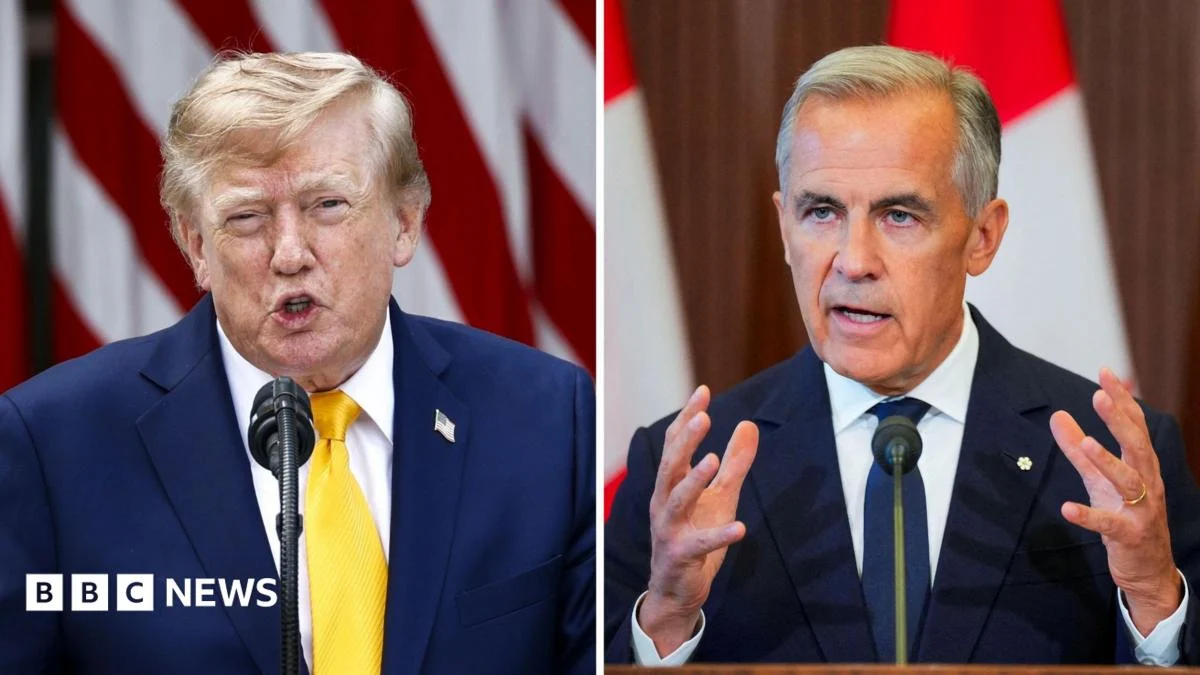
For the time being, the Canadian government’s planned retaliatory duties are meticulously strategic "dollar-for-dollar" countermeasures. These initial tariffs target specific US sectors and goods, including steel, dairy products, household appliances, agricultural equipment, electronics, and pulp and paper. While the definitive list is still being finalized, the intention is clear: to impose equivalent economic pain on the US economy, mirroring the impact of American tariffs on Canadian industries. This calibrated response is not merely a political manoeuvre; it is strongly backed by the Canadian populace. Recent polls indicate that a vast majority of Canadians would express profound dissatisfaction if their government were to buckle under pressure and make significant concessions to the US. This widespread sentiment is echoed by powerful provincial leaders, notably Ontario Premier Doug Ford, one of the most outspoken critics of former President Trump north of the border, who famously responded to tariff threats by telling the US president to "kiss my ass." The Canadian Finance Department has affirmed that additional measures designed to safeguard Canadian workers and businesses from the economic fallout will be unveiled in due course, signaling a resolute and multi-pronged approach to the dispute.
One of Canada’s most potent, yet currently untapped, areas of leverage lies in its vast energy and critical mineral resources. Prime Minister Trudeau highlighted this on a recent Saturday, underscoring Canada’s role as the primary supplier of natural gas and electricity imports to the United States, alongside providing approximately 60% of US crude oil imports. "I don’t think they want us to stop sending any of that energy," he stated, pointing to the essential nature of these supplies for American homes, industries, and overall energy security. While an "energy squeeze" is not part of the immediate countermeasures, various Canadian political officials have explicitly stated it remains an option on the table, reflecting the gravity of the potential escalation. Not all provincial premiers have been equally eager to wield this particular leverage, given the interconnectedness of the North American energy grid. However, Ontario Premier Ford, whose province is home to a significant portion of Canada’s vital auto manufacturing industry, has openly considered the full spectrum of potential responses. Ford, known for his directness, has explicitly declared that an "energy surcharge is on the table." He previously floated a bold proposal: a 25% surcharge on all electricity exports to the United States, projected to commence in 2025. His government’s estimates suggested such a measure would directly impact 1.5 million homes and businesses across key US states such as Michigan, Minnesota, and New York, causing substantial economic disruption.
Beyond energy, Canada is a global leader in the supply of critical commodities. It stands as the world’s top supplier of potash, a crucial ingredient in agricultural fertilizers. The implications of disrupting potash exports are profound, potentially affecting US agricultural yields, increasing food prices for American consumers, and impacting the profitability of American farmers who rely heavily on this essential nutrient. "I’d love to see [Trump] run cars without any oil. I’ll love to see him grow vegetables and fruit without the potash," Ford remarked pointedly on Monday, challenging the US president’s understanding of Canada’s strategic importance. "President Trump underestimates us, and that’s the biggest mistake." Furthermore, Canada possesses significant reserves of other critical minerals vital for modern industries, including lithium, nickel, and graphite. These minerals are indispensable for the production of electric vehicle batteries, advanced electronics, and defence technologies, areas where the US is actively seeking to onshore and secure its supply chains. The United States is currently the top destination for Canada’s overall mineral exports, presenting Ottawa with another powerful point of potential pressure. Premier Ford, once again taking a leading and uncompromising stance, declared in an interview with the Associated Press that the US "won’t get a grain of sand out of Ontario," a hyperbolic but effective statement underlining the province’s willingness to control its natural resources.
Canada has already demonstrated its capacity to inflict economic pain on specific US sectors. Even prior to the recent breakdown in trade talks, a coordinated decision by most Canadian provinces to ban US alcohol products from their liquor store shelves – a direct response to an earlier wave of US tariffs – dealt a devastating blow to the American alcohol industry. This boycott led to a significant collapse in American wine exports, which the Wine Institute described as the "most significant market disruption in decades." Government data revealed that US wine exports to Canada plummeted by a staggering 78% year-over-year, translating into a loss of $357 million (C$494 million; £261 million) in export value. The distillers association reported similar calamitous figures, noting that provincial bans had caused exports of American spirits to drop by more than 70%. This alcohol boycott remains in effect in 11 of Canada’s 13 provinces and territories, and it continues to be a point of significant frustration for the Trump administration.
Beyond officially sanctioned government actions, grassroots decisions by individual Canadians have also hurt the US economy. A notable example is the widespread avoidance of travel to the United States. Despite a slight uptick in road trips to the US in April, Canadians made 800,000 fewer trips that month compared to the same period in 2024, before Trump’s return to office. This sustained travel boycott resulted in an estimated loss of approximately C$3.3 billion ($2.35 billion; £1.75 billion) in revenue for the US economy last year. The impact has been particularly severe for American cities and states heavily reliant on tourism, prompting some to launch targeted advertisements and special deals in an appeal for Canadians to return.
The timing of these trade disputes, coupled with Canada’s robust political will, could prove to be a powerful negotiating tool. While Canadians acknowledge they will experience economic pain in this dispute – financial analysts have estimated that the most recent tariffs of 50% on about $20 billion of Canadian imports could trim between 0.3% to 0.6% off the country’s GDP in the short term – there is a strong national consensus. A majority of the country broadly backs Ottawa’s decision to drive a hard bargain against the Trump administration, and Canadian political leaders across the spectrum have presented a remarkably united front. A recent weekend poll from Angus Reid indicated that some 76% of Canadians support Ottawa’s decision to walk away from trade negotiations, even as they express concerns about their own job security.
Crucially, the US midterm elections are fast approaching, with the state of the economy positioned front and center for American voters, and the Republican hold on Congress appearing increasingly tenuous. This political vulnerability presents Canada with a strategic window. Two of the most significant Senate races are unfolding in Michigan and Maine, both of which share a border with Canada and send the vast majority of their exports northward. Economic disruption in these states due to Canadian retaliatory measures could directly influence electoral outcomes, putting immense pressure on Republican candidates and, by extension, the Trump administration. The Yale Budget Lab calculates that, under current law, Trump’s global tariffs will already cost American households an estimated $1,100 annually. Any further increase in the costs of goods, combined with the wider impact of an escalating trade dispute on businesses and employment, could further sour the American public on the economy and the administration’s trade policies.
Prime Minister Trudeau emphasized this point on Monday, warning that US workers would be significantly hurt by Trump’s most recent threat to increase tariffs on autos and auto parts from Canada to 50% after January 1. "What is the message sent out to the workers in Michigan, Ohio, Kentucky, Alabama?" he asked rhetorically, highlighting the profound interdependence of the North American auto industry. "These workers depend absolutely on Canada, their largest consumer," he added, noting that Canada purchases more American cars than the entire European Union and other countries combined. On CNN on Monday, British Columbia Premier David Eby further underscored how US consumers would feel the direct impact of US tariffs on a wide array of everyday goods. "If you’re building a new home, on plywood, if you’re replacing your floor, on veneers, if you’re getting married, on cut flowers, if you’re going out fishing, on fishing poles," he enumerated. "It is a bizarre policy for Americans. It’s going to hurt them." Ontario Premier Ford, one of the most vocal Canadian leaders opposing the Trump administration’s tariffs, did not rule out specifically targeting Republican US states with retaliatory measures, explicitly stating his aim of "making sure America’s economy feels the pain." As for the coming midterms, Ford’s message was unambiguous: "If I were allowed to, I’d be down there door-knocking." This statement encapsulates Canada’s multi-faceted strategy: to use economic leverage to create political consequences that could directly undermine the Trump administration’s electoral prospects and force a reconsideration of its aggressive trade policies.



 Roy Suryo
 George Anjay
 Ramos Leo