George Anjay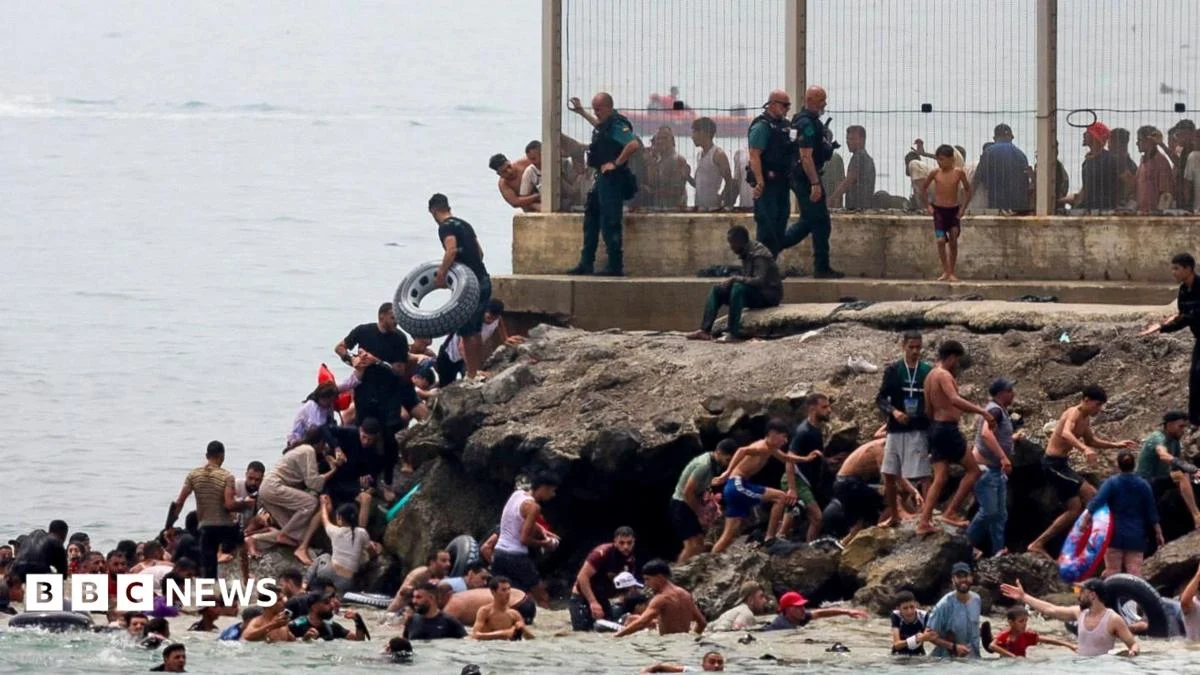
A significant surge of migrants, numbering in the hundreds and potentially reaching into the thousands, have crossed into Spain’s North African enclave of Ceuta from Morocco over the past week, prompting a dire warning from the territory’s leader about overwhelming resources and a call for urgent Spanish government intervention. The dramatic influx, with vivid footage emerging of individuals swimming and utilizing makeshift flotation devices to navigate the waters surrounding Ceuta on Thursday, alongside others scaling the border fence, has underscored the persistent and perilous journey many undertake in their pursuit of reaching Europe. This latest wave of crossings has reignited concerns about border security and the humanitarian challenges faced by both the migrants and the Spanish authorities tasked with managing the situation.
Juan Jesús Vivas, the leader of Ceuta, articulated the severity of the situation, stating that the territory’s resources are being stretched to their breaking point. His urgent plea to the Spanish government for immediate intervention highlights the scale of the humanitarian and logistical crisis unfolding. In response, Spain’s Interior Minister, Fernando Grande-Marlaska, is expected to visit Ceuta on Friday, a move anticipated to address the escalating crisis and explore potential solutions. The Ministry of the Interior has pointed to a recent ruling by the country’s Supreme Court, which prohibits the summary return of migrants intercepted at sea while attempting to reach Ceuta or Melilla. Authorities believe that human trafficking networks are exploiting this legal development to encourage a greater flow of undocumented migrants, predominantly young individuals, into Spanish territory. Spain has emphasized its commitment to cooperating with Morocco on all fronts, including migration management, and has stated that both nations have agreed to bolster their collaborative efforts to address the issue, specifically focusing on the prompt handover of all individuals who have entered Ceuta illegally.
Conflicting reports on the precise number of individuals who have crossed into Ceuta have added to the complexity of the situation. While Spanish media outlets, citing Reuters, have estimated that between 2,000 and 3,000 people entered Ceuta on Thursday alone, these figures have not been officially confirmed by the Guardia Civil. In contrast, Spain’s public broadcaster, RTVE, has reported that "hundreds" crossed into the territory throughout the day. RTVE also noted that over 1,500 migrants, predominantly young Moroccans, have reached Ceuta in the preceding two weeks. The grim reality of the perilous journey was further underscored by Vivas’s statement to RTVE that the bodies of 60 individuals have been recovered at sea in recent months, a stark reminder of the fatal risks involved.
Vivas further described the situation as a humanitarian and security emergency, emphasizing that reception centers for unaccompanied minors are operating at several times their intended capacity. This overcrowding poses significant challenges in providing adequate care and support for vulnerable young people. The current surge in arrivals has drawn comparisons to the events of May 2021, when approximately 8,000 people entered Ceuta over a matter of days, leading to significant diplomatic tensions with Morocco. Ceuta and its neighboring enclave, Melilla, situated on Morocco’s northern coast, represent the European Union’s only land borders with Africa. Despite years of increased security measures implemented by Spanish authorities, including enhanced surveillance, reinforcement of border barriers, and improved bilateral relations with Morocco, the allure of reaching Europe continues to drive individuals to attempt these perilous crossings.
The escalating situation in Ceuta has also drawn international attention and prompted strong reactions from other European nations. Italy, in particular, has voiced its concerns, with Prime Minister Giorgia Meloni calling for Spain to be suspended from the Schengen zone. Meloni stated that Italy is "prepared to intervene with extraordinary measures to defend the borders and the safety of citizens." In a post on X, she described the images from Ceuta as "striking" and asserted that "uncontrolled illegal immigration poses a concrete threat to the security of Europe’s borders." This sentiment reflects a broader debate within Europe regarding migration management and border control, highlighting the complex geopolitical and humanitarian dimensions of the ongoing challenges at the EU’s external frontiers.
The geographical proximity of Ceuta and Melilla to Morocco, separated from mainland Spain by the Strait of Gibraltar, has historically made them focal points for migrants seeking to enter Europe. The rugged terrain, the Mediterranean Sea, and the heavily fortified border fence all present formidable obstacles, yet the desperation for a better life continues to motivate thousands to attempt the crossing. The methods employed by migrants are varied and often reflect the ingenuity born of necessity. Some brave the waters of the Strait of Gibraltar, an area known for its strong currents and busy shipping lanes, using inflatable rings, makeshift rafts, and even swimming for miles. Others attempt to breach the physical barriers, scaling fences or hiding in vehicles. The risks are immense, encompassing drowning, hypothermia, injury from the border fence, and exploitation by criminal trafficking networks.
The role of human trafficking networks in facilitating these crossings is a significant concern for authorities. These networks often prey on the vulnerabilities of migrants, charging exorbitant fees for passage and frequently exposing individuals to dangerous conditions. The Supreme Court’s ruling, intended to uphold international protection principles, appears to have been inadvertently exploited by these groups to encourage more crossings, believing that migrants would be less likely to be immediately returned to Morocco. This has created a complex legal and operational challenge for Spanish authorities, who are caught between their legal obligations and the need to maintain border security and manage the influx.
The humanitarian crisis within Ceuta is palpable. The limited infrastructure, designed for a certain capacity, is struggling to cope with the sheer numbers of arrivals. The reception centers for unaccompanied minors are particularly strained, with reports of them operating at multiple times their intended capacity. This situation raises serious concerns about the welfare and protection of these vulnerable individuals, who often arrive traumatized and in need of specialized care. The Spanish government’s commitment to cooperation with Morocco is crucial, but the effectiveness of these joint efforts will be tested by the continued pressure on the border. The "handover, as soon as possible, of all people who have entered Ceuta illegally" is a stated goal, but the practicalities of implementing this, particularly in light of international human rights conventions and the realities on the ground, remain a significant challenge.
The comparison to the 2021 crisis in Ceuta is a stark reminder of the cyclical nature of these events and the potential for them to escalate rapidly. The diplomatic tensions that arose in 2021, largely stemming from Morocco’s perceived inaction or even tacit encouragement of the crossings, underscore the interconnectedness of migration flows and broader geopolitical relations. Spain’s position as the EU’s only land border with Africa places it at the forefront of these challenges, requiring not only robust national policies but also strong and coordinated European responses. The call for Spain’s suspension from the Schengen zone by Italy, while perhaps an extreme reaction, highlights the anxieties and pressures felt by other member states in the face of large-scale irregular migration. The debate over border security, asylum procedures, and burden-sharing within the EU is likely to intensify as events like the current surge in Ceuta unfold. The recurring nature of these crossings underscores the persistent push factors driving migration from various parts of Africa and the Middle East, including economic hardship, conflict, and political instability, alongside the enduring pull factors of perceived economic opportunity and safety in Europe. The complex interplay of these factors, coupled with the geographical realities of the Mediterranean and the Strait of Gibraltar, ensures that Ceuta will likely remain a critical and often volatile flashpoint in the ongoing European migration debate for the foreseeable future.




 Nakalama John
 Ramos Leo
 Nana Banana