
 George Anjay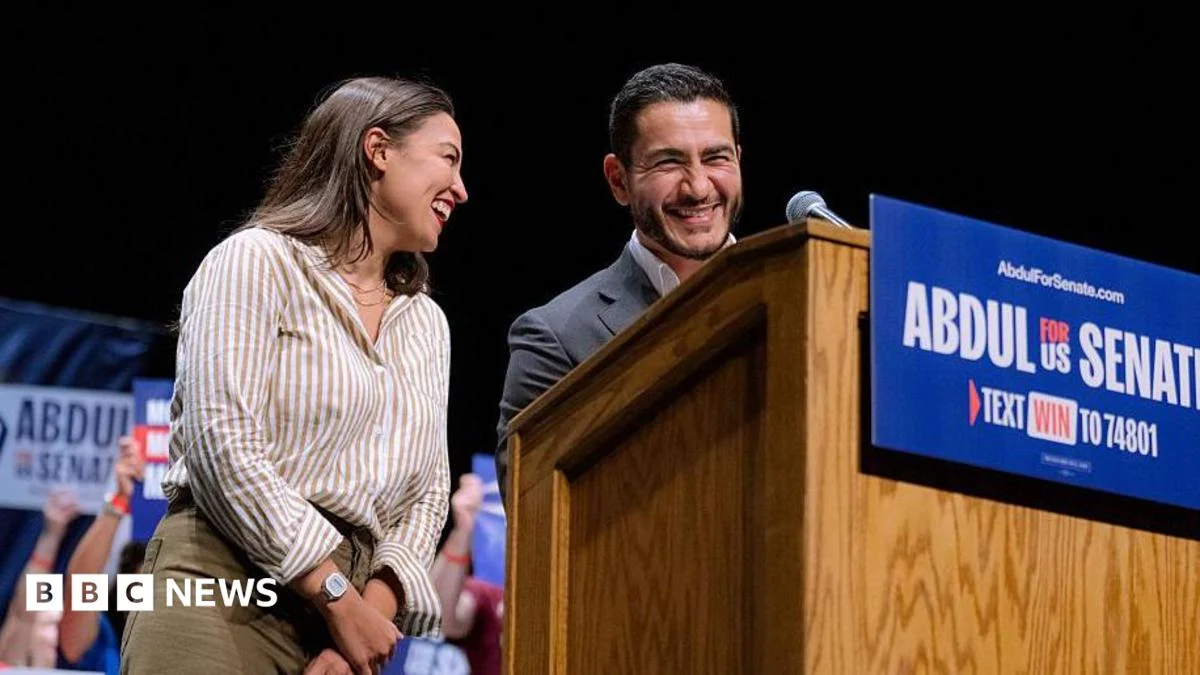
On a hazy Saturday evening in Detroit, Michigan, the historic grandeur of the 104-year-old Opera House was filled with the electrifying energy of hundreds of voters. They rose in a thunderous ovation as Senator Bernie Sanders and Representative Alexandria Ocasio-Cortez took the stage, two prominent figures of the American left, united in their support for Senate hopeful Abdul El-Sayed. El-Sayed, a physician, is campaigning on a progressive platform that includes universal healthcare, a message resonating deeply with the enthusiastic crowd. Many in attendance proudly displayed signs emblazoned with his slogan, "Medicare for All," and wore apparel advocating for an end to immigration enforcement and U.S. aid to Israel.
This fervent demonstration, however, is being closely observed not just by supporters, but by political observers and strategists nationwide. The question on everyone’s mind is whether El-Sayed can secure the Democratic nomination to contest the Senate seat in the upcoming November midterm elections. His primary opponent, incumbent Congresswoman Haley Stevens, represents a different wing of the Democratic Party. Stevens, an established politician, benefits from substantial financial backing, including significant corporate campaign donations, positioning her as the candidate of the centrist establishment. This dynamic highlights the internal divisions within the Democratic Party as it strategizes to regain control of Congress. The party finds itself at a crossroads, with the influential left flank, personified by Sanders, Ocasio-Cortez, and rising stars like New York City Mayor Zohran Mamdani, contrasting with the more traditional, centrist faction.
While the summer primaries have seen a surge of victories for left-wing Democrats in key states like New York and Colorado, a significant challenge remains: can they recapture the support of disillusioned working-class voters who gravitated towards former President Donald Trump in the 2024 election? Michigan, a crucial swing state that shifted from Democrat Joe Biden in 2020 to Trump four years later, presents a must-win scenario for Democrats. The open Senate seat, previously held by a Democrat, is vital for the party’s ambitions of expanding its Senate majority and effectively countering Trump’s political agenda. The winner of the August 4th primary will face Trump ally Mike Rogers in the general election on November 3rd.
At the Detroit rally, a palpable sense of optimism permeated the venue. Ocasio-Cortez articulated a vision where El-Sayed embodied the "politics of the future." Yet, beyond the immediate fervor of the event, a more cautious perspective emerged. Miles away from the Opera House, some voters expressed reservations about El-Sayed’s electability, not only against Stevens but also in a broader election where policies such as universal healthcare and a critical stance on Israel’s military campaign in Gaza might prove divisive. Colleen Houlihan, a 74-year-old resident of Ferndale, Michigan, who leans towards supporting Stevens, voiced this sentiment. "This may not be the moment for progressives," she stated. "I want radical change in the country, but we’ve got to start with this administration and it’s got to be an electable candidate to get power back in sane hands."
El-Sayed’s primary contest against Stevens is proving to be a closely fought battle. Stevens, a moderate Democrat, is campaigning on her experience and has secured endorsements from influential figures such as Michigan Governor Gretchen Whitmer and outgoing Senator Gary Peters. This race is not an isolated test of progressive influence in the Midwest; just a week later, self-described Democratic socialist Francesca Hong will be vying for victory in Wisconsin’s gubernatorial race. Political analysts and voters alike are scrutinizing whether the current progressive momentum can translate into wins in the politically diverse and historically working-class Midwest. Adrian Hemond, a political strategist based in Michigan, commented, "They got a big win electing Mamdani mayor of New York City, but also, it’s New York City. They have been much less able to win in some more traditionally purple areas."
On the streets of Hamtramck, a small town within Detroit, volunteers, including a canvasser named Johnson, are working diligently to spread El-Sayed’s message. Echoing the sentiment from a recent campaign meeting, they chanted, "Money out of politics, money in pockets, Medicare for all." El-Sayed, the former Wayne County health director, has proposed a platform that includes universal healthcare and an annual wealth tax on billionaires. These proposals represent a significant shift for a Democratic Party that has, in recent years, seen a decline in its favorability ratings. A 2025 Gallup poll indicated a 12% drop in Democrats viewing their own party positively, bringing the figure down to 67%. Despite his progressive stances, El-Sayed has strategically avoided the "Democratic socialist" label, while still drawing inspiration from the successes of those who embrace it. He has particularly taken note of Mayor Zohran Mamdani’s effective use of social media and his focused message on affordability, which contributed to his victory in New York.
The affordability platform, with a strong emphasis on healthcare, is precisely what resonates with Les Lukacs of Monroe, Michigan. A lifelong Democrat who currently lacks health insurance, Lukacs declared he would not vote for Stevens in November if El-Sayed loses the primary. "We can barely afford groceries and gas," he explained. "I have to make sacrifices – and healthcare is one of them." Recent polling data consistently shows that healthcare costs remain a paramount concern for voters in the upcoming midterm elections, alongside the escalating prices of gas, groceries, and housing. El-Sayed articulated his perspective to the BBC, stating that if the Democratic Party demonstrated greater concern for ordinary citizens, "they’d be fighting on the same policies I’m fighting for." In a statement to the BBC, a spokesperson for Stevens’ campaign asserted that the congresswoman is committed to "fight for all Michiganders from every zip code to lower costs, protect manufacturing jobs, and take on Donald Trump’s corruption and abuses of power."
In alignment with many of his progressive colleagues, El-Sayed has voiced strong opposition to U.S. involvement in the Middle East, including financial and military aid to Israel. Recent surveys indicate a growing segment of the electorate believes the United States provides excessive support to its long-standing ally, particularly in the aftermath of the recent conflict. This issue holds particular significance in Michigan, which is home to the second-largest Arab-American population in the United States. El-Sayed, the son of Egyptian immigrants, has explicitly characterized Israel’s actions in Gaza as genocide. He has also been vocal in highlighting his opponent’s ties to AIPAC (the American Israel Public Affairs Committee), an organization that has reportedly invested nearly $30 million to support Stevens in the race. In contrast, Stevens, like many moderate Democrats, maintains a position of support for U.S. aid to Israel without conditions. She did not respond to a BBC request for comment regarding her stance on Israel. Rex Nazarko, leader of the American Muslim Engagement and Empowerment Network, believes that El-Sayed is poised to attract thousands of Democratic voters in Michigan who abstained from supporting Kamala Harris and Joe Biden in the 2024 presidential election due to their policies concerning Israel.
While some left-wing voters are enthusiastically rallying behind El-Sayed, a significant portion of Democrats harbor concerns about the broader appeal of the progressive movement in securing victories in swing states. Sally, a 45-year-old Michigan resident who requested her last name be withheld due to her status as an elected official, expressed admiration for the movement’s energy but remained uncertain about its long-term sustainability. "There’s a lot of that momentum, but keeping that momentum going is really hard," she observed. She acknowledged that while Stevens faces criticism for her ties to corporate campaign funding, financial resources are undeniably crucial in politics. "It’s those connections that are going to support changes in law and make things move faster," Sally added.
Even among El-Sayed’s most committed supporters, a degree of apprehension exists regarding the potential impact of their votes. Claire McHugh, a 70-year-old attendee at the rally, shared her anxieties: "I’m a little scared. I’m a little nervous. I just hope that enough people are fed up with the status quo." When questioned about the possibility of left-wing candidates persuading more moderate Democrats to defeat Republicans, El-Sayed conveyed that his focus is not on the internal future of the Democratic Party. However, he added, "If Democrats want to find their future, I think we’re showing it to them right here." Larry Sabato, a political scientist, noted that the ultimate direction of the Democratic Party remains uncertain. Nevertheless, he emphasized that for the party to reverse its recent electoral defeats, it must find a way to "sew these two very large groups back together." Sabato concluded with a stark warning: "It’s already frayed. If they don’t do the repair job they need to do and quickly, certainly through 2028, then they’re going to have to get used to losing."



 Roy Suryo

 Nakalama John
 atisusanti
 Ramos Leo
