George Anjay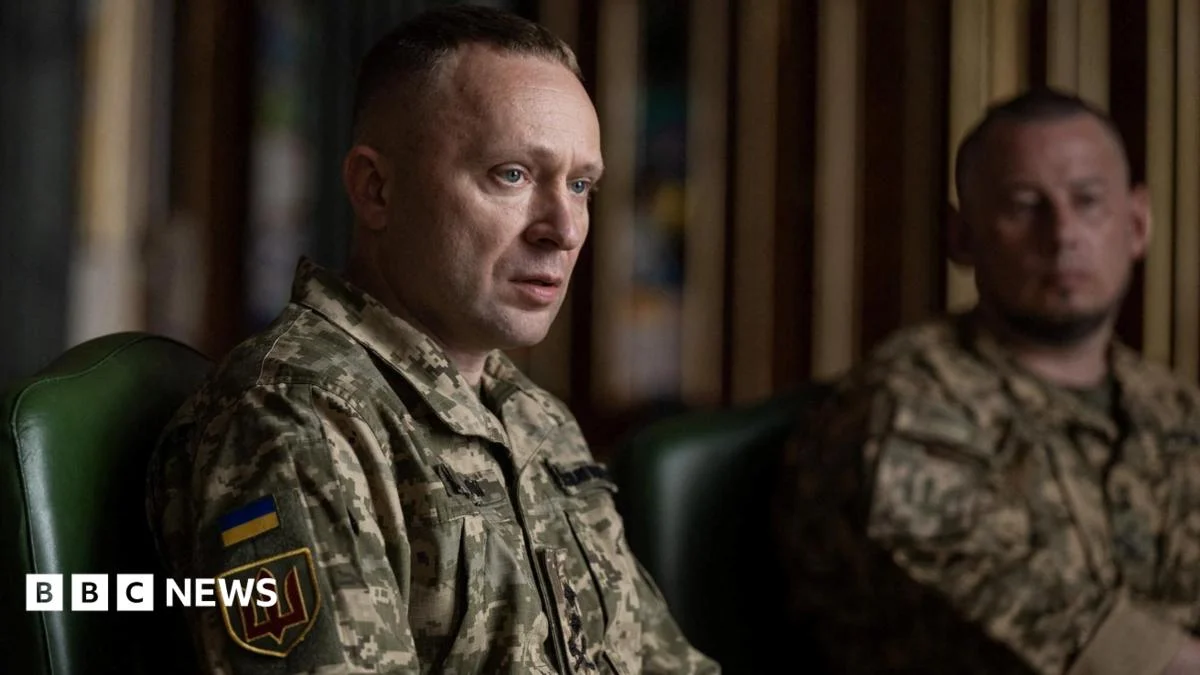
Maj Gen Mykhailo Drapatyi, a 43-year-old decorated military leader with a reputation for both battlefield prowess and deep moral conviction, has been appointed Ukraine’s new commander-in-chief, succeeding Oleksandr Syrskyi. This marks the third change in this pivotal role since Russia launched its full-scale invasion in February 2022, a transition met with widespread approval from Ukrainian civil society and the armed forces alike. Drapatyi’s ascent was not unexpected; his name was notably chanted during recent protests, initially organized in support of his friend and former Defence Minister Mykhailo Fedorov, but which ultimately evolved into calls for Syrskyi’s dismissal. "There’s no better person for this position nowadays in Ukraine," a Ukrainian soldier shared with the BBC, encapsulating the prevailing sentiment of confidence in Drapatyi’s leadership.
Drapatyi’s suitability for this demanding role is rooted in his extensive military experience within post-Soviet Ukraine, his proven acumen as a field commander, and his widely respected reputation for humane and steadfast leadership. His military journey began in 2004 after graduating from the Kharkiv Institute of Tank Troops, where he commenced his service as a lieutenant. A decade later, in May 2014, his bravery and decisive action propelled him into the national spotlight. During the pro-Russian separatist uprising in eastern Ukraine, Drapatyi’s battalion was tasked with liberating hostages held in the Mariupol police department. Faced with intelligence about makeshift barricades over a meter high, he famously declared, "let’s take it by storm," a moment captured on video that resonated globally. This decisive approach underscored his commitment to achieving objectives, even in the face of formidable obstacles. Later that same year, he further distinguished himself by successfully orchestrating the withdrawal of encircled Ukrainian units from a precarious border region in the Luhansk Oblast, a testament to his tactical foresight and concern for his troops’ safety.
His dedication to continuous improvement led him back to academia in 2021 for advanced operational and strategic training. His academic excellence was recognized in June 2021 when he was awarded a sword of honour as the top graduate by British Ambassador Melinda Simmons, signifying his commitment to mastering the complexities of modern warfare.
Upon the commencement of Russia’s full-scale invasion in February 2022, Drapatyi held the position of deputy commander of joint forces. In this capacity, he led crucial operational groups – dynamic, temporary task forces – across multiple front lines. His strategic leadership was instrumental in repelling Russian advances towards Kryvyi Rih and in the successful liberation of several settlements in the Kherson and Dnipropetrovsk regions. By 2024, he had risen to command the land forces of the Ukrainian army, taking charge of task forces engaged in some of the most brutal combat zones in the east.
A profound demonstration of Drapatyi’s integrity and sense of responsibility occurred less than a year prior to his current appointment. Following a devastating Russian missile strike on a training ground in the Dnipropetrovsk region that claimed the lives of 12 soldiers and wounded 60 others, Drapatyi submitted his resignation on the very same day. He cited his personal accountability for the "conspiracy of silence and impunity" that he believed contributed to the tragedy. His poignant written statement articulated a core tenet of his leadership philosophy: "An army in which commanders bear personal responsibility for the lives of personnel keeps living. An army in which nobody is responsible for a loss dies." This act of profound accountability was widely lauded, and President Zelenskyy’s decision to instead appoint him commander of the Joint Forces of the Armed Forces of Ukraine was seen as a testament to his character and leadership potential.
From that point forward, whispers of growing tension between Drapatyi and Syrskyi became increasingly prevalent within military circles. An unnamed officer confided in Ukrainian media in June 2025, describing Drapatyi as "a relatively young general. He is gifted. He was always sent to places where the situation was extremely difficult." This officer further speculated, "I do not think he has political ambitions. Yet I am sure his ambitions are not confined to the position of commander of the ground forces or the Joint Forces."
Now, just over a year later, with Syrskyi’s departure, hopes are soaring for Drapatyi’s tenure as commander-in-chief. Mykola Bielieskov, a senior analyst at the Ukrainian NGO Come Back Alive, notes that "Drapatyi has a very good reputation among the rank and file – especially those who joined after 2022 as civilians." However, Bielieskov cautions that Drapatyi faces significant constraints. "The Commander-in-Chief has a lot of leverage. But war is a combination of government, the president’s office, military suppliers, dependence on [Western] partners… so he’s got a tricky path before him."
The prospects for a ceasefire with Russia remain bleak, and Ukraine is bracing for another challenging winter campaign. Key priorities for Drapatyi include effective manpower mobilization and a concerted effort to combat corruption, which has permeated various levels of the army, from conscription officers to defense procurement. Simultaneously, he will be expected to leverage Ukraine’s remarkable technological advancements and foster the burgeoning defense tech industry that has been a significant factor in recent battlefield successes.
In his inaugural message after assuming the role of Commander-in-Chief, Drapatyi candidly acknowledged the formidable nature of his task. He pledged to operate "without making loud promises, with responsibility for our decisions, and with respect" for those serving on the front lines. Many anticipate a departure from Syrskyi’s perceived "outdated" combat methods, which were criticized for placing insufficient value on human life in favor of costly offensives. Analyst Bielieskov warns against "oversimplification," stating, "It’s a major role and people will expect change quickly." This sentiment is echoed by former interior ministry advisor Oleksiy Kopytko, who observes that a commander-in-chief "is worshipped and loved by all today, not loved by everyone tomorrow, and are guilty of everything the day after tomorrow, with none of your achievements mattering."
Valery Zaluzhnyi, who was removed as army chief in 2024, presciently predicted that Drapatyi "would have a very difficult time. Much harder than he imagines." Despite these acknowledged challenges, there is a palpable sense of optimism among many soldiers and ordinary Ukrainians regarding the fresh perspective and leadership style that Drapatyi represents. One individual expressed that if Mykhailo Fedorov were to be reinstated as defence minister, the combined leadership of Drapatyi and Fedorov would constitute "Russia’s worst nightmare."
During his resignation from his previous position in 2025, Drapatyi meticulously outlined the systemic issues he had addressed within the Ground Forces, encompassing reforms in combat training, inequities in mobilization, pervasive corruption, and flawed procurement systems. At the time, he stated, "There is expected resistance, but efforts need to be stepped up." He is now poised to confront these same deeply entrenched problems, albeit on a significantly larger scale and under the intense scrutiny of the entire nation. The success of his tenure will depend not only on his strategic acumen and leadership but also on his ability to navigate the complex political and logistical landscape, while inspiring the unwavering resolve of the Ukrainian people in their ongoing struggle for freedom.



 Roy Suryo
 Nakalama John
 atisusanti
 Ramos Leo