
 Roy Suryo
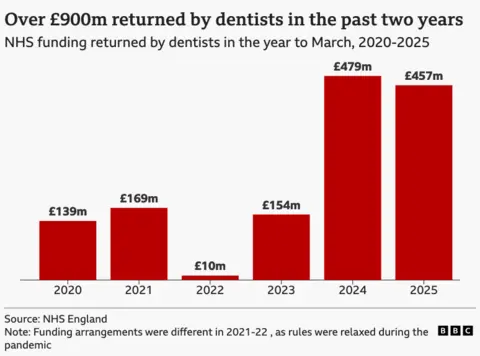
Dentists in England are returning hundreds of millions of pounds annually to the government, a consequence of their failure to deliver promised National Health Service (NHS) care. Over the past two years, a staggering sum exceeding £900 million has been returned, equating to approximately £1 out of every £7 allocated for NHS dentistry. This significant financial reimbursement indicates that a substantial portion of contracted NHS dental work is not being undertaken, with practitioners increasingly prioritizing private patient services. These findings provide a stark explanation for the persistent struggles faced by millions of patients attempting to access NHS dental care, despite record funding allocations. More than a fifth of the population reports being unable to obtain dental treatment when they require it, highlighting a critical gap between available resources and patient needs.
The government has acknowledged these issues, stating that improvements are being implemented this year and asserting that any returned funds are ultimately reinvested back into healthcare services. However, the scale of the unfulfilled contracts has drawn significant scrutiny. This situation coincides with a major investigation by the Competition and Markets Authority (CMA) into the private dentistry market, focusing specifically on the escalating prices patients are being charged. The CMA’s preliminary findings reveal a concerning trend, with patient fees in private dentistry increasing by as much as 22% between 2022 and 2024.
The financial incentives for dentists are starkly different between NHS and private practice. Dentists can now earn up to double by treating patients privately compared to undertaking the same procedures, such as fillings and extractions, under the NHS. The British Dental Association (BDA) attributes this disparity and the subsequent underdelivery of NHS care to the chronically low payment rates for NHS treatments. According to the BDA, dentists are frequently losing money on specific procedures when working for the NHS, making it financially untenable to fulfill their contractual obligations.
Under the current NHS contract system, dental practices agree to provide a specific volume of NHS work throughout the year and receive monthly payments from the health service based on this agreement. If a practice fails to meet a certain threshold of this contracted work – defined as delivering less than 96% of the contract value – the NHS is empowered to reclaim funds from these practices in the following year. This clawback mechanism has led to substantial financial returns. BBC analysis of NHS accounts reveals that in the 2024-25 financial year, over £450 million was returned, following a nearly £480 million return in the preceding year. Worryingly, in each of these years, more than 40% of dental practices were required to hand back funds, marking a significant escalation in the amounts returned compared to previous years.
The human cost of this system is palpable for patients like Nikita Jenkins, a 27-year-old from Cornwall. She has been unable to access NHS dental care for 14 years and has been forced to pay privately for her two young daughters’ dental treatment. Local waiting lists for NHS appointments were reportedly as long as seven years, leaving her with little choice. "I tried every dentist in and around my area, but it was near impossible," Jenkins explained. "We were waiting, and in the end, I felt like we had no choice but to take the jump and pay to go private, to ensure that our children had the right health care." For Jenkins, the added expense of private dentistry, on top of existing financial pressures, is a significant burden. She eloquently described dentistry as feeling like "a luxury, not a necessity, because it’s just so inaccessible, which shouldn’t be the case – especially for children."
Eddie Crouch, chair of the BDA, highlighted the detrimental impact of the current contract, which he described as being two decades old and no longer fit for purpose. He explained that dentists are left with few alternatives as the financial realities of delivering NHS care become increasingly unsustainable. Crouch stated that for new patient examinations under the NHS, a typical dentist could incur a loss of £7 per patient because the costs associated with the treatment far outweigh the reimbursement received. "It’s the simple fact we now have dentists losing money delivering NHS care," he commented. "It might suit the Treasury, but no healthcare professional can be expected to work this way."
While the majority of the returned funds are attributed to the failure to meet contract quotas, a smaller portion is sometimes returned due to audits revealing practices that have incorrectly claimed excessive amounts for NHS treatments. Rebecca Curtayne, from the patient advocacy group Healthwatch England, voiced the concerns of many, stating, "These figures reflect what people across the country tell us – many cannot get an NHS dental appointment and others find their dentist has stopped providing NHS care altogether and now only offers private treatment." She emphasized the disproportionate impact on vulnerable individuals, particularly those facing financial hardship, who are left without recourse under a fundamentally flawed dental contract.
In response to the crisis, the government has implemented measures aimed at improving access to NHS dentistry. These include increasing the remuneration dentists receive for NHS work and offering £20,000 "golden hello" incentives to attract dentists to areas with the most acute access problems. The government claims these initiatives are leading to an increase in the number of treatments being carried out. Furthermore, plans are underway to fundamentally reform the dentistry contract by the end of the current parliamentary term with the objective of further boosting patient access.
Health and social care minister Stephen Kinnock acknowledged the progress being made, stating that the government is "making progress." However, he conceded that "we know there is more to do to get to the root of the problem." An NHS England spokeswoman offered a different perspective on the clawback data, suggesting it is effectively "a year behind reality" and that the money being returned is consistently reinvested into dentistry services. She added that NHS England is "working closely with government to introduce further reforms in the coming months." This ongoing dialogue and proposed reforms signal a recognition of the deep-seated issues within the NHS dental system, though the tangible impact on patient access remains a pressing concern.
Additional reporting by Elena Bailey and data analysis by Aidan McNamee.




 Nakalama John
 atisusanti
 Ramos Leo
