George Anjay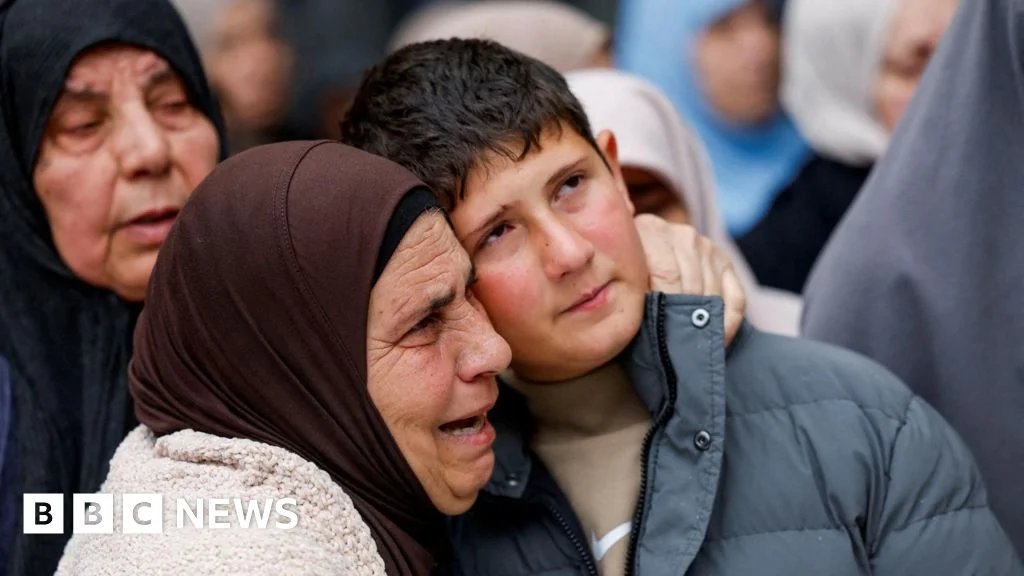
In the harrowing aftermath of gunfire that ripped through the darkness, 12-year-old Khaled Bani Odeh found himself in a terrifying silence, convinced he was the sole survivor of his family. Just moments before, the windshield of their car had become a tragic canvas, splattered with the lives of his parents and two youngest brothers, extinguished by Israeli forces as they journeyed home through the occupied West Bank. Among the innocent lives lost was six-year-old Othman, a blind and disabled child, who perished in his mother’s embrace. “My mother cried out one last time before going quiet,” Khaled recounted, his voice a fragile echo of the horror he witnessed. “My father recited the Shahada [the Islamic declaration of faith] as he died.” The terror escalated when Israeli forces attempted to pull his only surviving brother, Mustafa, from the vehicle. Khaled’s desperate attempt to intervene only led to his own violent ejection from the car, followed by brutal physical assault. “They pulled me out instead and began jumping on my back,” he stated, the memory etched onto his young face. “Then they took me to a corner and questioned me about who had been in the car. I told them it was my mother and father. They accused me of lying and started beating me.”
The family, Ali Khaled Bani Odeh, 37, and his wife Waad, 35, were mere minutes from their home in Tammun, near Tubas, when the tragedy struck shortly after midnight on Saturday. Their sons, Mohammed and Othman, aged and his younger brother, were also victims of the deadly encounter. Relatives shared that Ali had recently returned home after a six-week stint working on a construction site in Israel. The boys, eagerly anticipating the approaching Eid al-Fitr holiday, had implored him to take them shopping in Nablus. It was on this fateful return journey, after a day of shopping and dinner, that the Israeli army claims its soldiers and Border Police were conducting an operation in Tammun, targeting individuals suspected of terrorist activities against Israeli security forces.
The Israeli military’s official statement asserts that the Bani Odeh family’s car "accelerated towards the forces, who sensed danger and responded by shooting." However, this account is starkly contradicted by a witness who lives overlooking the road where the incident unfolded. This resident, who has requested anonymity for his safety, reported observing the family car turn left into his street, proceeding uphill, and coming to a complete stop before any shots were fired. He unequivocally stated that there were no warnings issued by Israeli forces, nor were any warning shots discharged. "No, nothing," he affirmed. "The firing directly targeted the car. I just heard the woman in the car screaming. The little kids were crying before they were killed." An account corroborated by the New York Times details Waad’s request to her husband to pull over so she could search for something in her bag, further undermining the Israeli army’s narrative of a car accelerating towards soldiers. The Israeli army has indicated that the incident is under investigation by the relevant authorities, and when pressed for a response to the claims of the car being stationary and fired upon without warning, directed inquiries to the police, whose response is still pending.
At the Bani Odeh family home, a somber atmosphere enveloped mourners gathered around Khaled’s grandmother, Najah Bani Odeh. Clad in traditional woollen shawls and headscarves, the women offered solace. Beside Najah sat eight-year-old Mustafa, his small frame trembling, his face bearing the marks of the brutal attack. A bandage across his face, she explained, was shrapnel and glass from the shattered car window, requiring an operation to remove. Najah Bani Odeh firmly stated that the family had no prior knowledge of any military operation in the village as they drove home. “They were driving by the school area where the special forces were hiding,” she recounted. “The kids were singing and having fun. Mohammed, who was in kindergarten, was sitting between his mum and dad when they were shot.” She described how Mohammed had fallen into Mustafa’s lap as the shooting began, his blood staining his brother’s clothes.
Hassan Fuqoha, a member of the Palestinian Red Crescent ambulance crew present at the scene, described the aftermath as unlike any he had witnessed before. He reported that both parents and one of the children had suffered catastrophic head injuries, a grim testament to the ferocity of the gunfire. “I saw a lot of bullet casings, everywhere around the car,” he stated, emphasizing the sheer volume of fire. “It was very heavy fire, directly at the car, it’s not normal.” Residents reported discovering over 50 bullet casings from assault rifles, consistent with those used by Israeli armed forces, which they subsequently handed over to the authorities. A single casing remained lodged under rubble by the roadside, a stark reminder of the violence, near lingering bloodstains on the ground.
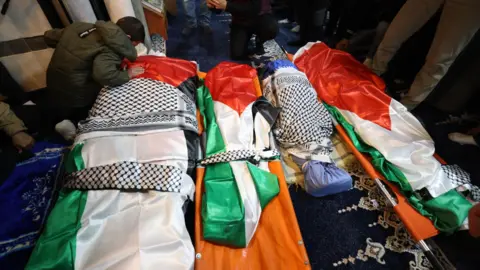
In a rare public criticism, Yair Lapid, the leader of the Israeli opposition party Yesh Atid, condemned the Israeli government for its failure to offer an apology to the family for the loss of their children. “A seven-year-old boy with special needs should not die in the wars of adults,” he declared, highlighting the profound tragedy of Othman’s death. The deployment of lethal force against a civilian vehicle carrying four young children has reignited critical discussions surrounding the Israeli military’s response to Palestinians in the West Bank, and the parameters defining a perceived threat.
Najah Bani Odeh articulated a chilling perspective, viewing the killing of her son, daughter-in-law, and two grandchildren as part of a disturbing escalation of violence against Palestinians in the West Bank. She pointed to a perceived rise in aggression from both Israeli soldiers and settlers, particularly in the wake of the Hamas attacks on Israel on October 7, 2023. “A settler over there goes on rampage hurting men, women and children, and we only defend ourselves by hurling stones,” she stated, her voice heavy with resignation. “They want to strip us out of our lands. They are now building walls around the lands they have seized and firing at will at anyone approaching.” Official figures from the UN’s Office for the Coordination of Humanitarian Affairs (OCHA) paint a grim picture: between October 7, 2023, and March 15, 2026, 1,071 Palestinians, including at least 233 children, were killed in the West Bank. During the same period, 19 Israeli civilians and 23 Israeli security forces lost their lives in the region.

 Nakalama John
 Ramos Leo
 Nana Banana