Nana Banana
The flickering fluorescent lights of a secluded north-west London lab cast an eerie glow on three black metal robotic hands. Far from the menacing claws of science fiction, these are intricate contraptions of four fingers and a thumb, opening and closing with unnerving anatomical precision, joints articulating in all the right places. "We’re not trying to build Terminator," quips Rich Walker, director of Shadow Robot, the innovative firm behind these advanced prototypes. His appearance, more reminiscent of a thoughtful artist than a tech mogul, belies the profound ambition driving his team: to construct a "general-purpose servant" capable of tackling household chores and, more critically, addressing the escalating social care crisis.

This ambition is not merely theoretical; it strikes at the heart of one of the UK’s most pressing societal challenges. Reports from charities like Skills for Care paint a stark picture: 131,000 vacancies for adult care workers in England alone last year. Simultaneously, Age UK estimates that approximately two million individuals aged 65 and over are living with unmet care needs. With projections indicating that by 2050, one in four people in the UK will be aged 65 or older, the strain on an already fragile care system is set to become unbearable. This demographic shift, mirroring trends across many developed nations, underscores the urgent need for innovative solutions to a looming global crisis.
Enter the robots. The previous government, recognizing the impending crisis, pledged a substantial £34m investment into developing care robots. In 2019, it boldly predicted that "within the next 20 years, autonomous systems like robots will become a normal part of our lives, transforming the way we live, work and travel." This "techno-solutionism," often invoked to describe the belief that technology can solve complex social problems, sounds like something lifted from a dystopian novel. Yet, it forces a crucial question upon us: could these sophisticated machines truly fill the void in human care? And, more fundamentally, would we, or our most vulnerable loved ones, ever truly trust a powerful, emotionless machine with intimate personal care?

Japan, a nation grappling with an even more rapidly aging population and a deep-seated cultural reverence for robotics, offers a compelling glimpse into this potential future. A decade ago, its government initiated a strategic program, offering generous subsidies to manufacturers to accelerate the development and adoption of care robots in residential settings. Dr. James Wright, an AI specialist and visiting professor at Queen Mary University of London, embarked on a seven-month immersive study to observe these robots in action within a Japanese care home environment.
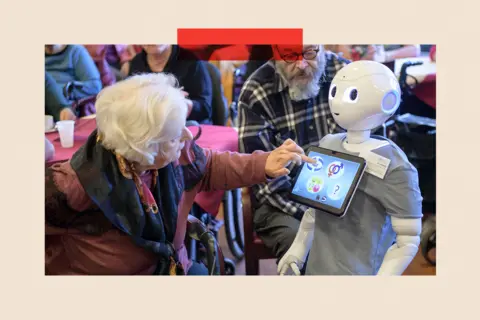
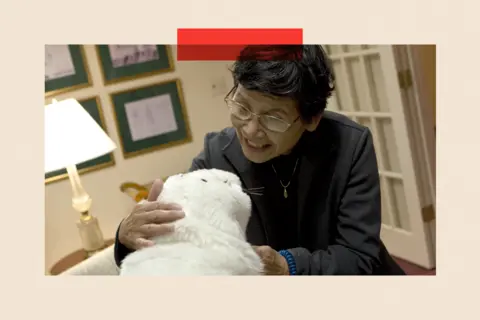
His study focused on three distinct types. First, the HUG robot, developed by Fuji Corporation, presented as a highly sophisticated mobility aid, resembling a walking frame but equipped with supportive pads designed to assist carers in safely lifting residents from beds to wheelchairs or toilets, thereby reducing physical strain on staff. Second, the therapeutic robot Paro, a cuddly, baby-seal-like companion, was engineered to respond to touch and sound, aiming to provide comfort and stimulate engagement among dementia patients. Lastly, Pepper, a small, humanoid robot with a friendly demeanor, was deployed to lead exercise classes, demonstrating movements with its arms and issuing instructions.

Dr. Wright confessed to initially being somewhat swayed by the prevailing hype. "I was expecting that the robots would be easily adopted by care workers who were massively overstretched and extremely busy in their work," he recalled. "What I found was, almost the opposite." His observations revealed a stark reality: the robots, far from alleviating the burden, often added to it. Care workers found themselves dedicating significant time to cleaning, recharging, and, most frequently, troubleshooting when the machines inevitably malfunctioned.
"After several weeks, the care workers decided the robots were more trouble than they were worth and used them less and less, because they were too busy to use them," Dr. Wright explained. Specific design flaws and operational challenges became evident. HUG, despite its lifting capabilities, was cumbersome and constantly needed repositioning to avoid obstructing residents. Paro, while generally well-received, caused unexpected distress to one resident who developed an "overly attached" emotional bond, highlighting the unpredictable complexities of human-robot interaction. Pepper’s exercise routines were often ineffective; its diminutive stature made it difficult for residents to see its movements, and its high-pitched voice proved challenging for many elderly residents to hear clearly.
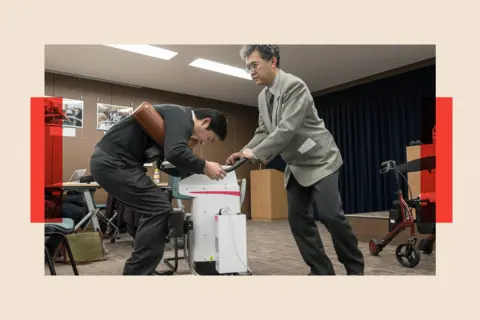
The manufacturers, naturally, have responded to these critiques. Fuji Corporation has since refined HUG’s design, aiming for greater compactness and user-friendliness. Takanori Shibata, Paro’s creator, underscored its two decades of use and pointed to clinical trials demonstrating its therapeutic efficacy. Pepper, now under new ownership, has undergone substantial software updates to address previous limitations. Yet, Dr. Wright’s research serves as a vital cautionary tale, emphasizing that technological prowess alone does not guarantee practical utility or acceptance in complex human care environments.
Despite these early setbacks, the potential of robots in care remains a fiercely debated topic. Rich Walker of Shadow Robot adamantly believes that dismissing their utility would be premature. He argues that the next generation of robots, learning from these early trials, will be exponentially more capable and integrated.
Praminda Caleb-Solly, a professor at the University of Nottingham, is at the forefront of this pragmatic evolution. Her mission is to transition these advanced machines "out of the labs into the real world." To achieve this, she established Emergence, a crucial network designed to bridge the gap between robot developers and the end-users – businesses and, crucially, elderly individuals themselves. Through this network, direct feedback from prospective users is gathered, shaping the future of care robotics. Common requests include intuitive voice interaction, a non-threatening and even "cute design" to foster acceptance, and, perhaps most tellingly, a desire for robots that can adapt to changing needs and, importantly, manage their own maintenance. As one participant succinctly put it: "We don’t want to look after the robot – we want the robot to look after us." This feedback highlights a fundamental requirement: robots must genuinely reduce, not increase, the burden on both carers and care recipients.
In the UK, some care providers are already pioneering trials. Caremark, a home care provider in Cheltenham, has been testing Genie, a small, voice-activated robot, with some of its service users. Director Michael Folkes describes reactions as "like Marmite" – some individuals, like the man with early-onset dementia who enjoyed asking Genie to play Glenn Miller songs, adore their robotic companion. Others, however, are less enthusiastic. Mr. Folkes is quick to clarify the underlying philosophy: "We’re trying to build a future where carers have more time to care," emphasizing that these devices are intended to augment, not replace, human interaction and support.
Back in the Shadow Robot Company lab, Rich Walker highlights another formidable technical hurdle: replicating the unparalleled dexterity of the human hand. "For the robot to be useful, it needs to have the same ability to interact with the world as a human does," he explains. "And for that, it needs human-like dexterity." The metallic and plastic hand he demonstrates is indeed impressive, equipped with 100 sensors, mimicking the strength and agility of its biological counterpart. Each finger executes precise, fluid movements, culminating in a perfect ‘OK’ gesture. It can even solve a Rubik’s Cube with one hand, a feat of complex manipulation.
Yet, even this


 Ramos Leo
 atisusanti
 Roy Suryo
 George Anjay