
 Roy Suryo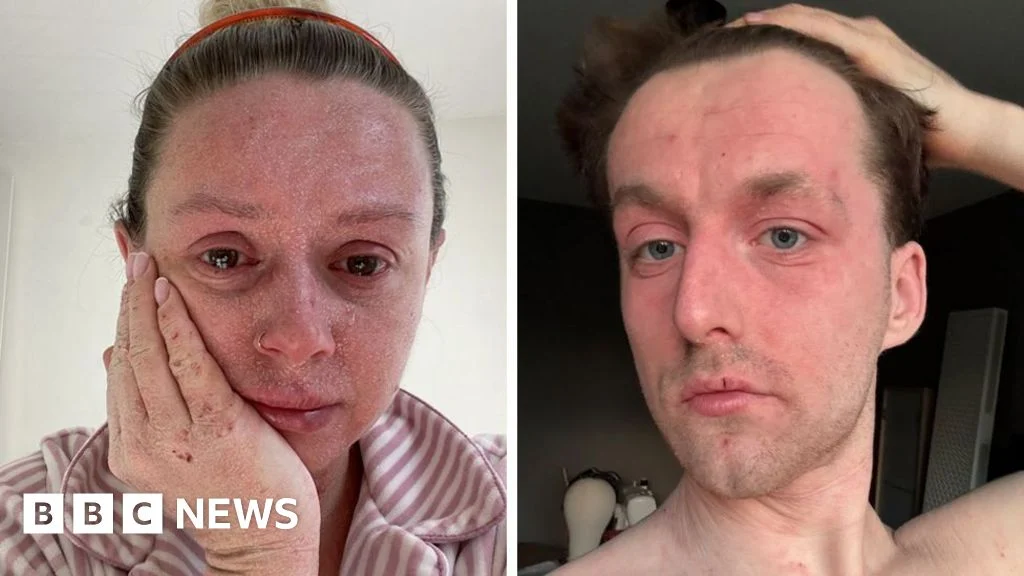
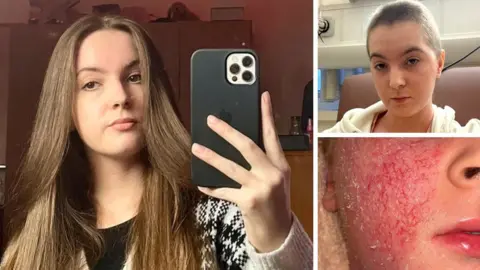
Bethany Gamble was prescribed steroid creams from the tender age of two to manage her eczema. For years, these potent remedies kept her skin condition in check, a manageable aspect of her life. However, this relative peace was shattered when, at 18, the small patches of eczema in the creases of her elbows and behind her knees began to spread with alarming ferocity. "My skin was hot, so inflamed and red," Bethany recalls, her voice still tinged with the memory of the ordeal. "It began to crack and ooze, and the itch was bone deep. It consumed my whole body, and then it began to consume my whole life."
By the time she reached her 20th birthday, Bethany was incapacitated by pain, unable to leave her bed, to feed herself. Her mother was forced to take time off work to care for her. Yet, the most devastating aspect, Bethany reveals, was the pervasive disbelief she encountered. "I was constantly gaslit by doctors," the now 21-year-old from Birmingham explains, her eyes reflecting a steely resolve. "They kept telling me it was just my eczema and offering me more steroids. I’ve had eczema my whole life – this was different." Bethany’s experience is far from isolated. She is part of a growing wave of individuals documenting their harrowing journeys with Topical Steroid Withdrawal (TSW), also known as Red Skin Syndrome, on social media platforms. The hashtag #TSW has garnered over a billion views on TikTok alone, a testament to the widespread suffering and the urgent need for understanding.
TSW remains a tragically under-researched condition, leaving many General Practitioners (GPs) and dermatologists struggling to diagnose and treat it effectively. A significant body of experts believes TSW to be a debilitating reaction to steroid creams, the very treatments prescribed as a first-line defence for the estimated eight million people in the UK living with eczema. Conversely, some medical professionals view TSW as merely a severe flare-up of eczema or other specific skin conditions, remaining unconvinced of its distinct existence. Despite its perceived rarity, the burgeoning chorus of individuals on social media sharing graphic images and accounts of red, inflamed, and peeling skin covering their entire bodies has finally spurred the first UK-based research into the condition.
Professor Sara Brown, a consultant dermatologist at the University of Edinburgh, has been profoundly affected by the "unexplainable" symptoms observed in her own patients and the palpable desperation evident in online posts. Her commitment to understanding TSW has led her to secure funding from the National Eczema Society for a groundbreaking study. "We’re seeing patterns in TSW that cannot be explained by what is known about eczema," Professor Brown states. "Symptoms like thickening and laxity of the skin, so-called ‘elephant skin’, extreme shedding and sharply defined areas of redness next to normal skin." Collaborating with Dr. Alice Burleigh from Scratch That, a TSW patient advocacy group, Professor Brown’s team has recruited hundreds of participants across the UK. They are meticulously analysing symptoms, saliva samples, and skin biopsies in a quest to unravel the underlying causes of TSW and identify why some individuals develop the condition while others do not.
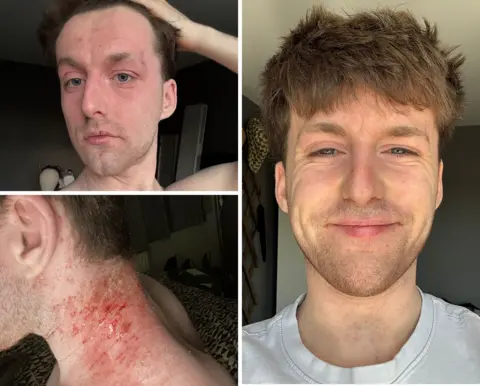
Henry Jones, a 22-year-old from High Wycombe, is one of the dedicated participants in this vital research and a vocal advocate for TSW awareness, proudly calling himself a "TSW warrior." His journey began with occasional steroid cream use for eczema as a teenager, a seemingly innocuous habit that escalated into horrific symptoms forcing him to drop out of his university degree. "My GP at university kept telling me it was just eczema – and kept prescribing me more steroid cream. Something didn’t feel right," Henry recounts. The more cream he applied, the worse he felt. "I was so red, my skin was so tight, then it would flake, then it would ooze, and then the cycle would begin again." As the eczema spread across his entire body, movement became agonizing. He was confined indoors, unable to socialise or pursue his studies. At his lowest points, Henry admits, he contemplated suicide. "My world," he says with a sigh, "became a dark hole caused by the weight of my skin."
A critical aspect of TSW, like many dermatological conditions, is its varied presentation across different skin tones. On lighter skin, TSW often manifests as an intense redness, but on darker skin, it can appear as deep purple, brown, or a concerning greyish tinge. This variability often exacerbates diagnostic challenges, making it even harder for healthcare professionals to identify. Karishma Leckraz, from Kent, speaks of years spent in denial, convinced that her condition could not be TSW because it looked so different from the experiences of white individuals she saw online. "TSW took everything away from me," she explains. "I had to hide from the world for so long. My skin was so bad, the pain, the lack of sleep, just not recognising myself." After five years of abstaining from steroid creams, Karishma’s skin has largely healed, but the psychological scars remain profound. "My social anxiety is huge," she confesses.
Andrew Procter, from the National Eczema Society, acknowledges that while steroid creams remain highly effective for the vast majority of patients, those experiencing TSW-like symptoms are caught in a distressing dilemma. "We know that steroids work for the many millions who use them," he states. "But we also have a condition that at the moment, can’t be explained, which is causing real fear – and that is completely understandable. That is why more research is desperately needed." For individuals already grappling with anxiety and uncertainty about their condition, accessing appropriate treatment presents another significant hurdle. GPs may refer patients to dermatologists, but waiting lists can stretch for over a year, and for many, steroid creams remain the sole readily available option.
At the Royal London Hospital, Dr. Alia Ahmed, a consultant dermatologist, leads a specialist NHS clinic for individuals with chronic skin diseases. Her clinic offers a multidisciplinary approach, including psychological support, immunosuppressants, and phototherapy, all aimed at reducing inflammation and calming the body’s immune response. "The psychological impact, as well as the physical effects, is huge," Dr. Ahmed, a member of the British Association of Dermatologists, emphasizes. "We have to work with the patient to understand the best course of treatment for them."
In 2021, the Medicines and Health Regulatory Authority (MHRA), the UK’s medicines watchdog, officially recognised TSW as a severe reaction to steroid creams. However, they maintain that the condition is still considered relatively rare. In response to concerns, cream manufacturers now use distinct potency ratings on their labels, ranging from mild to very potent, to enhance clarity regarding medication strength. The Royal College of GPs affirms that steroid creams are a "safe and effective treatment for many skin conditions," but acknowledges that in "rare cases," individuals may experience reactions linked to "long-term or inappropriate use." They strongly advise patients to consult their GP if they have concerns about their treatment and to avoid discontinuing medication without medical guidance.
Rebecca Ebbage, 32, describes the onset of TSW symptoms as the moment her skin became her "ruler." In July 2022, after experiencing a severe flare-up, she ceased topical and oral steroid use. "My skin governs what I am allowed to do," Rebecca explains, "what I can eat and even what I can wear – and whether I can leave the house." After a year-long wait for a dermatologist appointment, she was prescribed various immunosuppressants, which she took over 18 months with no discernible improvement. "Nothing was working," she states.
Ultimately, Rebecca sought alternative solutions and began fundraising to fund treatments at one of the UK’s few private clinics offering Cold Atmospheric Plasma (CAP) therapy. This relatively new therapy, not yet officially recognized by the NHS, utilizes charged gas particles to reduce inflammation and combat bacteria on the skin, aiming to accelerate the healing process. After nearly a year of CAP therapy, Rebecca reports that she is beginning to recover, though she stresses it is not a cure.
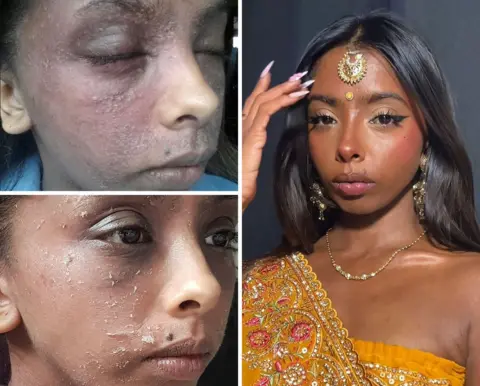
Meanwhile, Henry, after three years of profound suffering, has finally received an official TSW diagnosis in August 2025 and is now under the care of a TSW specialist at the Royal London Hospital. He is undergoing treatment with immunosuppressants and is finally beginning to feel "normal again." Karishma, who once struggled to recognize herself, has become a prominent advocate, appearing in marketing campaigns and on social media and billboards to raise awareness about debilitating skin conditions. "I’ve spoken to thousands of people around the world about their skin condition," she shares. "I don’t want anyone to go through what I have gone through." Bethany, after years of struggle, is now taking biologics, a cutting-edge class of medication targeting inflammation. She has recently secured her first job and feels she is finally reclaiming her "life." She admits that in the past, she would have been tempted to lash out at anyone who told her to "just stop scratching." Now, her message to others experiencing similar suffering is unequivocal: "Do not feel guilty, do not feel like it’s your fault – and fight to be believed."



 George Anjay
 Nakalama John
 atisusanti
 Ramos Leo
 Nana Banana