Nana Banana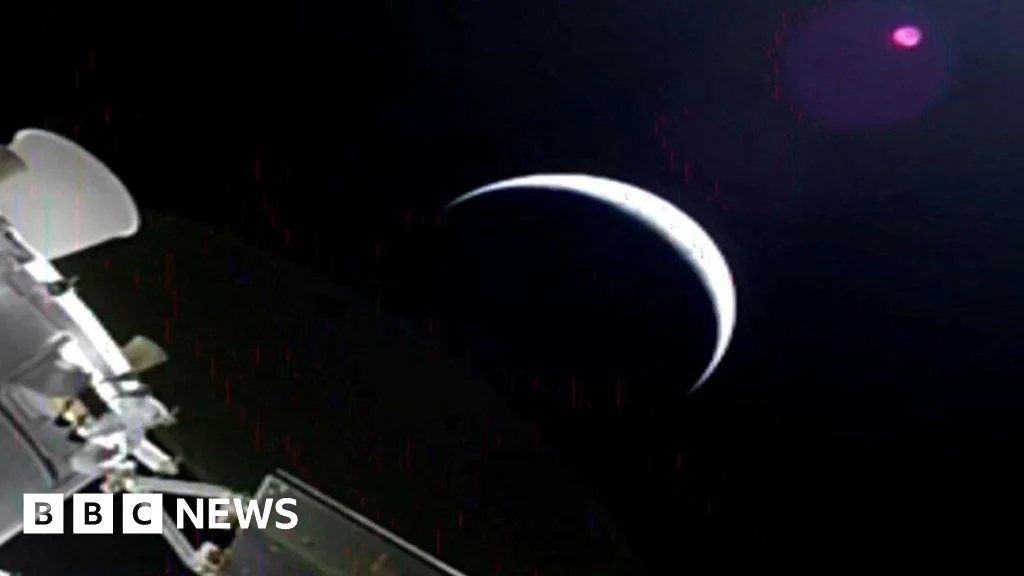
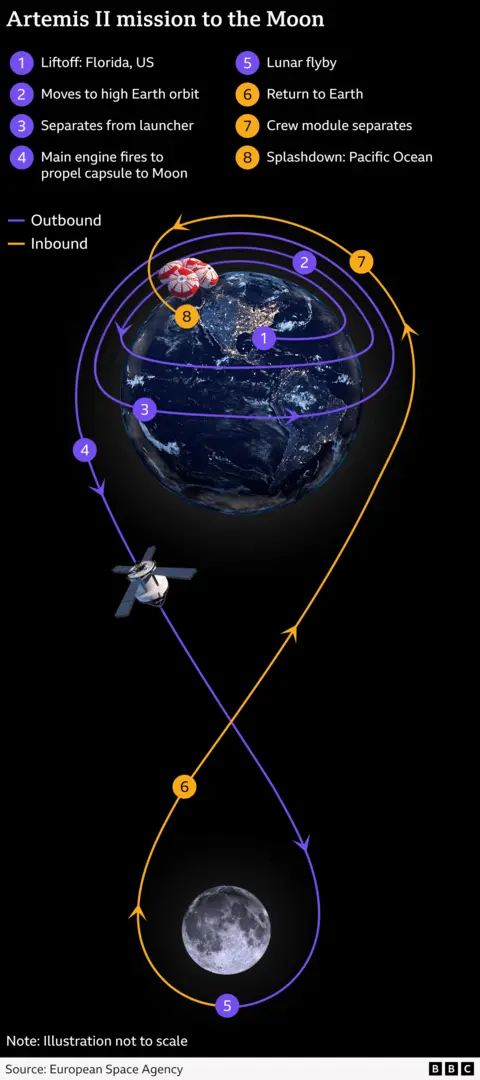
This pivotal moment represents the first time in over half a century, since Apollo 17 in 1972, that humans have ventured beyond low Earth orbit. The Artemis II mission is now set on an expansive, looping trajectory that will carry its intrepid crew around the far side of the Moon and ultimately back to Earth. As the Orion capsule continues its journey, the familiar blue marble of Earth is steadily receding, shrinking into a distant disc against the vast canvas of space, a sight that has historically inspired awe and a profound sense of perspective.
Jeremy Hansen, who is making history as the first non-American to journey to the Moon, articulated the profound collective effort behind this endeavor. Addressing NASA’s mission control, he expressed that the crew "firmly felt the power" of every individual who has persevered and dedicated countless hours to bring this mission to fruition. "Humanity has once again shown what we are capable of," Hansen declared, adding, "It’s your hopes for the future that carry us now on this journey around the Moon." His words resonated with the global aspirations that underpin the Artemis program, aiming to establish a sustainable human presence on the Moon and pave the way for future missions to Mars.
Prior to the TLI burn, the Orion spacecraft spent approximately a full day in a carefully calibrated "high Earth orbit." This crucial period was dedicated to meticulous in-space systems checks, during which engineers rigorously assessed the spacecraft’s engines, navigation systems, and vital life-support equipment. Looping around our planet, the crew and ground control ensured every component was operating optimally, verifying Orion’s readiness for the immense journey ahead. Only after receiving final approval from mission control was the command given for the engine burn to commence – the mission’s ultimate, decisive push towards the Moon.
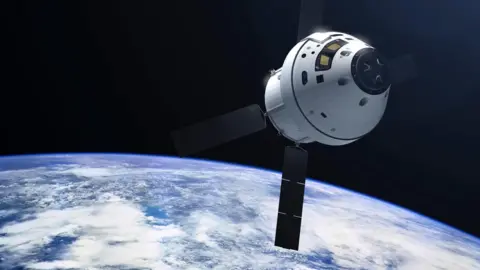
The powerful single main engine of the European Service Module (ESM), located behind the crew’s seats, ignited with a long, steady thrust. This burst of propulsion added thousands of kilometers per hour to Orion’s velocity, accelerating it beyond Earth’s gravitational embrace and onto its lunar transfer trajectory. The ESM, a vital contribution from the European Space Agency, provides propulsion, power, air, and water for the astronauts, showcasing international collaboration at the heart of modern space exploration.
The TLI maneuver is designed to propel the spacecraft on a journey expected to take the crew farther from Earth than any human has ever traveled before. The mission profile anticipates that Orion will reach a maximum distance of more than 4,700 miles (7,600 km) beyond the far side of the Moon before the celestial mechanics of gravity gently swing them back towards their home planet. NASA estimates that this remarkable achievement could potentially surpass the previous record set by the Apollo 13 mission in 1970, depending on the precise timing and trajectory executed during this complex orbital ballet.
Crucially, the TLI is not an irreversible commitment. Even after this significant burn towards the Moon, mission controllers retain the ability to perform an "abort-to-Earth" maneuver. This contingency, akin to an emergency handbrake turn in space, could bring the crew safely back to Earth if a serious anomaly were to occur. In the initial 36 hours post-TLI, a direct U-turn represents the fastest path home. Beyond that window, it can often be equally swift, and sometimes simpler, to maintain course around the Moon and utilize its gravity to slingshot back to Earth. Howard Hu, Orion program manager, emphasized the extensive preparation for such scenarios before the launch, stating that the team had "run hundreds of thousands of [simulations] to ensure that we are able to get the crew home safely." His beaming smile at a post-burn briefing, as he told reporters, "What a great couple of days!" underscored the confidence and relief following the mission’s critical success.
As Orion hurtles deeper into space, the panoramic views through its windows will become progressively more breathtaking and inspirational. Earth, initially a prominent sphere, will diminish into a small, fragile blue and white marble – the iconic "pale blue dot" famously described by Carl Sagan – receding behind them. Simultaneously, the Moon, initially a bright disc, will steadily grow in prominence, transforming into a heavily cratered, detailed world that eventually fills the spacecraft’s view.
One of the mission’s unique visual spectacles is anticipated around the sixth day of the journey, as Orion cruises beyond the Moon. The astronauts will be treated to the rare sight of a total solar eclipse. The Moon will precisely position itself directly in front of the Sun, completely obscuring its brilliant face. This will reveal the Sun’s normally concealed, ethereal shimmering corona, a crown of plasma stretching millions of miles into space, all while Earth hangs majestically off to one side in the background. Such a vista is a privilege granted to only a select few in human history.
The Artemis II crew comprises a diverse and highly experienced group of astronauts: Commander Reid Wiseman, Pilot Victor Glover, and Mission Specialists Christina Koch and Jeremy Hansen. Wiseman, a former International Space Station (ISS) commander, brings a wealth of orbital experience. Glover is making history as the first person of color to journey to the Moon, while Koch is set to become the first woman to undertake a lunar voyage, building on her record-breaking long-duration spaceflight on the ISS. Hansen’s participation as the first Canadian to travel to the Moon further highlights the international scope and collaborative spirit of the Artemis program. Their mission is not merely a flyby; it is a critical test flight designed to validate Orion’s systems, life support, communication networks, and navigation capabilities in the harsh environment of deep space, preparing the way for Artemis III, which aims to land humans on the lunar surface once more.
Space missions often come with their own specialized lexicon, and "TLI" has now joined the ranks of astro-jargon familiar to those closely following this mission. This successful Translunar Injection burn, a testament to decades of scientific and engineering ingenuity, will hopefully be remembered not just as a technical achievement, but as the giant push that propelled humanity one significant step closer to establishing a sustained presence on the lunar surface and realizing our ambitious dreams of venturing further into the cosmos. The journey of Artemis II is more than a mission; it’s a beacon of human aspiration, pushing the boundaries of what is possible and inspiring future generations to reach for the stars.




 Nakalama John
 George Anjay
 Ramos Leo
 atisusanti
 Roy Suryo