
 Nana Banana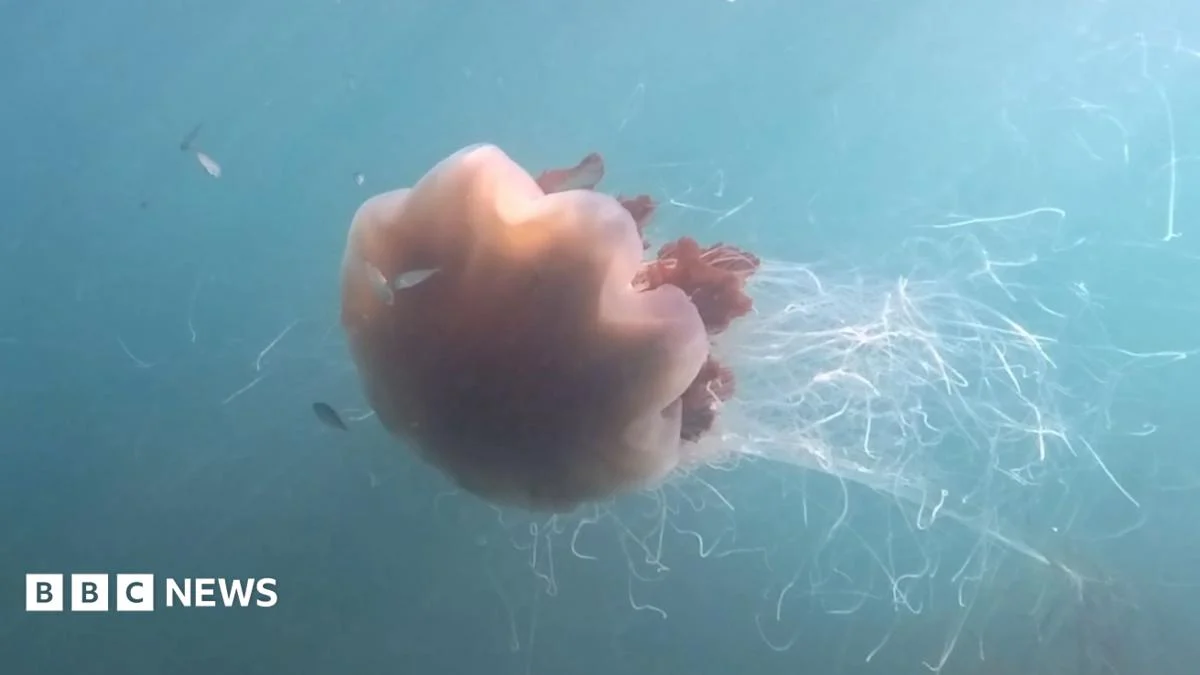
The initial sighting was subtle, a mere wisp of movement in the cerulean depths. "Three turned to 10, and then to 20. They just kept on coming," Morgan recounted, describing the bewildering moment as he began to grasp the true scale of the marine behemoth. What started as a few delicate strands quickly multiplied into a bewildering curtain of ethereal tendrils, extending far beyond the immediate vicinity of its bell. The sheer volume and reach of the tentacles were such that they went "beyond the range of visibility," disappearing into the murky distance as if belonging to an entity too vast for the human eye to fully encompass. The experience was both humbling and thrilling, a stark reminder of the ocean’s capacity to surprise and astonish.
Morgan, initially assuming he had encountered a particularly large compass jellyfish, a species common in UK waters and identifiable by its distinctive V-shaped markings, quickly realised his initial assessment was far from the truth. The sheer magnitude of this specimen dwarfed any compass jellyfish he had ever seen. The bell, though not fully visible in its entirety, suggested an immense body, but it was the incredible reach of its stinging apparatus that truly defied belief. "It must have been the length of a bus or small train. I couldn’t believe how big it was," he exclaimed, still processing the monumental scale of the creature. This wasn’t just a large jellyfish; it was an aquatic leviathan.
The identification soon became clear: Morgan had encountered a Lion’s Mane Jellyfish, scientifically known as Cyanea capillata. The Wildlife Trusts, a leading conservation charity, aptly describe this magnificent creature, noting that it gets its evocative name from its sprawling mass of reddish-brown tentacles that resemble a lion’s shaggy mane. They possess "all the beauty and bite of a lion," a descriptor that perfectly encapsulates their captivating appearance and potent defensive capabilities. While the bell of a Lion’s Mane Jellyfish can grow to an impressive 3 meters (9ft 8in) in diameter – making it one of the largest jellyfish by bell size – it is its extraordinary tentacles that truly set it apart. These incredibly long, fine filaments, laden with stinging cells, can extend to a staggering 30 to 36.5 metres (98ft 4in to 119ft 8in). This makes the Lion’s Mane Jellyfish not just one of the largest marine invertebrates, but also one of the longest animals on Earth, surpassing even the blue whale in linear length. To put this into perspective, its tentacles could easily span the length of a professional basketball court or several double-decker buses parked end-to-end.
Dr. Cathy Lucas, a marine biologist from the University of Southampton, affirmed the exceptional nature of Morgan’s sighting, particularly after reviewing his video footage. "The tentacles are so long and so fine you might not even see them," she explained, highlighting the deceptive nature of these ethereal appendages. This characteristic makes their true length even more astonishing, as much of their immense reach often remains invisible to the casual observer. Dr. Lucas recounted personal experiences during field work in Scotland, where divers would mysteriously get stung despite no visible jellyfish in their immediate vicinity. This phenomenon, she clarified, is due to the fragile nature of the tentacles, which can break off and drift independently in the water, remaining potent and capable of delivering a sting even when detached from the main body. "They still sting after they break off," she warned, a crucial piece of information for anyone sharing the waters with these giants.
While the sting of a Lion’s Mane Jellyfish is undoubtedly "nasty" and widely considered "the worst in the UK" in terms of pain and discomfort, Dr. Lucas reassuringly added that it is "not dangerous" to humans, at least not in the same life-threatening way as some tropical species. The sting typically results in a burning sensation, itching, skin irritation, and sometimes blistering, but serious systemic reactions are rare. Nonetheless, divers and swimmers are advised to avoid contact, and if stung, to carefully remove any remaining tentacles (preferably with gloves or tweezers) and rinse the area with vinegar or seawater, avoiding fresh water which can exacerbate the sting. The sheer number of nematocysts – the microscopic harpoon-like stinging cells – on such an extensive tentacle mass means a full encounter could be incredibly unpleasant, making Morgan’s observational distance a wise choice.
The appearance of such a colossal Lion’s Mane Jellyfish near the Pembrokeshire coast, while not entirely unprecedented, is a significant event. These magnificent creatures typically thrive in colder, northern waters of the Atlantic and Pacific oceans, preferring the chilly embrace of the Arctic and sub-Arctic seas. While they are known to venture further south, particularly during late summer and autumn when water temperatures are still relatively cool, a specimen of this magnitude is a rare sight even in their preferred habitats. Their life cycle sees them growing rapidly over the summer months, feasting on plankton and small fish, before often dying off as winter approaches. This specific timing might explain the incredible size of Morgan’s discovery, suggesting it had enjoyed a particularly successful feeding season.
Pembrokeshire itself is a designated National Park, celebrated for its pristine coastline and rich marine biodiversity. It is home to a myriad of species, from seals and porpoises to an array of fish and invertebrates. Divers and wildlife enthusiasts frequently explore its underwater realm, but even among this experienced community, a Lion’s Mane Jellyfish of this scale is considered a once-in-a-lifetime sighting. Such encounters underscore the incredible, often hidden, wonders that lie beneath the surface of our oceans and highlight the importance of preserving these delicate ecosystems.
Morgan’s footage and detailed account serve as a valuable piece of citizen science, contributing to our understanding of marine populations and distribution. As ocean temperatures fluctuate and marine ecosystems adapt, observations like these become increasingly important for scientists tracking species movements and bloom patterns. The awe-inspiring encounter near Trefin Beach not only provided Morgan with an unforgettable experience but also offered a rare glimpse into the majestic, yet often elusive, giants that inhabit our planet’s vast and mysterious oceans. It is a powerful reminder that even in well-explored coastal waters, breathtaking discoveries await, challenging our perceptions of size and the boundless beauty of the natural world.




 George Anjay
 Nakalama John
 atisusanti
 Ramos Leo
 Roy Suryo