
 Nana Banana
This pivotal finding not only rewrites the chronology of canine domestication but also illuminates the profound and enduring nature of this early partnership. According to Dr. William Marsh, a leading researcher at the Natural History Museum, the evidence suggests that the unique friendship between the very first dogs and Stone Age humans was established almost from the outset of their co-existence. "It shows that by 15,000 years ago dogs and humans already had an incredibly tight, close relationship – and this tiny jawbone, which seems like such a small thing, has helped to unlock the whole human story of how that partnership began," Dr. Marsh explained, underscoring the immense significance of the unassuming fossil in revealing deep historical truths.

The journey of dogs from wild predators to loyal companions began with their grey wolf ancestors. These opportunistic animals, driven by a combination of curiosity and the promise of easy meals, started to linger around human encampments at the twilight of the last Ice Age. Scavenging on discarded food scraps and waste, they gradually became accustomed to human presence and, over countless generations, grew progressively tamer. This initial tolerance evolved into a profoundly mutually beneficial relationship. Humans quickly recognized the latent potential of these nascent canids, leveraging their keen senses, cooperative instincts, and pack mentality for critical survival tasks such as hunting, guarding settlements against rival predators, and tracking elusive prey. This symbiotic partnership transformed the wild canids into invaluable working partners, marking the true beginning of their domestication. Over hundreds of generations of both natural selection and, increasingly, human-directed breeding, these proto-dogs underwent significant physical and behavioural changes, developing distinct characteristics such as shorter muzzles, smaller teeth, and an astonishing diversity in size and appearance, ranging from compact lapdogs to formidable guardians.
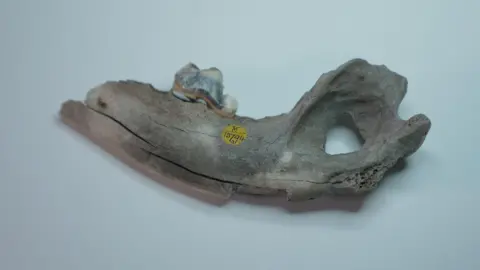
The pivotal jawbone itself was an accidental but transformative discovery during Dr. Marsh’s PhD research. The specimen had originally been excavated from Gough’s Cave in Cheddar Gorge, a site now famed for its distinctive cheese, during archaeological digs conducted in the 1920s. For nearly a century, it lay unassumingly in a museum drawer, mistakenly categorized as an unremarkable animal bone – perhaps a wolf or another wild carnivore. However, Marsh’s serendipitous encounter with an obscure research paper published a decade earlier hinted at the tantalizing possibility that the bone might, in fact, belong to a dog. Driven by this intriguing lead, he embarked on a meticulous genetic analysis of the jawbone. To his astonishment and immense delight, the results conclusively proved it was indeed from a domesticated dog. This finding instantly made it the first unambiguous genetic evidence of dogs existing thousands of years earlier than previously confirmed, shattering long-held archaeological and genetic assumptions.

Barely able to believe the profound implications of his own test results, Dr. Marsh shared his findings with his friend and scientific collaborator, Dr. Lachie Scarsbrook, from the University of Oxford and LMU Munich. Dr. Scarsbrook vividly recounted the moment of revelation: "William tells me: ‘I found dog from the early stone age,’ and I’m like, ‘No you haven’t – every other dog has been a wolf,’ but he’s super confident of it." Scarsbrook’s initial skepticism was entirely understandable, given the persistent difficulties in definitively distinguishing early dog remains from those of wolves using morphological evidence alone, a challenge that had plagued researchers for decades. "He then shows us his results, and we’re like, ‘(Gosh), this guy might have actually found a dog that far back in time," Scarsbrook added, admitting his "actual language was more colourful" than could be published, a testament to the sheer magnitude of his friend’s breakthrough. The scientific community had been waiting for such definitive evidence.
With the Gough’s Cave jawbone now confidently identified and its unique genetic signature established, it became a crucial reference point, a ‘Rosetta Stone’ for ancient canine DNA. This allowed researchers to re-examine and rigorously test specimens of a similar age from various archaeological sites across western Europe and central Anatolia, the large Asian peninsula that constitutes most of modern Turkey. Remarkably, all these previously ambiguous remains, once sitting in "no man’s land" between wolves and dogs, also turned out to be from dogs. Dr. Scarsbrook elaborated on the impact of this newfound clarity: "We’ve spent years trying to make sense of ancient samples whose DNA sits between wolves and dogs. Everything sat in no man’s land because we simply couldn’t tell where dogs truly began." He concluded, "Then this little jawbone turns up and it is the key to then identifying other ancient dogs all across Europe that had just been sitting under our noses this whole time."

Further sophisticated analysis, led by Dr. Selina Brace of the Natural History Museum, revealed even more compelling evidence of this ancient companionship. The tests not only demonstrated that these early dogs were genetically similar across vast geographical distances – strongly suggesting that their human masters had travelled across Europe with them, facilitating the spread of these domesticated animals – but also provided remarkable insights into their shared diet. "We know from their diet that they either shared fish in Turkey or the same meat and plant diet in Gough’s Cave," Dr. Brace explained. "So what this would suggest is an incredibly close relationship between humans and dogs." She passionately concluded, "And isn’t that amazing? 15,000 years ago, we see that level of companionship that we still see today. That’s a really long relationship." This dietary commonality is a powerful indicator of deep integration into human life, far beyond mere scavenging; it points to sharing resources, living as part of the same social unit, and a mutual reliance.
While previous archaeological findings had indeed hinted at the existence of small dog-like animals in Late Ice Age caves across regions like Germany, Italy, and Switzerland – some even buried alongside humans, suggesting an early bond of affection and respect – these discoveries often lacked the definitive genetic proof required for unambiguous classification. This new research, with its detailed DNA testing of the Gough’s Cave specimen, provides the first irrefutable confirmation that the animal was indeed a domesticated dog, and critically, that it was part of a widespread, early population of dogs that had already dispersed across significant portions of western Europe and Asia.
Adding another crucial layer to this evolving narrative, a separate, equally significant study published concurrently in the journal Nature sheds further light on the intricate ancestry of all modern dogs. Dr. Anders Bergström of the University of East Anglia and the Francis Crick Institute, along with his international team of colleagues, conducted extensive DNA analysis on over 200 dog and wolf remains from numerous archaeological sites across Europe and the Near East, stretching geographically from Switzerland and Sweden to Turkey and Armenia. Their comprehensive findings revealed that the diverse canine companions curled up on our sofas today all descend from a complex, dual ancestry that had already spread across much of the northern world by the close of the Ice Age. Specifically, they discovered that some of the earliest European dogs – slightly younger than the Gough’s Cave specimen but still ancient – shared a clear genetic lineage with dogs found in Siberia, East Asia, and beyond. This crucial insight indicates a shared ancestral origin, disproving previous hypotheses of a separate, distinct European domestication event that subsequently vanished without contributing to modern dog lineages. "Wherever dogs were first domesticated, they had already reached Europe by at least 14,000 years ago and they go on to contribute quite substantially to the dogs we see today," Dr. Bergström affirmed, highlighting the ancient and widespread genetic legacy of these pioneering canines.
These collective discoveries have been met with profound awe and excitement, particularly within communities dedicated to canine welfare, history, and the unique human-animal bond. Ciara Farrell, head of culture and heritage at the Royal Kennel Club, articulated the profound resonance of these findings with heartfelt sentiment. "As a dog lover, I think every dog lover knows that feeling where your dog is almost speaking to you. And that is a relationship that’s developed over many, many years and it’s unique to dogs and humans," she remarked. Her words encapsulate the enduring, almost mystical connection that these scientific revelations have now proven to be rooted in a shared history stretching back to the very dawn of human civilization. The Somerset jawbone, once an overlooked relic, now stands as a powerful testament to an ancient, profound, and enduring partnership that continues to enrich human lives today, a bond forged in the distant Ice Age and still cherished in our modern world.




 George Anjay
 Nakalama John
 atisusanti
 Ramos Leo
 Roy Suryo