
 Roy Suryo
Hundreds of General Practitioners (GPs) in England have indicated they have never refused to sign a "fit note" for patients experiencing mental health issues, according to a BBC News survey. The questionnaire, sent to over 5,000 GPs, revealed that out of 752 respondents, a significant majority – 540 – stated they have never denied a sick note request for mental health reasons. Conversely, 162 GPs reported having turned down at least one such request, while 50 preferred not to disclose their experience. The survey also highlighted considerable frustration among GPs regarding the current system, with many expressing the view that the provision of fit notes should not be a core part of their responsibilities. This sentiment is compounded by experiences of patient aggression when requests for fit notes are denied, with one GP recounting an instance where a patient refused to leave the practice without one. It is important to note that the representativeness of these respondents for all GPs nationwide remains unknown.
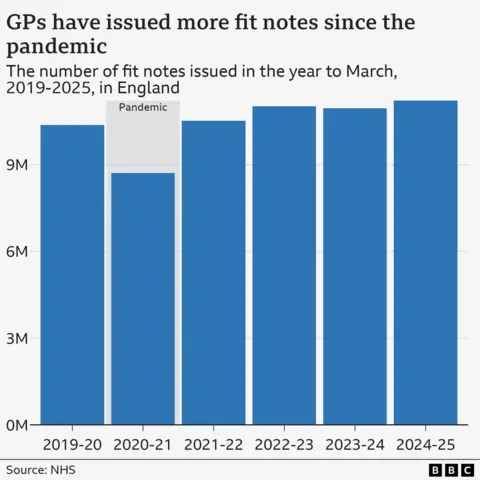
The findings emerge against a backdrop of a notable increase in the issuance of fit notes. In the most recent year for which data is available, there were nearly 850,000 more fit notes issued compared to six years prior. Fit notes are typically provided to individuals who are unwell or unable to work for more than seven consecutive days. While these notes do not necessitate specifying the exact reason for absence – with BBC analysis of NHS data indicating that 72% of fit notes do not disclose a cause – mental health and behavioural disorders are cited as the underlying reason for over 956,000 notes issued last year, significantly outpacing all other conditions.

Although GPs are the primary issuers of fit notes, other healthcare professionals, including nurses, pharmacists, physiotherapists, and occupational therapists, are also authorized to provide them. Fit notes are designed to assess how a patient’s health condition impacts their capacity to work and can be instrumental in accessing certain benefits and statutory sick pay. Patients can be deemed either "not fit for work" or "maybe fit for work" with specific workplace adjustments, though the majority of fit notes advise a complete cessation of work.
The hundreds of comments received from GPs alongside their survey responses reveal a pervasive theme: the imposition of signing fit notes is perceived as an unfair burden. One GP articulated this sentiment by stating, "It is hard to be patient’s advocate and a judge." Many expressed concern that the current system jeopardizes the vital doctor-patient relationship. One doctor lamented, "Patients come for support – not to be dismissed," while another asserted, "GPs should not be gatekeepers of fitness to work." The task has been described by some as "a dirty task," with a strong conviction that it is not their role to "police the sick note system." A common practice among these doctors is to issue fit notes for shorter durations than initially requested by patients, with some explaining that returning to work can, in fact, be beneficial for an individual’s mental well-being.
A distinct division was observed in GPs’ attitudes towards patients. While some expressed unwavering trust in their patients’ honesty, a significant number found it particularly challenging to refuse time off for mental health complaints. A common query posed was, "Who am I to say I don’t believe that someone is struggling with their mental health? It’s not like a chest infection where there is definite proof of illness." Conversely, a more cynical perspective was also present, with some GPs expressing suspicion about patients’ motives, labelling them as "not genuine" or accusing them of "milking the system." Although fit note data is not disaggregated by age, several GPs suggested that younger adults are more inclined to request time off work. One commented, "We sign off legions of young patients with anxiety and depression who are quite clearly not ill."
While some GPs stated they would only issue a fit note if it was deemed "medically appropriate," others admitted that it was "not worth the grief" or "the hassle" to dispute a patient’s request. Several pointed out that issuing a fit note was a quicker and simpler resolution than dealing with a formal complaint for refusal. Instances of aggression from patients were also reported, with one doctor stating, "They argue and fight, we end up having to give in for our own safety." Another added, "It would be insane to challenge the patient."
In the previous year, a government-commissioned review, the Keep Britain Working report, highlighted that fit notes were "often problematic." The report underscored that GPs frequently lack the necessary time or occupational health training to conduct a thorough assessment of an individual’s fitness for work. The report also emphasized the correlation between the duration of sickness absence and the likelihood of returning to work, noting that an absence of 4-6 weeks has a 96% chance of a return, which drops to 50% after a year.
The Royal College of GPs (RCGP) has acknowledged that family doctors may not always be the "most appropriate professionals" for providing sustained support to facilitate a return to work. Professor Victoria Tzortziou Brown, Chair of the RCGP, suggested that GPs should continue to approve fit notes for up to three weeks, but indicated the RCGP is open to exploring alternative arrangements for longer-term fit notes. The government has stated its recognition that the current fit note system requires reform and is actively testing new approaches. A government spokesperson commented, "We know that we need to do more to build a system that works for everyone."
The BBC understands that government officials are investigating various options, including the development of "stay in/return to work" plans in collaboration with businesses and occupational health professionals. The precise nature of these reforms, whether they will modify existing fit notes or introduce a completely new system, remains unclear. Jaguar Land Rover (JLR) is among the 60 companies engaged with officials to explore these possibilities. JLR has established six "centres of wellbeing" for its UK employees, offering a blend of preventative measures such as exercise classes and NHS health checks, alongside support for physiotherapy, counselling, and occupational health needs. Dr. Richard Peters, JLR’s Chief Medical Officer, stated that companies have a "part to play" in supporting employees with health conditions at work, adding, "It’s the right thing to do because if we have a healthier staff, then we have a more productive workforce."
However, broader concerns exist regarding the scalability of such initiatives. Small businesses are already expressing apprehension about upcoming changes to statutory sick pay, which will mandate payment from the first day of absence. Tina McKenzie of the Federation of Small Businesses warned that proposals requiring small businesses to fund occupational health advice and fit notes would exacerbate costs and introduce additional bureaucracy. Tom Pollard, Head of Policy and Campaigns at the mental health charity Mind, cautioned that any transition to an alternative system must be "approached with caution" and "built around trusting and compassionate relationships," emphasizing that "it is essential that people do not feel they are being forced to work when they don’t feel able to." Additional reporting was provided by Vicki Loader and Amy Jackson. A correction was issued on March 12th, clarifying that occupational therapists, not occupational health therapists, are able to issue fit notes.




 Nakalama John
 atisusanti
 Ramos Leo
