
 George Anjay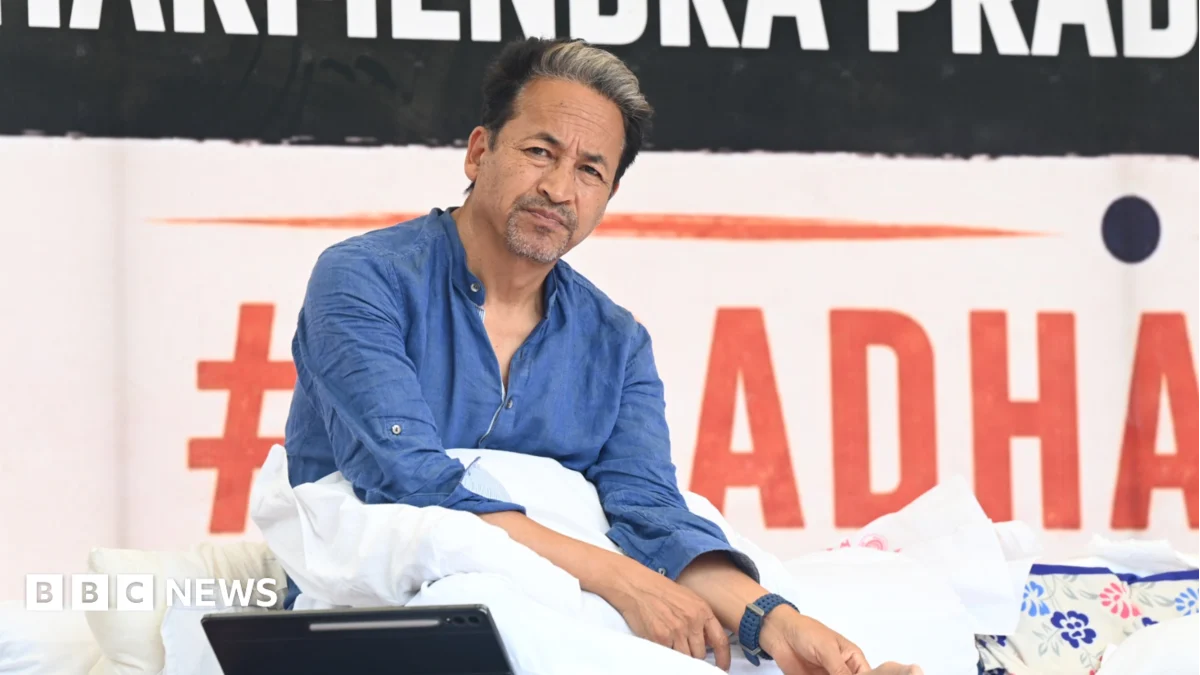
The simmering public anger over a series of high-profile exam paper leaks has intensified, presenting a significant challenge to Prime Minister Narendra Modi’s government. At the heart of this growing unrest is the unwavering hunger strike of renowned activist Sonam Wangchuk, who, after 26 days, has lost an estimated 11 kilograms but remains resolute, declaring, "I am still alive." While Wangchuk is no longer physically present at the Jantar Mantar protest site, his presence is profoundly felt, with countless placards and drawings bearing his likeness and slogans echoing his demands.
The recent violence that erupted during a protest march to Parliament has further galvanized India’s opposition and amplified public discontent. Prime Minister Modi, while not directly engaging with the protesters, made a public statement on X (formerly Twitter) on Thursday, which observers interpret as an attempt to connect with the frustrated student community. "Nothing is more important than the welfare and future of our youth," he wrote, announcing the government’s decision to establish fast-track courts to ensure swift and stringent punishment for those involved in paper leaks. He emphasized that this was part of ongoing efforts to safeguard students’ interests and warned that "Those who try to harm the future of our youth will not be spared."
However, a spokesperson for the Citizens for Justice and Peace (CJP), Ashutosh Ranka, dismissed the government’s announcement as a superficial remedy. "You are applying medicine after an injury, but our struggle asks why the injury has to happen," Ranka stated in a video message on X, underscoring the protesters’ determination to continue their agitation until their core demands are met. The CJP maintains that the fundamental questions of why paper leaks occur and who benefits from them remain unaddressed.
Before being admitted to the hospital, Wangchuk endured 21 days of his fast under Delhi’s scorching summer heat, sustaining himself solely on salt and water. On Wednesday, Medanta Hospital in Gurugram confirmed his admission to the Intensive Care Unit (ICU). A statement from the hospital detailed that he is being treated by a multidisciplinary team of doctors and is currently stable, oriented, and exhibiting vital signs within accepted parameters. All medical interventions are being administered with his informed consent.
The appeals for Wangchuk to end his hunger strike have been numerous and came from high-ranking officials. On Wednesday, CJP founder Abhijeet Dipke, along with dozens of opposition Members of Parliament, activists, and celebrities, renewed their entreaties. Union Health Minister JP Nadda had also visited Wangchuk at the hospital on Tuesday night, urging him to break his fast, join the mainstream, and guide students. Nadda conveyed the government’s openness to discussing the issues raised by Wangchuk.
Despite these appeals, Wangchuk has remained steadfast in his resolve. In a three-minute video statement from his hospital bed on Wednesday night, he expressed his desire to end the fast, acknowledging the importance of his work. However, he reiterated his condition: an assurance from the government that no force or retaliatory action would be used against students. "If I receive that assurance soon, I will end my hunger strike today. If not, I will unfortunately have to continue," he stated.
Wangchuk also took the opportunity to "salute all the students who conducted themselves with remarkable restraint" during the crackdown on the CJP protest. He expressed his dismay at the "brutal action against them" and stated that witnessing their resilience in the face of "lathi-charge" (baton-charging) was a significant factor in his decision to continue his hunger strike.
While Wangchuk’s statement and an earlier letter to federal ministers he met on Tuesday omitted any direct mention of Union Education Minister Dharmendra Pradhan’s resignation, the CJP insisted this demand remained non-negotiable. "The peaceful protest at Jantar Mantar will continue until Pradhan resigns," Dipke declared to his supporters. "We will not let Sonam sir’s hunger strike go in vain. We will not let the brutal assault on students go in vain."
Students have placed the blame for the repeated leaks of major public examinations, most recently the National Eligibility cum Entrance Test (NEET) for medical admissions, squarely on Pradhan. They argue that he must take moral responsibility and step down. Pradhan, however, has remained silent on the resignation demand, opting instead to criticize the opposition Congress party for "shamelessly [exploiting] students as political tools to manufacture disruption."
The escalating tensions culminated on Monday when tens of thousands of people participated in a march through central Delhi, organized by the CJP, to mark the opening of Parliament’s monsoon session. The protest was met with a forceful police response, resulting in injuries to scores of demonstrators. Opposition parties and human rights groups have vehemently condemned the police action. Official figures reported 60 protesters and 118 police personnel injured, while the CJP claimed the number of injured demonstrators was as high as 150. By Thursday, reports indicated that at least 300 individuals, including both protesters and police, had been admitted to hospitals, with a majority being demonstrators.
Human Rights Watch issued a strong statement, accusing the security forces of using "excessive force" against the protesters in Delhi. The organization urged the Modi administration to "promptly and impartially investigate unnecessary and excessive use of force, allow peaceful protests and stop suspending mobile internet services, which put people at added risk." BBC reporters on the ground on Monday witnessed police employing batons and tear gas, and video footage corroborated these accounts.
While the police arrested protesters, most have since been released on bail. Authorities also dismantled the stage and makeshift tents at the Jantar Mantar protest site. Despite these actions, demonstrators have refused to disperse, maintaining a round-the-clock sit-in under a heavy deployment of police and paramilitary forces. In what protesters allege is a tactic to prevent people from reaching Jantar Mantar, authorities closed 16 metro stations in central Delhi from Wednesday onwards, without providing a clear explanation.
The ongoing hunger strike by Sonam Wangchuk, the sustained protest at Jantar Mantar, and the widespread public outcry over exam paper leaks have collectively painted a picture of deep-seated public frustration with the current administration’s handling of critical issues affecting the youth and the integrity of public examinations. The government’s response, while acknowledging the problem of paper leaks, has been met with skepticism by activists and protesters who demand more fundamental systemic changes and accountability. The steadfastness of Wangchuk, even in the face of declining health, serves as a potent symbol of this ongoing struggle for justice and reform.



 Roy Suryo

 Nakalama John
 atisusanti
 Ramos Leo
