Ramos Leo
Prime Minister Sir Keir Starmer has affirmed that the United Kingdom is actively collaborating with international partners to formulate a "viable, collective plan" aimed at restoring full navigation through the critical Strait of Hormuz. His statement comes amidst heightened geopolitical tensions in the Gulf region, following an appeal from US President Donald Trump for Britain and other nations to deploy naval assets to safeguard the vital shipping lane, which is indispensable for global oil supplies.
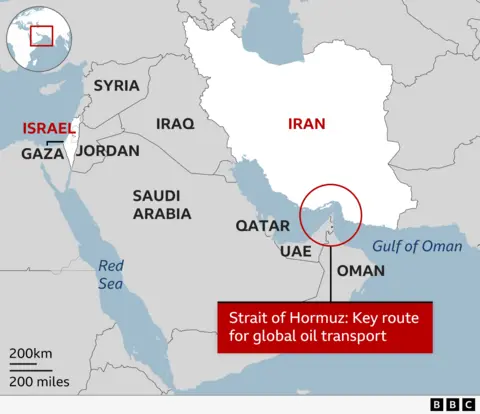
The Strait of Hormuz, a narrow and strategically paramount waterway, separates Iran from Oman and the United Arab Emirates. Its geographical significance cannot be overstated, as approximately one-fifth of the world’s total petroleum consumption, and a substantial portion of global liquefied natural gas, transits through this chokepoint daily. The effective closure of this channel to oil tankers, a direct consequence of the ongoing conflict with Iran, has already sent shockwaves through international markets, manifesting in surging oil prices and raising profound concerns about global energy security. Iran has issued explicit threats to target any vessels perceived as affiliated with the United States, while the presence of sea mines further compounds the maritime hazards, rendering the strait a perilous zone for commercial shipping.
During a recent news conference, Sir Keir acknowledged the existing deployment of UK minehunters in the region, a testament to Britain’s long-standing naval presence and commitment to maritime security. However, he clarified that no definitive decision had yet been reached regarding the specific scope or nature of additional actions. A cornerstone of his foreign policy approach, Sir Keir emphatically stressed that he would not permit the United Kingdom to be inadvertently drawn into "the wider war" in the Middle East, a stance that has defined his leadership throughout the current crisis.
The Prime Minister articulated the gravity of the situation, stating, "Ultimately, we have to reopen the Strait of Hormuz to ensure stability on the market. That is not a simple task." He elaborated on the comprehensive diplomatic efforts underway, involving close coordination with a broad spectrum of allies, including European partners, the United States, and key Gulf countries. The objective, he underscored, is to forge a consensus-driven, multilateral strategy that can "restore the freedom of navigation in the region as quickly as possible and ease economic impact." He insisted that any intervention must be agreed upon "by as many partners as possible," highlighting a preference for broad international legitimacy and burden-sharing rather than unilateral action.
The economic ramifications of the Strait’s closure are particularly acute for consumers reliant on oil-based fuels. Unlike households in the UK that use gas and electricity for heating and hot water, whose prices are subject to regulatory caps by Ofgem until the end of June, those dependent on oil are not afforded the same protection, leaving them directly exposed to volatile global price fluctuations.
Sir Keir’s measured approach has been a defining feature of his premiership during this conflict. He had previously drawn criticism, particularly from President Trump, for his initial refusal to grant the US permission to utilize UK military bases for offensive strikes against Iran. This decision underscored his commitment to prevent the UK from being a primary belligerent in a conflict he viewed as escalating dangerously. However, in a demonstration of conditional support for allied defence, he subsequently authorized the use of these bases for defensive operations against potential Iranian missile strikes, carefully delineating the parameters of UK involvement.
Defending his earlier, cautious stance, Sir Keir remarked that others might have "rushed the UK headlong into this war without the full picture of what they were sending our forces into and without a plan to get us out." He asserted, "My leadership is about standing firm for the British interest. No matter the pressure," a clear indication of his resolve to prioritize national interests and strategic prudence over external demands for immediate military escalation. This position had previously drawn sharp criticism from domestic political rivals, including the Conservative Party and Reform UK, who had voiced concerns about the perceived hesitancy to support US offensive operations at the outset of the conflict.
Acknowledging the inherent unpredictability of the crisis, the Prime Minister conceded that the future trajectory, both in terms of the conflict’s resolution and its broader economic fallout, remained uncertain even six months ahead. Nevertheless, he reaffirmed his unwavering priority: "de-escalate" the situation and find a peaceful, lasting solution.
The international community’s response to President Trump’s call for naval assistance has been varied. While Sir Keir stressed that any joint action would be an "alliance of partners" rather than a formal Nato mission – a point reiterated by other European leaders – the US president has explicitly urged the UK, China, France, Japan, and South Korea to contribute ships to secure the route. Sir Keir, when pressed on whether he was implicitly rejecting Trump’s demand for the Royal Navy’s commitment, maintained that the UK was "looking through the options" while highlighting the existing minehunting capabilities already deployed in the region. He reaffirmed the strength of the UK-US relationship as one of "strong allies" but reiterated his prerogative to "act in what I consider to be the best interests of Britain."
Germany, a significant European power, has firmly distanced itself from any military involvement. A German government spokesman clarified that the conflict "has nothing to do with Nato," emphasizing that the alliance is fundamentally defensive. Defence Minister Boris Pistorius was even more explicit, stating there would be "no military participation" from Germany, although Berlin remained prepared to support diplomatic initiatives aimed at protecting the strait. Pistorius critically questioned the efficacy of such a deployment, asking, "What does Donald Trump expect from a handful of European frigates in the Strait of Hormuz that the mighty US navy cannot manage alone?" This sentiment was echoed by Gen Sir Nick Carter, former head of the British military, who underscored Nato’s defensive charter, asserting it "was not an alliance that was designed for one of the allies to go on a war of choice and then oblige everybody else to follow."
Meanwhile, EU foreign ministers are currently convened to deliberate on strategies to safeguard the channel. Kaja Kallas, the bloc’s foreign policy chief, suggested that one pragmatic option could involve amending the mandate of the EU’s existing naval mission in the Red Sea. She posited that such an adaptation would represent the "fastest" and most efficient method to bolster security in the broader region, leveraging existing infrastructure and experience.
Domestically, the Prime Minister faces scrutiny from the opposition. Conservative leader Kemi Badenoch expressed her concerns, stating, "It is not clear the prime minister has been involved in the planning process. All of our allies seem to be worried about how slow he is." She further added, "I’m worried that he’s not deep enough in conversations with the US. But before we start sending ships out [to the Strait of Hormuz], we need to know what the plan is," calling for greater transparency and strategic clarity. The Liberal Democrats, another prominent opposition party, have taken a distinct stance, advocating that the UK should refrain from sending ships to secure the strait, arguing instead that the focus should remain exclusively on de-escalating the broader conflict with Iran.
The intricate geopolitical landscape surrounding the Strait of Hormuz presents a formidable challenge for Sir Keir Starmer’s government. Balancing the imperative of maintaining international maritime security, upholding alliances, managing domestic political pressures, and steadfastly pursuing de-escalation in a volatile region demands a nuanced and strategic approach. The UK’s commitment to a collective, viable plan underscores its intent to navigate this crisis through multilateral diplomacy and carefully considered action, rather than precipitous military engagement.



 Roy Suryo
 Nakalama John
 atisusanti