
 Nana Banana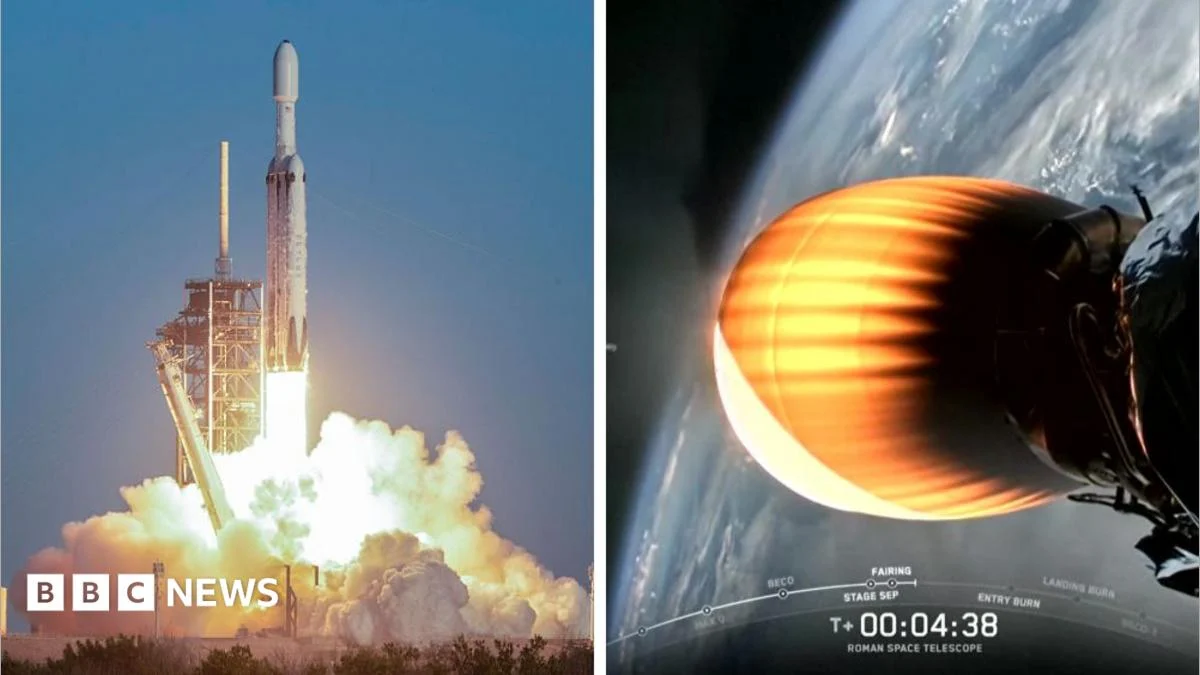
"What a glorious dawn launch," Jackie Townsend, a project manager on Nasa’s Roman telescope, exclaimed at the news conference following liftoff. Her words captured the palpable excitement and relief among the teams who had dedicated years to bringing this mission to fruition. "The ride was magnificent. It put us right where we wanted to be." Indeed, the launch was flawless, with the Falcon 9 delivering the Roman telescope precisely into its intended trajectory, a critical first step for its long journey and operational success. Approximately 30 minutes after launch, Roman gracefully separated from its second stage and began its independent voyage towards its ultimate orbital destination, a million miles away from Earth.
Astronomer Jenifer Millard elaborated on the telescope’s unique positioning, explaining that Roman will orbit the Sun at the Earth-Sun L2 (Lagrange Point 2) – a gravitationally stable point four times further from Earth than the Moon. This specific location is meticulously chosen for infrared space cameras, which are designed to detect what Millard aptly describes as "heat light." Operating at L2 is paramount to the telescope’s mission because it provides an exceptionally cold and stable environment, crucial for the highly sensitive infrared instruments. From this vantage point, Roman will be shielded from the significant infrared interference emitted by the warm Earth and Moon, allowing its detectors to capture the faint infrared signals from the distant Universe without obstruction.
The Nancy Grace Roman Space Telescope is poised to complement and extend the capabilities of its distinguished predecessors, each of which has carved out its own legacy in cosmic exploration. Nasa’s James Webb Space Telescope (JWST), launched in 2021, also operates from the L2 point, excelling in deep-field infrared observations with unparalleled sensitivity. However, Roman’s primary differentiator is its expansive field of view, which is 100 to 200 times larger than Webb’s. While Webb provides highly detailed, narrow-field views of specific targets, Roman is designed for crisp, sweeping surveys, making it an ideal instrument for mapping vast swathes of the cosmos and discovering rare phenomena across broad areas. In contrast, Nasa’s iconic Hubble Space Telescope, launched in 1990, orbits at about 300 miles above Earth’s surface and primarily observes in visible and ultraviolet light, offering stunning close-up images of galaxies and nebulae, but with a more limited infrared capability and field of view compared to its younger counterparts.
While Roman will gaze outward into the deepest reaches of the Universe, Millard highlighted that scientists are equally anticipating its ability to discover thousands of new exoplanets within our own Milky Way galaxy. The telescope’s primary method for exoplanet detection will be gravitational microlensing, a technique where the gravity of a foreground star and its potential planets temporarily magnifies the light from a background star. This method is particularly effective at finding exoplanets that are typically difficult to detect by other means, such as those that are far from their host stars or free-floating planets.
Nasa articulates Roman’s ambitious scientific agenda: its "crisp, sweeping surveys will help scientists investigate dark energy and dark matter, discover and characterise exoplanets, map billions of galaxies, study black holes, and explore objects from our own solar system to the edge of the observable Universe." The mission is fundamentally about addressing the most pressing questions in cosmology and astrophysics.
Dark matter and dark energy represent two of the Universe’s most profound mysteries. Dark matter, an invisible substance that interacts gravitationally but not electromagnetically, acts as a kind of cosmic glue, holding galaxies and galaxy clusters together. Its presence is inferred from its gravitational effects on visible matter. Dark energy, conversely, is believed to be a repulsive force that is accelerating the expansion of the Universe. Together, these enigmatic components are thought to constitute approximately 95% of the Universe’s total mass-energy content, yet their true nature remains unknown. Roman will tackle these mysteries through multiple approaches, including wide-field surveys of Type Ia supernovae (standard candles for measuring cosmic distances), weak gravitational lensing (measuring the subtle distortions of distant galaxy shapes caused by intervening mass), and mapping the large-scale distribution of galaxies across cosmic time. By observing how these structures have evolved, scientists hope to discern the properties of dark energy and dark matter.
"One of our main goals at Nasa is answering the question: are we alone in the Universe?" a Nasa spokesperson named Fox emphasized at the Sunday morning news conference. "With Roman, we are going to make this giant leap forward… that is going to allow us to look at these distant, distant worlds and start to really resolve the atmosphere around them to let us know: could they be habitable?" Roman’s wide-field infrared vision will be instrumental in identifying a vast population of exoplanets, many of which may reside in the habitable zones of their stars. Follow-up observations, potentially by Webb, could then analyze their atmospheric compositions for biomarkers, bringing us closer to answering that fundamental question.
Millard further explained that, through the extensive work of telescopes like Roman, scientists are hoping to create "enormous cosmic maps" of the Universe at various stages of its evolution. "They’ll be almost like an onion, so you can peel back layer upon layer… and see how the distribution of galaxies changes through cosmic time," she illustrated. This cosmic cartography will allow astronomers to reconstruct the Universe’s history, tracing the formation and evolution of galaxies, clusters, and the cosmic web itself. By observing billions of galaxies stretching back billions of years, Roman will provide unprecedented statistical power to test cosmological models and refine our understanding of how the Universe came to be the way it is today. "What we want to do is use this distribution to try and figure out dark matter and dark energy because we know they exist, we see their effects, but what they are is a real mystery," Millard concluded, underscoring the pivotal role the Roman Space Telescope will play in pushing the boundaries of human knowledge. Its launch marks a monumental step forward in our quest to understand the vast and mysterious cosmos.




 George Anjay
 Nakalama John
 atisusanti
 Ramos Leo
 Roy Suryo