Nana Banana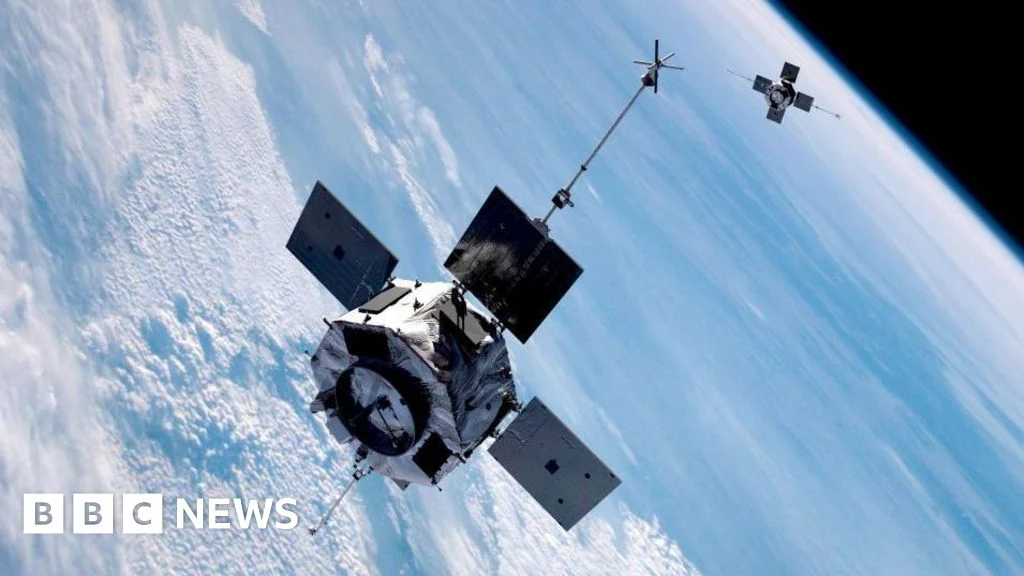
After nearly 12 years traversing the Earth’s formidable radiation belts, one of NASA’s pioneering Van Allen Probes, designated Van Allen Probe A, has completed its mission in spectacular fashion by re-entering Earth’s atmosphere. The spacecraft, a robust sentinel weighing over 1,300lb (approximately 600kg), made its fiery descent over the Eastern Pacific region, confirmed by the US Space Force on Wednesday at approximately 06:37 EDT (10:37 GMT). While the re-entry occurred roughly 12 hours later than initial predictions, it remained well within the expected margin of error for such complex orbital mechanics.
Launched in August 2012 as part of the Radiation Belt Storm Probes (RBSP) mission, the Van Allen Probes were a dual-spacecraft initiative designed to unlock the mysteries of Earth’s two gargantuan belts of energetic particles, named the Van Allen belts after their discoverer, Dr. James Van Allen. These belts are dynamic regions of space populated by high-energy electrons and protons trapped by Earth’s magnetic field, constantly fluctuating in response to solar activity and geomagnetic storms. They play a crucial role in shielding our planet from the harsher aspects of space weather, but simultaneously pose significant hazards to satellites, spacecraft, and human spaceflight.
The mission, initially planned for a two-year operational lifespan, defied expectations, ultimately extending to almost seven years of groundbreaking data collection. Operating in an extremely harsh radiation environment, the probes were engineered to withstand intense bombardment from charged particles, enabling them to make unprecedented direct measurements within these hazardous regions. Their instruments provided a comprehensive view of the composition, distribution, and dynamics of the particles within the belts, offering critical insights into how these particles are accelerated to relativistic speeds and subsequently lost from the belts.
During its extended operational phase from 2012 to 2019, Van Allen Probe A, along with its twin, Van Allen Probe B, orbited Earth in highly elliptical paths, repeatedly passing through both the inner and outer radiation belts. This orbital strategy allowed them to observe the belts across a wide range of altitudes and latitudes, capturing how they responded to varying solar conditions, from quiet periods to intense solar flares and coronal mass ejections. The data streamed back to Earth by the probes revolutionized our understanding of space weather, a field vital for protecting our increasingly space-dependent infrastructure.
One of the mission’s most significant discoveries was the confirmation and detailed study of a transient third radiation belt. This ephemeral belt, observed forming and then dissipating during periods of intense solar activity, challenged existing models and provided critical data on the complex interplay between solar wind, Earth’s magnetic field, and the creation of new particle populations. Scientists learned that this third belt could appear rapidly, persist for weeks, and then vanish, revealing a previously unseen level of dynamism within Earth’s magnetosphere. Other key findings included understanding the role of various plasma waves in accelerating and scattering particles, and how the belts can be depleted or replenished during geomagnetic storms. These insights are instrumental in improving space weather forecasts, which in turn help safeguard critical satellite systems—from communications and navigation to weather monitoring—and protect astronauts on future deep-space missions.

The end of the mission for the Van Allen Probes came not from failure, but from a planned and responsible conclusion of operations. By 2019, both spacecraft had depleted their hydrazine fuel reserves, rendering them unable to orient themselves effectively towards the Sun to power their systems or maintain stable orbits. Recognizing the importance of mitigating space debris, NASA initiated a controlled deorbiting strategy. This involved performing a series of maneuvers to lower the probes’ perigee (the lowest point of their orbit) to ensure they would eventually re-enter Earth’s atmosphere within a reasonable timeframe. This proactive approach prevents defunct spacecraft from becoming long-term hazards in Earth’s crowded orbital environment.
The re-entry itself was a natural consequence of the spacecraft’s interaction with the extremely tenuous upper layers of Earth’s atmosphere. As Van Allen Probe A gradually lost altitude, atmospheric drag increased, heating the spacecraft’s exterior to extreme temperatures. Most of the probe, constructed primarily from aluminum and other common spacecraft materials, was expected to incinerate during this fiery plunge, fragmenting into smaller pieces that would burn up completely before reaching the surface. However, some denser or more heat-resistant components, such as titanium or stainless steel elements, could potentially have survived the intense re-entry heating.
Regarding the safety implications for those on Earth, NASA characterized the risk as "low," estimating a one in 4,200 chance of a surviving piece of the probe causing harm to a person. To put this into perspective, the likelihood of being struck by lightning is significantly higher, around 1 in 15,300 over an 80-year lifespan, and the chance of being hit by a meteorite is even lower. This calculated risk underscores NASA’s rigorous safety protocols and the vast, predominantly unpopulated nature of Earth’s surface, particularly over oceanic regions like the Eastern Pacific. Predictions for re-entry events are inherently complex, influenced by subtle variations in solar activity which can expand or contract Earth’s upper atmosphere, thus altering the drag on orbiting objects. This explains the slight deviation from the initial predicted re-entry time for Van Allen Probe A.
While Van Allen Probe A has concluded its journey, its twin, Van Allen Probe B, continues its slow descent. Due to slightly different orbital parameters and accumulated atmospheric drag over its lifetime, Probe B is not expected to re-enter Earth’s atmosphere before 2030, offering a decade-long window for its eventual, similarly controlled demise.
The Van Allen Probes mission stands as a testament to NASA’s commitment to scientific discovery and responsible space stewardship. Its legacy includes not only a wealth of groundbreaking data that continues to be analyzed by scientists worldwide but also a blueprint for designing robust spacecraft capable of operating in extreme environments and a model for the safe and planned disposal of end-of-life assets. The insights gained from Van Allen Probe A and B continue to inform the design of future spacecraft, improve space weather forecasting, and enhance our fundamental understanding of the dynamic space environment that surrounds our home planet.


 George Anjay
 Ramos Leo
 Roy Suryo