
 Nana Banana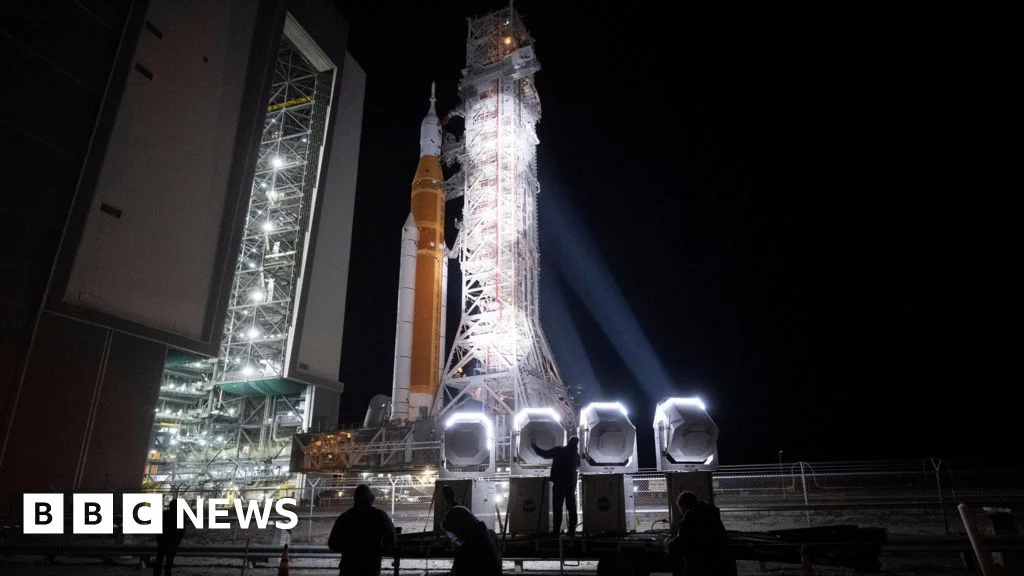
This significant move follows an earlier setback in March when a problem with the rocket’s vital helium system necessitated the abandonment of a planned launch attempt and the complex return of the entire vehicle indoors for comprehensive repairs. Engineers at NASA have now confirmed that the elusive issue has been successfully rectified. Their hope is that a rigorous series of final tests conducted directly at the launch pad will conclusively affirm the rocket’s readiness for an early April launch window, marking a pivotal step in humanity’s return to lunar exploration.
Just after nightfall, the towering SLS, a monumental symbol of modern space exploration, majestically emerged from the Vehicle Assembly Building (VAB) – one of the largest buildings by volume in the entire world. It then began its slow, deliberate crawl towards the Atlantic coast, a journey steeped in history and engineering marvel. Standing taller than London’s Big Ben clock tower, nearing an imposing 100 meters, the fully stacked rocket and its mobile launch platform together weigh an astounding 5,000 tonnes. This immense load is meticulously carried by Crawler-Transporter 2, a legendary, low-slung, tank-like vehicle equipped with massive caterpillar tracks. NASA originally built these robust crawlers in 1965 specifically to transport the mighty Saturn V Moon rockets to their launch pads during the Apollo program, a testament to their enduring design and capability.
The Crawler-Transporter 2’s maximum speed is a mere 1 mile per hour (1.6 km/h), and it proceeds even more slowly when navigating bends or ascending the gentle ramp leading to the launch pad. Consequently, the four-mile journey from the VAB to Pad 39B can extend for up to 12 hours, an incredible display of patience and precision engineering. This snail’s pace is not accidental; it is a critical operational decision. Much like carrying a priceless Ming vase, the slow, gentle motion is meticulously engineered to minimize stresses and vibrations on the multi-billion-dollar rocket and its towering launch infrastructure. The deliberate speed also affords the flight teams the optimal opportunity to detect and halt any unwelcome movement or anomaly in what is effectively a mobile skyscraper, ensuring the integrity and safety of the entire system.
Upon the rocket’s arrival and secure positioning at the launch pad, NASA engineers will dedicate several days to an intensive verification process. This includes meticulously checking that the repairs carried out within the VAB have functioned precisely as intended and that no components or systems have shifted or been compromised during the slow, arduous journey outdoors. They will re-establish the crucial electrical, data, and fluid connections between the launch tower and the vehicle, and then proceed with vital pressure tests on the helium system – the very component that caused the earlier problem and subsequent rollback.
Furthermore, controllers will conduct comprehensive rehearsals of critical countdown procedures. These rehearsals involve sending commands through the identical computers and networks that will be utilized on the actual launch day, simulating every step of the pre-launch sequence. However, during these rehearsals, the rocket’s massive propellant tanks will not be filled with cryogenic fuel, making it a "dry" run. Once these exhaustive tests are successfully completed and all data thoroughly analyzed, NASA’s mission management team will convene a few days prior to the earliest launch opportunity, currently set for April 1st. This crucial meeting will involve a meticulous review of all collected data and a final decision on whether to proceed with the launch.
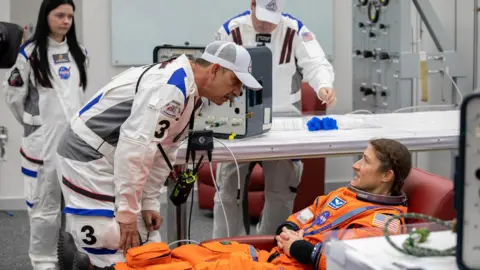
The esteemed Artemis II crew – comprising Commander Reid Wiseman, Pilot Victor Glover, Mission Specialist Christina Koch, and Canadian Space Agency Mission Specialist Jeremy Hansen – has already entered pre-flight quarantine, a standard procedure to ensure their health and safety before spaceflight. They will travel to Florida closer to the launch date to participate in various final rehearsals, including critical suiting-up procedures and traveling to the pad for ingress simulations. NASA is currently targeting specific launch opportunities in the first week of April for this landmark ten-day mission, which will see the Orion spacecraft loop around the far side of the Moon, pushing further into deep space than any human mission in over half a century, before executing a precise return to Earth.
This marks the second instance the Artemis II rocket has embarked on the journey to the pad. In March, NASA was compelled to roll it back to the assembly building after an unexpected interruption in the flow of helium to the rocket’s upper stage was detected during a crucial fuelling test. Helium plays a vital role in rocket operations; it is used to pressurize propellant tanks, ensuring the steady and efficient flow of fuel and oxidizer to the engines, and also for purging lines to prevent blockages or contamination. Any fault in this intricate system could significantly compromise the performance of the upper stage engine, jeopardize the safe draining of the highly volatile fuel, and ultimately lead to a mission abort.
Rather than attempting to diagnose and fix the complex issue while the rocket stood exposed on the launch pad, managers wisely opted to stand down from the planned launch window. This strategic decision allowed for the return of the SLS to the VAB, providing engineers with full, unhindered access to the problem area. This approach mitigated risks and facilitated a more thorough and controlled investigation and repair process. Inside the cavernous VAB, specialized work platforms were raised around the upper stage, enabling expert technicians to meticulously access and inspect the valves, seals, and intricate plumbing within the helium circuit. Engineers systematically replaced suspect components, including critical batteries in several key systems, and then rigorously repeated their diagnostic tests to conclusively confirm that the fault had been cleared and the system was operating nominally.
Following a comprehensive review of the detailed repair data and subsequent test results, NASA managers officially signed off on the second rollout and the commencement of the next critical phase of checks, which are now being conducted at the pad. If these final tests are completed without incident, Artemis II will proudly become the first crewed mission in the ambitious Artemis program. This foundational flight will pave the way for Artemis III, a subsequent crewed test flight currently scheduled for 2027, which aims to see astronauts set foot on the Moon’s surface for the first time since 1972. Beyond that, Artemis IV is planned for 2028, further expanding humanity’s lunar presence and ultimately serving as a crucial stepping stone for future deep-space exploration, including missions to Mars.
For the initial launch opportunity of Artemis II, NASA is precisely targeting 18:24 Eastern Daylight Time on April 1st, which translates to 23:24 in the United Kingdom. Should this primary attempt be delayed for any reason, further launch windows are currently available on April 2nd, 3rd, 4th, 5th, and 6th. If all these early April opportunities are missed, there remains a final backup opportunity within the month on April 30th, underscoring the complex orbital mechanics and mission parameters that dictate these precise launch windows. The world watches with bated breath as NASA prepares to write the next chapter in lunar exploration.




 Roy Suryo
 Nakalama John

 atisusanti