
 Nakalama John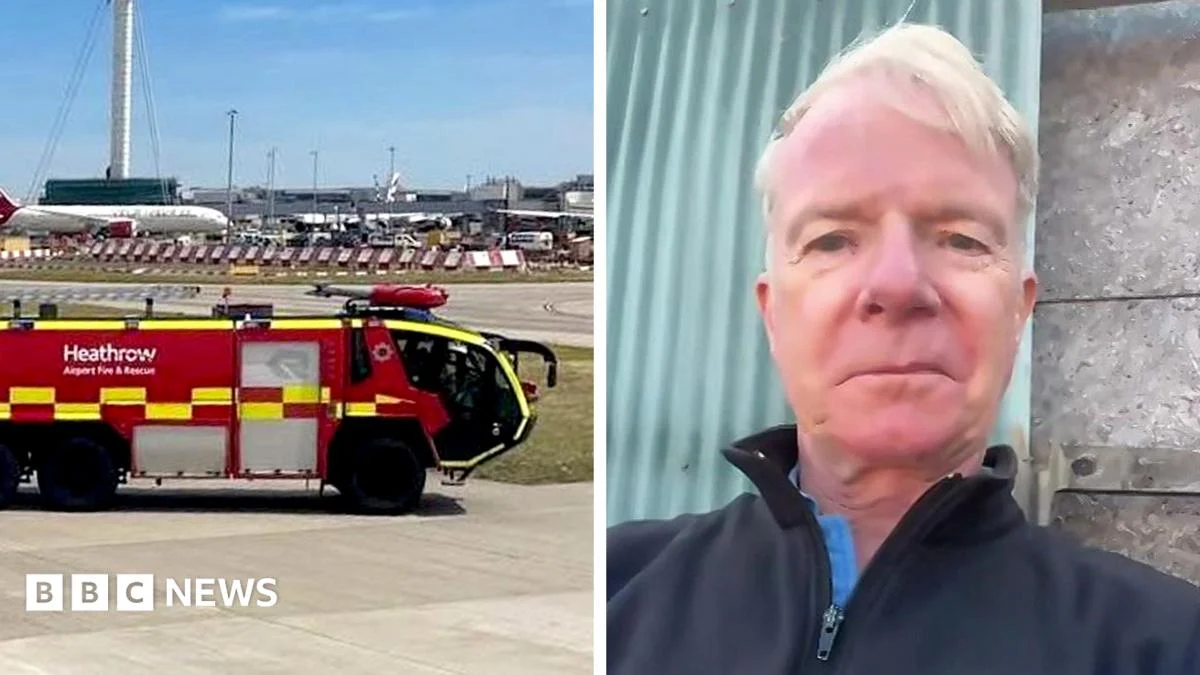
The terrifying ordeal aboard a British Airways flight that issued a distress call on its approach to London Heathrow Airport earlier this month has been vividly recounted by a passenger, painting a stark picture of escalating fear, unsettling silence from the crew, and a desperate plea for survival echoing through the cabin. Edward Killiwick, returning from a friend’s birthday celebration in Dusseldorf, Germany, with his partner Julie on July 6th, found himself at the heart of an unfolding mid-air drama that would transform a routine journey into a harrowing test of nerves.
The flight, an Airbus A320, had been making its final descent towards one of the world’s busiest airports when the first signs of trouble emerged. Passengers were initially informed of an aborted landing, a manoeuvre that, while sometimes necessary, immediately introduces an element of unease. What followed, according to Killiwick, was far more alarming: a "very violent manoeuvre" that jolted the aircraft and its occupants, leaving a profound sense of dread. The sudden, aggressive shift in the aircraft’s trajectory, combined with the powerful surge of the engines, led Killiwick to a chilling conclusion: "I did think we could crash." This visceral fear was not isolated; he sensed it rippling through the cabin, a shared, unspoken terror amplified by the absence of clear communication from the flight deck. In the midst of this palpable anxiety, Killiwick and Julie found themselves comforting a fellow passenger who, overwhelmed by the situation, "completely lost it and started screaming, ‘I don’t want to die.’"
The incident, now under investigation by both the UK’s Air Accidents Investigation Branch (AAIB) and France’s Bureau of Enquiry and Analysis for Civil Aviation Safety (BEA), involved a series of critical failures and emergency responses. The BEA confirmed on Wednesday that the aircraft had indeed issued a distress call, a signal of imminent danger that activates a comprehensive emergency response on the ground.
Killiwick’s account detailed the unnerving silence from the crew following the initial aborted landing and violent manoeuvre. "The violent manoeuvre almost felt like it was avoiding another aircraft," he speculated, describing the engines roaring to full power, an indication of rapid ascent or evasive action. This period of intense, unexplained activity was followed by the aircraft entering a holding pattern, circling above the ground for approximately 15 minutes. For passengers like Killiwick, this prolonged period of uncertainty, devoid of updates, was deeply unsettling. "It was a bit odd going around in a holding pattern with no information. I thought if they’re not talking, then they’re not in a good place," he recalled, articulating the common passenger anxiety that silence in an emergency often equates to severe trouble.
Technical details later released by the BEA shed light on the gravity of the situation. As the Airbus A320 approached Heathrow, a critical data system failure occurred, which subsequently triggered a stall warning. A stall warning indicates that the airflow over the wings is insufficient to generate enough lift, a highly dangerous condition that can lead to a loss of control if not immediately corrected. In response to this initial warning, the flight crew transitioned the aircraft into "alternate law," a degraded flight control mode that removes some of the automated flight protection systems typically present in modern airliners. These automated protections are designed to prevent the aircraft from exceeding its operational limits, particularly regarding speed and angle of attack, which are crucial in avoiding a stall. Operating in "alternate law" places a greater burden on pilot input and judgment, effectively requiring more manual control in a high-stress environment.
Compounding the crisis, a second stall warning then activated when the aircraft was at an altitude of just 3,000 feet. Aviation experts suggest this altitude would have placed the plane mere miles from the airport, significantly reducing the time available for recovery and escalating the danger. It was at this critical juncture that the crew, who had already made an urgency call, upgraded their transmission to a "mayday," signifying an immediate and grave threat to the aircraft and its occupants. A mayday call is the highest level of distress signal in aviation, prompting emergency services to prepare for the worst.
The raw fear experienced by Edward Killiwick was undeniable. "I was definitely scared. After the violent manoeuvre I thought, there is definitely something very badly wrong here. I did think we could crash," he confessed. The possibility of impact, once an abstract fear, became a tangible and terrifying prospect for him and, he believed, for everyone else on board. The lack of information from the flight deck during these harrowing moments created a vacuum that was quickly filled with apprehension and worst-case scenarios.
The emotional peak of the ordeal arrived when the collective anxiety in the cabin found voice in the desperate cry of a fellow passenger. "I think everyone was getting very scared, including one lady who completely lost it and started screaming ‘I don’t want to die,’" Killiwick recounted. This outburst, a primal expression of terror, would have reverberated through the confined space of the aircraft, solidifying the unspoken fears of every passenger. It was a stark reminder of the ultimate stakes involved and the fragility of life when suspended thousands of feet in the air, seemingly at the mercy of malfunctioning systems and a silent, battling crew. Killiwick and Julie’s instinct to comfort the distraught woman highlights the human response to shared peril, a brief moment of connection amidst overwhelming fear.
Miraculously, after what felt like an eternity, the flight eventually landed safely at Heathrow. However, even the moment of touchdown was tinged with an eerie quiet. "Then we did land, but still no communication from the flight deck, which I suppose isn’t surprising as I suppose they had quite a lot to do," Killiwick observed, acknowledging the immense pressure on the pilots. As the plane taxied, the extent of the ground emergency response became evident: several fire trucks and at least one police car were visible on the tarmac, awaiting the aircraft. This visual confirmation of the severity of the incident, even after landing, served as a chilling postscript to the airborne terror.
The immediate aftermath on board was far from celebratory. While a few passengers managed a sparse round of applause, it was not the usual enthusiastic cheer of relief. "There was a few people that did clap, but not that many because I think everyone was just relieved to be on the ground," Killiwick explained. Instead, a profound silence settled over the cabin. "Everyone was very, very quiet. There was almost no conversation. That’s the eerie thing." This quietude spoke volumes, reflecting a state of shock, profound relief, and perhaps, a lingering trauma. The emotional toll was evident in the quiet tears shed by his partner, Julie, once they were safely on solid ground.
British Airways has confirmed its full cooperation with the AAIB in its ongoing investigation but stated it is "not legally able to comment further at this stage." Such incidents, while rare in the highly regulated world of commercial aviation, underscore the critical importance of robust safety systems, rigorous pilot training, and transparent investigations to ensure the continued safety of air travel. For passengers like Edward Killiwick and Julie, the memory of that flight, the violent lurch, the silent fear, and the desperate scream of "I don’t want to die" will undoubtedly linger, a stark reminder of the unexpected perils that can arise even in the most routine of journeys. The incident serves as a potent testament to the extraordinary pressures faced by flight crews in emergencies and the resilient spirit of passengers navigating through unforeseen airborne crises.

 George Anjay
 atisusanti
 Ramos Leo
 Roy Suryo
 Nana Banana