atisusanti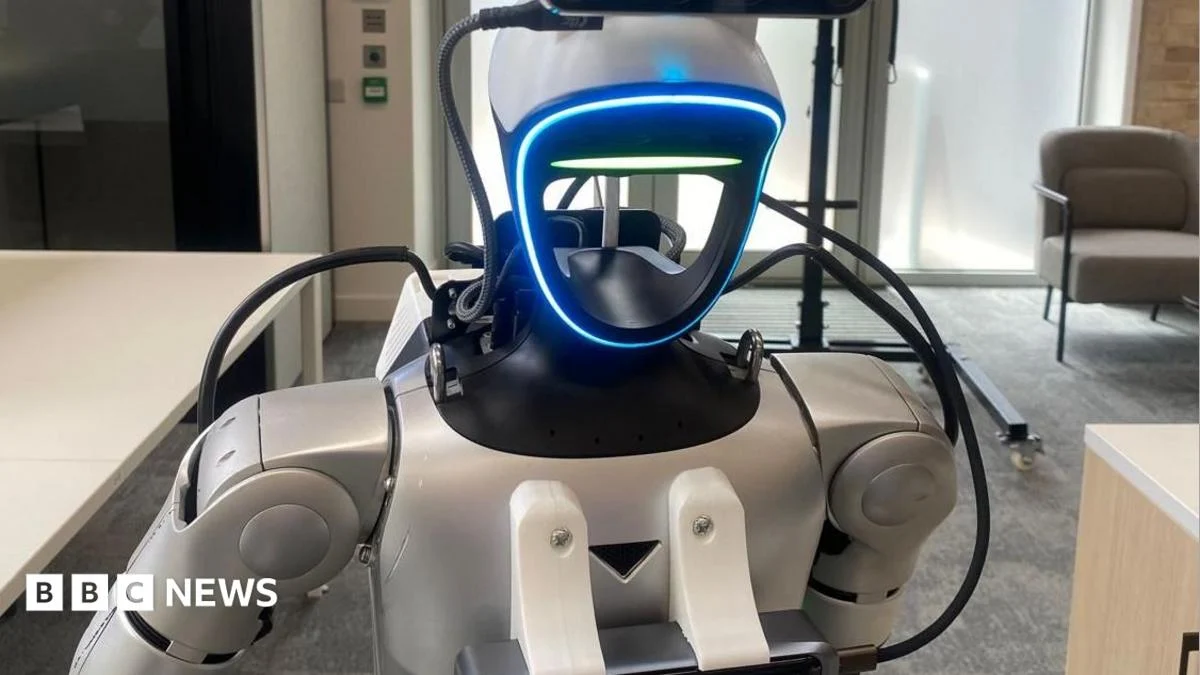
Freddo the robot gracefully navigates the office space, its metallic hand extending to accept a plastic bottle from a staff member. While this might not seem as astonishing as a robot recently outpacing Usain Bolt’s 100m sprint record, the sheer speed at which Freddo acquired these sophisticated skills—walking, recognizing the bottle, and executing a precise grasp—is truly remarkable. Developers at Vsim, a British start-up based in Cambridge, report that Freddo’s capabilities were honed and uploaded in mere minutes, a stark contrast to rival systems that could take days to achieve similar proficiency. Founders Michelle Lu and Kier Storey envision a future where their software empowers robots to perform intricate tasks in both domestic and professional settings, though they acknowledge the significant hurdles remaining.
"It’s a peculiar paradox in robotics," explains Kier Storey, co-founder of Vsim. "The tasks humans find incredibly challenging, like complex gymnastic maneuvers, can be executed by robots with relative ease. Conversely, the seemingly simple yet nuanced skills humans possess, particularly fine motor dexterity, remain exceptionally difficult for robotic systems to master."
Freddo’s impressive learning curve is attributed to its training within a sophisticated virtual environment. This digital realm allows tasks to be simulated millions of times, enabling the rapid identification and optimization of the most effective approach, known as a "policy." Once this optimal policy is determined, it can be seamlessly transferred and implemented by the physical robot hardware. This approach to robot training through virtual simulation is a widely adopted methodology in the field. Tech giant Nvidia, a pioneer in AI hardware, offers its own simulation platform, Isaac Sim, which operates on a similar principle. Notably, both Lu and Storey were instrumental in the development of an early iteration of Nvidia’s system before co-founding Vsim in 2022 with the ambition of creating their own advanced training environment and complementary tools.
By building their system from the ground up, Lu and Storey were able to meticulously optimize the software architecture to leverage the immense processing power of modern Graphics Processing Units (GPUs), the specialized chips that are the backbone of artificial intelligence. "The fundamental algorithms that underpin most of these robotic simulations actually originate from the 1970s and 1980s," Storey points out. "However, these legacy algorithms are not inherently well-suited to the parallel processing capabilities of GPUs." This architectural insight proved to be a game-changer. Within a matter of months, Vsim’s system demonstrated a performance leap far exceeding anything they had previously encountered.
"Eighteen months into our development, we now possess a fully functional, exceptionally high-performance simulator," Lu proudly states. The software’s efficiency is so profound that it can operate directly on the hardware integrated into Freddo. This allows the robot to conduct tens of thousands of simulations concurrently as it navigates its environment. "It can peer approximately one second into the future, exploring around 20,000 distinct potential scenarios and their outcomes," Storey elaborates. This predictive capability is absolutely critical for a robot operating in unpredictable, unstructured environments, such as a typical home.
"Unforeseen events, initiated by factors beyond the robot’s direct control – such as the spontaneous actions of humans, pets, or even other robots – can necessitate an immediate strategic adjustment," Lu explains. "These unexpected occurrences can transpire with startling rapidity, and the robot must possess the agility to adapt swiftly, ensuring its actions remain both safe and aligned with its primary objectives."
Vsim, a burgeoning start-up comprising ten dedicated engineers, represents one facet of the rapidly evolving robotics landscape. At the opposite end of the industry spectrum stands Nvidia, a dominant force in the AI chip market and a leading innovator in robotics software, boasting a formidable team of hundreds of engineers. Nvidia does not manufacture robots itself; instead, it provides a comprehensive suite of software solutions designed to empower organizations in the training and control of their robotic systems. This includes advanced virtual simulation platforms and a sophisticated "world model" named Cosmos. Cosmos endows robots with a foundational understanding of real-world physics and how their surroundings might dynamically change as they interact with them.
However, even with Nvidia’s considerable computational resources, the current software offers only a rudimentary grasp of the complexities of the real world. "Simple manipulation tasks, like picking up a bottle, are relatively straightforward," concedes Spencer Huang, Director of Product for Robotics at Nvidia. "The true challenge emerges when we introduce long-horizon tasks, such as instructing a robot to ‘take this bottle, fill it with water, and then pour it out.’" Despite these complexities, Huang expresses unwavering confidence in the ongoing progress. This year, Nvidia has begun deploying AI agents to assist in the creation of virtual environments for robot training and to rigorously validate the efficacy of training solutions.
"The process of constructing these [virtual] worlds and accurately scanning real-world environments often involves a significant amount of manual labor," Huang notes. "By deploying AI agents, we are essentially automating this process, effectively creating a massive virtual workforce."
While simulation represents a cornerstone of robot training, it is not the sole methodology. Robots can also acquire skills by observing human actions or by analyzing video demonstrations. Rika Antonova, an associate professor at the University of Cambridge’s Department of Computer Science and Technology, has been deeply involved in robotics research since 2015. Her work centers on developing both software and hardware that can facilitate robots in learning complex behaviors. Antonova utilizes MuJoCo, an open-source training system acquired by Google’s DeepMind in 2021. Its open-source nature provides researchers and small start-ups with free access and the flexibility to modify the underlying code.
"MuJoCo is exceptionally user-friendly, making it an invaluable resource for research groups and smaller enterprises," Antonova observes. She views Vsim’s approach to ultra-fast simulation as highly promising. "A significantly accelerated simulator allows for the processing of hundreds of millions of data points within the few seconds a robot is actively calculating its next movement, enabling near real-time adjustments to its actions," she explains. Nevertheless, Antonova acknowledges that these simulated environments remain imperfect approximations of reality, thereby imposing limitations on the scope of what can be effectively trained. "Certain phenomena, such as highly deformable objects and the act of cutting, are inherently difficult to accurately model within a simulation," she states.
This persistent challenge is precisely what Nvidia and Vsim, with its ambitious founders Lu and Storey, are actively addressing. Lu asserts that their system has "significantly reduced approximation errors, employing highly accurate simulations to train models that perform just as effectively in the real world as they do within the virtual domain." The development pipeline at Vsim is set to accelerate further with the imminent arrival of Nacho, a second robot that will contribute to refining their technology. Lu anticipates that this will expedite their development cycle and ensure their software’s compatibility across a wider range of hardware platforms. And, of course, Nacho will provide Freddo with a much-needed companion in their quest for robotic advancement.




 George Anjay
 Nakalama John
 Nana Banana