
 George Anjay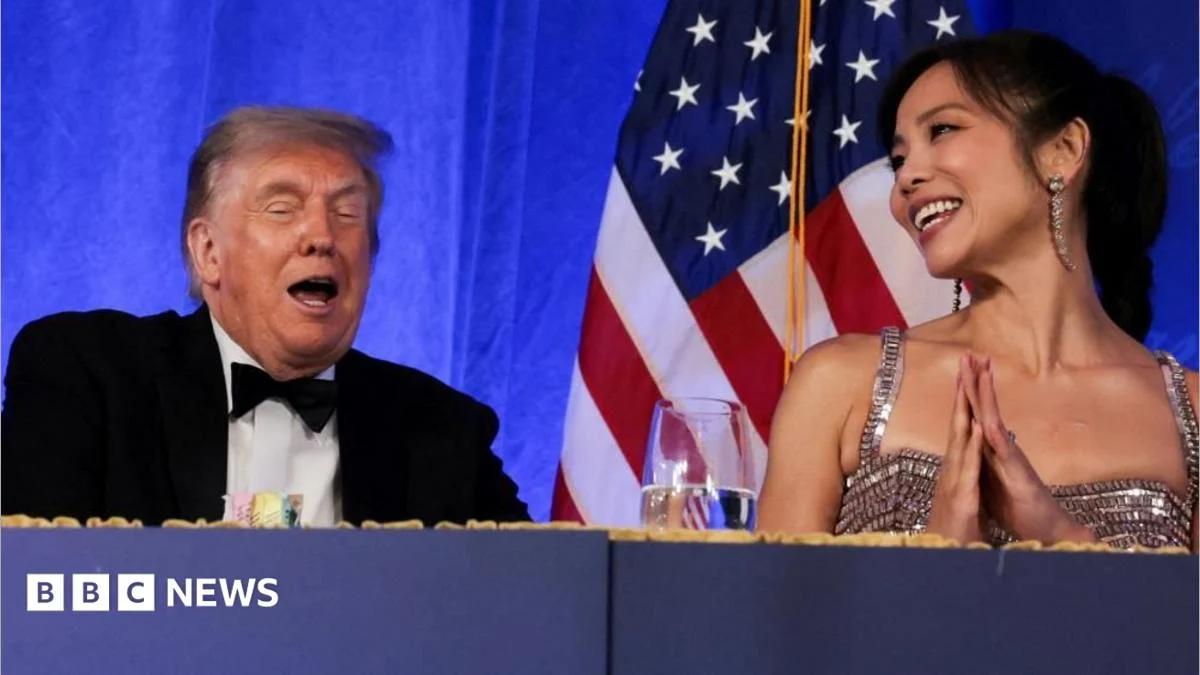
US President Donald Trump offered a complex and at times contradictory display of engagement with the press at the rescheduled White House Correspondents’ Association (WHCA) dinner, an event that had been postponed and subsequently marked by the shadow of a violent attack. The evening, intended to celebrate the vital role of a free press, saw Trump oscillate between moments of apparent conciliation and sharp, characteristic barbs directed at journalists whose outlets he has frequently criticized, sued, and often labeled as purveyors of "fake news." The event, held at the Washington Hilton, the very scene of the attempted shooting three months prior, carried an palpable undercurrent of resilience and a determination to uphold the tradition of open discourse.
The outgoing WHCA president, Weijia Jiang of CBS News, set a determined tone early on, vowing to "refuse to let an act of violence have the final word." Her statement was a direct reference to the April incident where a gunman was tackled by security just moments before he could access the ballroom where the dinner was to commence. Jiang’s assurance that the event would return to the Washington Hilton the following year underscored the organization’s commitment to its foundational principles. The bravery and swift action of Officer Victor Gonzalez of the US Secret Service, who was injured during the April incident, were formally recognized. President Trump himself presented Gonzalez with an award, a gesture of solidarity and appreciation for his heroic actions on that harrowing night.
Despite the somber backdrop and the emphasis on press freedom, the atmosphere shifted as President Trump took the stage. While acknowledging the significance of the occasion and the importance of open debate, he couldn’t resist aiming pointed remarks at many of the journalists present. He accused a significant portion of the attendees of suffering from "Trump Derangement Syndrome," a phrase he has frequently used to dismiss criticism of his administration. This declaration, delivered with a mix of humor and pointedness, highlighted the deep chasm that often exists between the President and a segment of the media.
The President’s address was a carefully calibrated performance, weaving together elements of praise, humor, and pointed criticism. He acknowledged the resilience of the press corps, stating, "As I said three months ago, the show must go on." He also took a moment to call upon Americans to respect freedom of speech, framing it as a cornerstone of democracy. "We settle our differences not with bullets, but with open and vigorous debate," Trump declared, directly referencing the violence that had disrupted the earlier event. He emphatically added, "And no deranged loser with a gun will ever change that. We can’t let that ever happen."
Throughout his remarks, Trump projected an air of geniality, even admitting with a laugh, "sometimes I really do think that some of you don’t like me." This was swiftly followed by his assertion that the dinner represented "really the largest group of ‘Trump derangement syndrome’ people ever put together at one time." He even playfully hinted at his own frustration, suggesting, "I suspect some of you are lucky that our last dinner was cut short…I was going to go after you." This remark, while delivered with a smile, underscored the adversarial relationship he often cultivates with the media.
The contrast in scale and security between the April event and its rescheduled iteration was stark. The dinner was considerably scaled down, with approximately 700 attendees compared to the more than 2,000 who had been expected in April. Security measures were significantly heightened. Several blocks surrounding the hotel were cordoned off, with a visible and substantial presence of police and National Guard personnel. Attendees underwent multiple security screenings, including checks of QR codes and identification, and were issued wristbands for access. At one point, guests were directed to walk in a single file line past two Secret Service officers armed with rifles, a palpable reminder of the security concerns.
The suspect in the April shooting, identified as 31-year-old Cole Tomas Allen, faces serious charges, including attempting to assassinate the President of the United States. His apprehension by agents occurred just before he could reach a staircase leading down to the ballroom where the dinner was scheduled to take place. The gravity of this incident loomed over the rescheduled event, contributing to the heightened security and the somber undercurrent of resilience.
Notable figures in attendance alongside President Trump included Defense Secretary Pete Hegseth, acting Attorney General Todd Blanche, FBI Director Kash Patel, Treasury Secretary Scott Bessent, and Commerce Secretary Howard Lutnick. Their presence underscored the government’s engagement with the press corps and its commitment to maintaining the tradition of the WHCA dinner, even in the face of adversity.
The awards presented during the dinner highlighted the diverse and often challenging work undertaken by journalists. Among the recipients were a team from the Wall Street Journal, honored for their in-depth coverage of President Trump’s alleged links to disgraced financier Jeffrey Epstein. This award served as a potent example of the press’s role in holding powerful figures accountable, a function that President Trump himself has often sought to challenge. The presence of recipients whose work has been critical of the administration, and who were honored by the President, presented a complex tableau of power dynamics and journalistic integrity.
The White House Correspondents’ Association dinner, historically a platform for both celebration and pointed commentary, served this year as a potent symbol of the ongoing tension between the executive branch and the press. President Trump’s participation, marked by his characteristic blend of defiance and humor, underscored the deeply polarized media landscape in the United States. While he offered pronouncements of respect for the press and called for vigorous debate, his repeated criticisms and accusations of bias served as a stark reminder of the challenges facing journalists seeking to report freely and without undue influence. The event, therefore, was not just a dinner; it was a microcosm of the broader struggle for truth, accountability, and the very definition of a free press in the modern era. The resilience shown by the WHCA and the journalists who attended, despite the lingering threat of violence, was a testament to their unwavering commitment to their profession.



 Roy Suryo

 Nakalama John
 atisusanti
 Ramos Leo
