George Anjay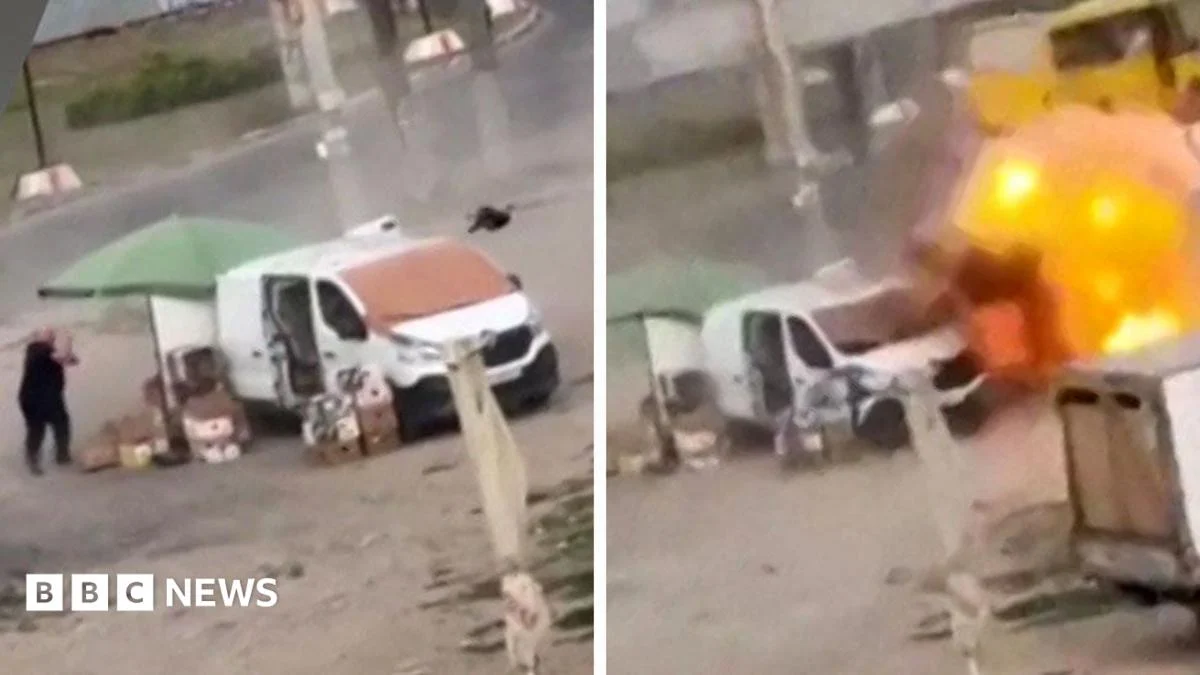
The video unfolds with agonizing clarity, showing the vendor, later identified as Yuriy, a 52-year-old man who sold vegetables from his van, attempting to evade the aerial predator. As the drone circles above, Yuriy moves away, his every step a desperate bid for survival. The drone, seemingly playing a cruel game of cat and mouse, tracks his movements, its camera capturing his panicked flight as he maneuvers around a white van. The pursuit escalates, and in a chilling climax, the drone swoops down with deadly precision, detonating upon impact with Yuriy. Miraculously, the man survived the brutal assault, though he sustained multiple shrapnel wounds, a concussion, and severe psychological trauma, as confirmed by medical professionals.
This deployment of remotely-operated drones against civilians, often chillingly referred to as "human safaris," has become a disturbing tactic employed by Russian forces to instill terror in the hearts of residents living in front-line areas of Ukraine. President Zelensky, visibly outraged, took to Telegram to share the video, urging the world to bear witness to the barbarity. "The world must see this," he wrote, his words resonating with a plea for international accountability. "It must see every piece of evidence that Russia has gone mad, and every fact that Russian soldiers are enjoying killings and tormenting people."
Ukraine’s Foreign Minister, Andrii Sybiha, echoed Zelensky’s condemnation, labeling the video as evidence of a "barbaric war crime." Sybiha emphasized that these "safaris" were not isolated incidents but rather a "deliberate and systemic Russian strategy." He underscored the depravity of the act, stating, "The sadist operating this drone knows full well that he is targeting a civilian." The Foreign Minister further asserted that this attack was an integral part of a calculated Russian campaign designed to intimidate the civilian population, issuing a stern demand for global condemnation.
Adding a personal dimension to the tragedy, the Kherson regional governor later released a video from a hospital bed, showing Yuriy speaking about his ordeal. The 52-year-old vendor recounted the terrifying moments when he and his wife began arranging their crates of vegetables next to his van. The distinctive buzzing sound of the drone overhead shattered the ordinary scene, signaling the imminent danger. As his wife fled for safety, the drone, with chilling focus, turned its attention to him. In a desperate attempt to signal his non-threatening status, Yuriy held up heads of garlic towards the drone’s camera, hoping the operator would recognize him as a mere vendor. "It could see that I had tomatoes out, some cucumbers and eggplants laid out on the floor," Yuriy recounted, his voice heavy with the trauma of the event. He even described how the drone seemingly tracked him as he attempted to use an umbrella for cover while running.
The BBC Verify team has meticulously geolocated the footage to a market space adjacent to a roundabout in the Tavriiskyi district, located in the northern part of Kherson. While the exact circumstances of the filming and the identity of the original filmer remain unclear, the earliest publicly available copy of the video was disseminated by a pro-Ukrainian Instagram account on Tuesday morning.
The use of "safari" attacks by Russian troops in Kherson is not a new phenomenon. The region, situated just a few miles from the front lines, has been a consistent target. A United Nations report from 2025 highlighted the recurring nature of Russian armed forces "killing and injuring civilians" in the area through the deliberate use of drones to target them. The chilling practice of filming these attacks, often capturing the final terrifying moments of the victims before the drones impact their targets, and then disseminating these videos online, allows for a widespread witnessing of civilian suffering. The UN has rightly classified the posting of such videos as a war crime, specifically citing "outrages upon personal dignity."
Russia initiated its full-scale invasion of Ukraine in February 2022, a military operation that has been met with widespread international condemnation. Despite overwhelming evidence and consistent allegations from Ukraine and international bodies, Russia has consistently denied targeting civilians. The drone attack on Yuriy serves as yet another graphic and undeniable testament to the brutal realities faced by ordinary Ukrainians caught in the crossfire of this devastating conflict, and a stark reminder of the urgent need for international justice and accountability. The psychological impact of such attacks, designed to sow fear and despair, is as profound as the physical injuries inflicted. This deliberate targeting of civilians, stripped of any military justification, underscores a disturbing willingness to inflict suffering and terror for its own sake. The global community is once again called upon to condemn these heinous acts and to support Ukraine in its fight for survival and justice. The courage of individuals like Yuriy, who survive such encounters and bear witness to the atrocities, is a crucial element in the ongoing struggle for truth and accountability. The systematic nature of these attacks, as highlighted by Ukraine’s Foreign Minister, points towards a deeply ingrained disregard for human life and international law within the Russian military apparatus. The implications of these "human safaris" extend beyond the immediate victims, impacting entire communities and fostering a pervasive atmosphere of fear and uncertainty. The international legal framework must be rigorously applied to hold perpetrators accountable for these egregious war crimes. The ongoing documentation and dissemination of such evidence are vital for ensuring that history records these events accurately and that justice is ultimately served. The psychological toll on the civilian population cannot be overstated, and the world must recognize the long-term consequences of such deliberate acts of terror. The resilience and bravery of the Ukrainian people in the face of such relentless aggression continue to inspire, but the need for decisive international action remains paramount. The world must not turn a blind eye to these atrocities, and the voices of those who have suffered must be amplified in the pursuit of peace and justice. The future of international law and humanitarian principles is being tested in the crucible of this conflict, and the response from the global community will shape the course of human rights and accountability for generations to come. The chilling efficiency with which these drones are deployed, coupled with the sadistic pleasure reportedly derived by their operators, paints a grim picture of the moral decay that can accompany prolonged conflict. The fight for Ukraine is a fight for fundamental human dignity and the rule of law, and the world’s commitment to this struggle must be unwavering. The sharing of this video by President Zelensky is a powerful act of defiance and a crucial step in ensuring that the world cannot feign ignorance to the barbarity unfolding in Ukraine. The international community must respond with commensurate outrage and a resolute commitment to justice.

 Nakalama John
 Ramos Leo
 Nana Banana