
 Nana Banana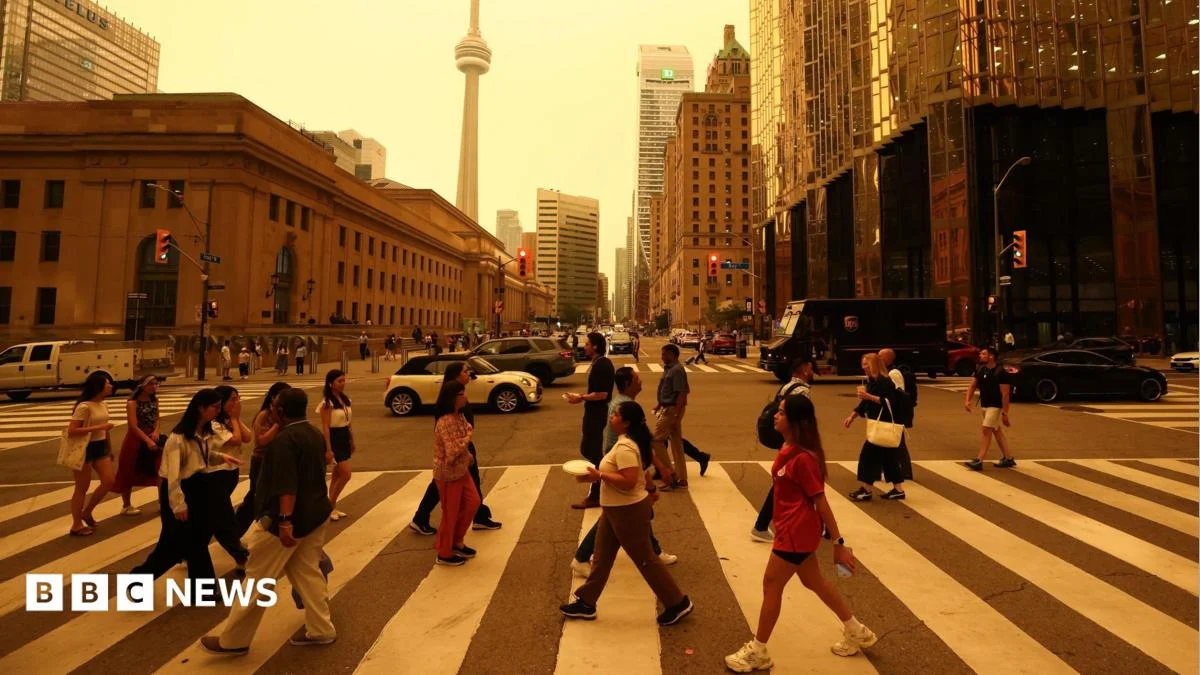
Across broad swathes of the US and Canada, a thick, persistent blanket of smoke has settled, obscuring prominent city skylines and compelling millions to don facemasks as a protective measure against the noxious air. The visual impact alone has been striking, transforming vibrant urban landscapes into muted, sepia-toned scenes. On a particularly alarming Friday, major American cities including Detroit, Chicago, Washington D.C., and New York found themselves topping the global list for the worst air quality, a stark indicator of the severity of the crisis. Local officials in these metropolitan areas issued grave warnings, strongly advising residents to limit their time outdoors due to the serious potential health impacts of inhaling the dense fumes. The transboundary effects of this environmental catastrophe have also ignited a political dispute between Canadian and US officials, with President Trump reportedly threatening new tariffs to offset the "incalculable" cost of the smoke damage to the United States.
Currently, the Canadian Interagency Forest Fire Centre (CIFFC) reports an alarming number of approximately 888 wildfires actively burning across Canada. Of these, nearly 200 are concentrated within Ontario, a province bearing a significant burden of the crisis. These statistics underscore the immense scale of the firefighting efforts required and the broad geographical impact. Along the northern edge of Minnesota, a cluster of 15 fires remains active, prompting an emergency declaration to mobilize additional suppression efforts and resources. In Ontario, the majority of the fires are situated north of Lake Superior, often in more remote and challenging-to-access parts of the province. Many of these blazes are burning within or perilously close to national parks and numerous First Nation communities, which often lack the infrastructure and resources to cope with such large-scale disasters.
The human cost is already evident, with six communities currently under evacuation orders, and initial reports confirming significant damage to properties and vital infrastructure. Matthew Hoppe, the incident commander for the Namaygoosisagagun First Nation, provided a harrowing account to the BBC, describing the utter devastation wrought by the wildfires in northern Ontario. Community members were forced into a desperate "self-evacuation" via small boats on a Monday afternoon as the fire rapidly bore down upon them. While remarkably there were no deaths or direct physical injuries reported, Hoppe lamented that the community has been "completely levelled," a testament to the destructive power of these uncontrolled blazes. While wildfires are a common, even natural, phenomenon within Canada’s vast boreal forests, the sheer number and intensity of outbreaks have escalated dramatically in recent weeks and months, surpassing historical averages and straining response capabilities.
IQAir, a prominent company renowned for tracking global air quality data in real-time, underscored the severity of the situation by ranking cities like Detroit, Toronto, and Minneapolis among those with the worst air quality in the world. This dire assessment was directly attributed to the persistent, suffocating smokey haze blanketing these urban centres. Wildfire smoke is far from benign; it is a hazardous cocktail containing a complex mixture of very small polluting particles, most notably PM2.5 (particulate matter less than 2.5 micrometres in diameter), and various gases, including nitrogen dioxide. These microscopic particles pose a significant threat to human health due to their ability to penetrate deep into the respiratory system.
As explained by Jim McDonald, the New York State Department of Health commissioner, in a public address video, "These particles when they get into our system get all the way down into our lungs, all the way down to our tiny breathing tubes and… they cause inflammation." This inflammation can trigger a cascade of adverse health effects. According to the World Health Organization (WHO), wildfire smoke can significantly exacerbate existing respiratory conditions such as asthma and chronic obstructive pulmonary disease (COPD), as well as heart, kidney, and eye conditions. Symptoms can range from irritated eyes and throat, coughing, and difficulty breathing to more severe outcomes like heart attacks, strokes, and even premature death in vulnerable populations.
Emergency responders, who are on the front lines of the crisis, and vulnerable groups such as individuals with chronic illnesses, the elderly, and young children, are most at risk. Children are particularly susceptible because their respiratory systems are still developing, they breathe more air relative to their body weight, and they are physically closer to the ground where smoke can often sink and become more concentrated. Governments and health authorities typically issue warnings depending on the prevailing air quality level, advising people on specific precautions to take. For example, an "orange alert" often means that individuals, especially those with pre-existing conditions, are advised to stay indoors, keep windows closed, avoid strenuous outdoor activities, and use air purifiers if available. For general protection against particulate matter, properly fitted KN95 or N95 masks are recommended, as they are designed to filter out 95% of these tiny particles. However, it is crucial to be aware that counterfeit masks are prevalent online, so ensuring that any mask purchased is government-certified is paramount to guarantee its efficacy. Many affected cities have activated their air quality emergency protocols, which often include the distribution of free masks at local community centres to help protect their residents. For real-time, location-specific air quality alerts and further information, residents in Canada can consult the Environment and Climate Change Canada website, while those in the US can refer to resources from the Environmental Protection Agency (EPA) or their local state health departments.
Beyond the immediate environmental and health crises, the fires are also reigniting existing political tensions between the North American neighbours. On a specific Friday, US President Donald Trump reportedly escalated the diplomatic friction by threatening to impose new tariffs on Canada. His rationale for this move was Canada’s alleged "willful negligence" in effectively combating the wildfire threat. Trump asserted that "The United States is being unnecessarily invaded by filthy, polluted, and unhealthy air," and indicated he would contact Prime Minister Mark Carney (likely a misattribution, referring to the sitting Canadian Prime Minister Justin Trudeau) regarding Canada’s perceived failure to engage in "basic Forest Management."
This tariff threat followed a wave of complaints from US lawmakers. Earlier in the week, four Republican lawmakers from Michigan, a state directly bordering Ontario and significantly impacted by the smoke, penned an open letter to the Prime Minister. In their letter, they sharply criticized Canada and "demanded immediate action" to contain the fires’ transboundary impacts. Their blunt message stated: "American lungs are paying the price for Canadian inaction, year after year." While the Prime Minister did not directly respond to these specific claims, his office emphasized the shared responsibility of both countries to address climate change, highlighting the larger context of the crisis. It’s important to note that Canada’s vast forests are largely managed by its individual provinces, not the central federal government, which complicates a unified national response and international accountability.
Ontario’s Premier Doug Ford, however, issued a direct and robust response to the complaints, pushing back vigorously on any claims that Canada was not doing enough to fight the threat. He highlighted the massive scale of the response to the blazes and pointed out that the region has spent more than $1 billion in recent years on wildfire mitigation efforts. Ford retorted, "Maybe what you should do rather than complain is send support, send help, because we have done the exact same thing for our American friends." He reminded critics that Canada has historically provided crucial assistance to the US in battling its own devastating wildfires and hurricanes, emphasizing a spirit of mutual aid. Experts, including Patrick James from the University of Toronto, have told the BBC that blaming Canada for wildfire smoke often misses the larger, more complex picture. "Weather doesn’t care about international borders," James noted, explaining that once smoke reaches the atmosphere, it is carried wherever the prevailing winds dictate. He also pointed out that smoke from major US wildfires has frequently affected Canada in recent years, illustrating the reciprocal nature of transboundary smoke pollution. Furthermore, experts emphasize that many of the current fires are burning in Canada’s vast, remote boreal forests, where early detection and containment are exceedingly difficult before they escalate into massive, uncontrollable infernos. While improved forest management practices can certainly reduce wildfire risk in specific areas, particularly near communities, it is simply not feasible to prevent fires across an ecosystem of this immense scale and natural predisposition.
Wildfires are, in fact, a natural and essential part of the boreal forest ecosystem, of which Canada possesses vast swathes. Historically, these fires played a vital role in forest regeneration and maintaining ecological balance. However, their frequency, intensity, and destructiveness have demonstrably worsened in recent years, largely due to human-induced climate change. In recent years, for example, the 2023 fires razed an unprecedented 15 million hectares (37 million acres) – an area larger than England – while another significant year saw 8.3 million hectares (20.5 million acres) burned. These figures represent a dramatic increase over historical averages, indicating a fundamental shift in fire regimes.
In Canada, approximately half of all wildfires are sparked by natural phenomena, primarily lightning strikes, with the remaining half attributed to human activity, often accidental. However, the underlying conditions that allow these sparks to ignite and spread into massive blazes are increasingly being exacerbated by climate change. Drier soils and vegetation, a direct consequence of prolonged droughts and higher temperatures, provide an abundance of highly flammable fuel, significantly increasing the likelihood of ignition and rapid spread. Rising global temperatures, a hallmark of climate change, are making heatwaves more frequent, longer-lasting, and more severe, directly contributing to these parched, fire-prone conditions. Climate change is also influencing winter temperatures. Milder conditions during the first part of the year can stimulate earlier plant growth, which in turn provides more combustible fuel for the subsequent fire season. Moreover, reduced snow cover, another consequence of warmer winters, plays a critical role. Snow, with its highly reflective white surface, helps to reflect the sun’s radiation back into space, thereby exerting a crucial cooling effect on the landscape. Less snow means more solar radiation is absorbed by the ground, leading to higher temperatures and drier conditions earlier in the spring, setting the stage for more intense and prolonged wildfire seasons.



 George Anjay
 Nakalama John
 atisusanti
 Ramos Leo
 Roy Suryo