Nana Banana
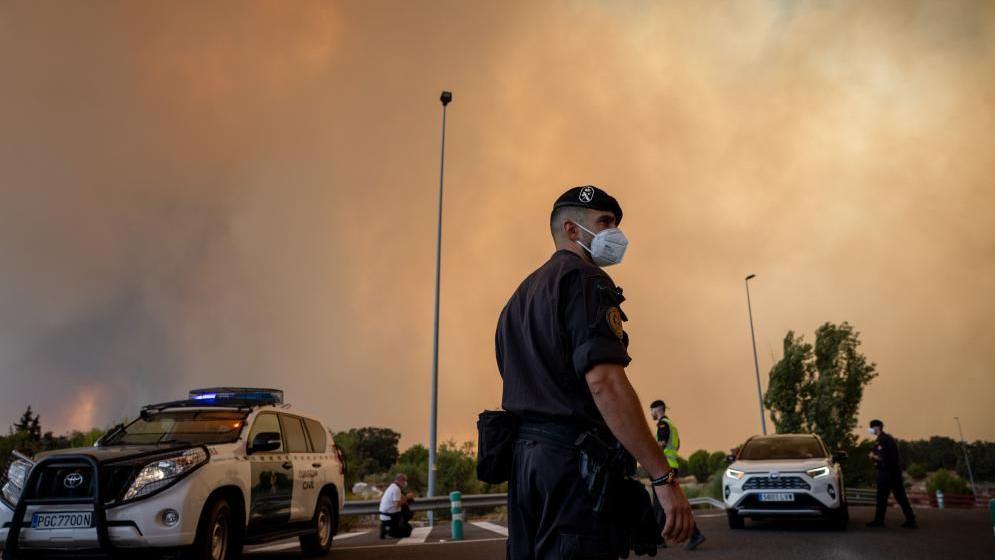
A catastrophic wildfire near Madrid has been officially declared "beyond the capacity" of firefighters to contain, a stark warning issued by Spanish officials as three distinct fire fronts west of the capital tragically merged into a single, formidable inferno. This escalating crisis has prompted Spain’s government to declare a national emergency, impacting tens of thousands of residents, with 63,000 people initially advised to evacuate or remain indoors, and at least 25,000 having already been compelled to flee their homes.
Isabel Díaz Ayuso, Madrid’s regional president, articulated the gravity of the situation, describing it as unequivocally the "worst fire in the history of the region." She highlighted a "perfect storm" of environmental factors contributing to the unprecedented devastation: soaring high temperatures, relentless winds that fan the flames, and the dangerous merging of multiple fire fronts, creating an unpredictable and rapidly expanding conflagration.
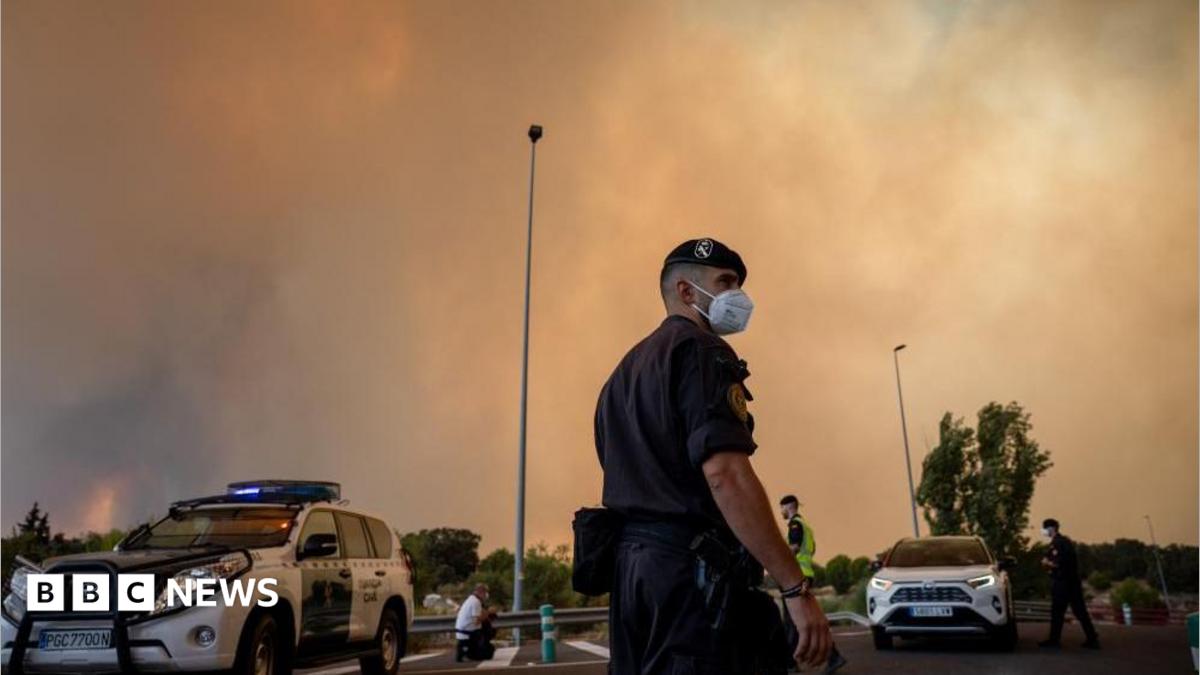
Simultaneously, across the border in south-west France, an even larger number of people have been displaced, with approximately 140,000 individuals evacuated after ferocious wildfires ripped through the Gironde and Landes regions. The situation in France intensified significantly when the primary fire changed direction later on Friday, turning its destructive path towards the major city of Bordeaux, leading to expectations of further, widespread evacuations. In response to the escalating crisis, French President Emmanuel Macron has mobilised the military to provide critical assistance to the overstretched civilian emergency services.
In Spain, local emergency services have reported that the wildfires are aggressively advancing towards the municipalities of Robledo de Chavela and Fresnedillas de la Olivia, situated approximately 50 kilometres (31 miles) west of the bustling capital. Carlos Novillo, the Madrid regional government’s emergency management chief, grimly informed reporters that the wildfire had reached its "peak" intensity, rendering it currently "beyond the capacity of firefighters to contain." He further explained the operational shift, stating, "It’s not possible to attack the fire in that area, so defensive measures are being taken," underscoring the defensive posture forced upon emergency crews by the sheer scale and intensity of the blaze.
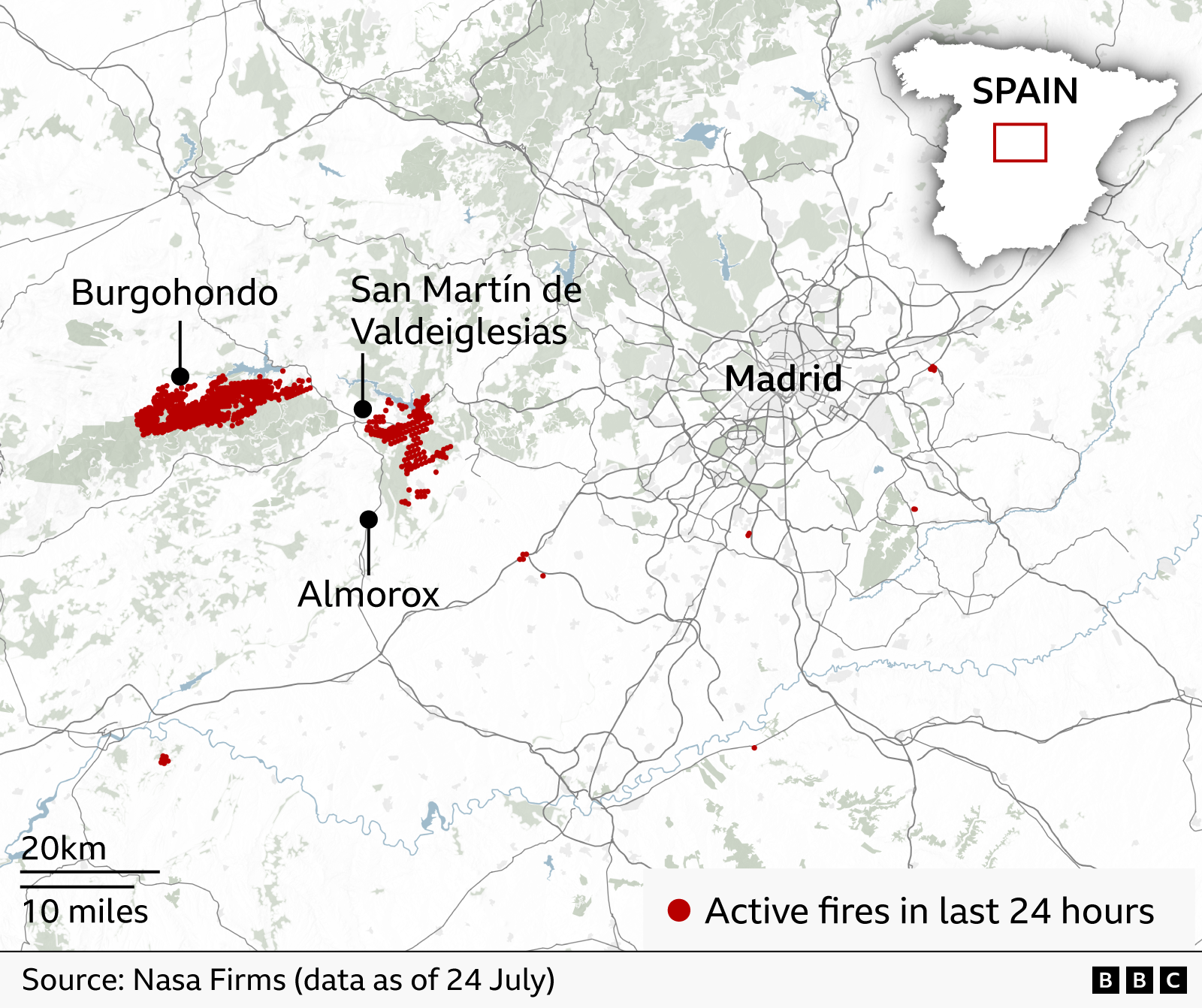
To combat the relentless advance of the flames and protect vulnerable communities, Spain’s Military Emergency Unit (UME) has been deployed. Their primary focus is to establish defensive perimeters and safeguard areas in close proximity to the historic town of El Escorial, a significant cultural and historical site. Authorities are also meticulously monitoring a separate, equally concerning wildfire in the nearby Ávila province. Officials harbour grave fears that the enormous Burgohondo blaze, which is rapidly consuming land, could potentially merge with the already unmanageable Madrid fire, creating an even more colossal and uncontrollable conflagration. Spain’s Interior Minister Fernando Grande-Marlaska assured the public that authorities were doing "everything we can" to prevent such a catastrophic merger.
The human toll in the Madrid region alone is staggering, with over 60,000 people directly affected. This includes 30,000 individuals forced to evacuate their homes and another 20,000 placed under strict lockdown orders. Francisco Martín, the government delegate in Madrid, warned that these numbers were likely to surge, explaining the dynamic and unpredictable nature of the fire: "embers are flying for miles and the fire is jumping great distances," making containment exceedingly difficult and expanding the potential impact zone. The environmental devastation is equally profound; at least 6,000 hectares of land have been incinerated in the Madrid region, while the Ávila blaze has consumed an even larger area, scorching almost 9,000 hectares, according to official estimates.
The rapid spread of the fires has necessitated the evacuation of eight municipalities, including Chapinería, Navas del Rey, Colmenar del Arroyo, Fresnedillas de la Oliva, Robledo de Chavela, Aldea del Fresno, Navalagamella, and Zarzalejo. Several other towns, such as San Martín de Valdeiglesias, Pelayos de la Presa, and Villa del Prado, remain under lockdown, with residents confined to their homes for safety as the fires rage nearby. The mayor of El Tiemblo, one of the severely affected areas in Ávila, Arturo Varas González, recounted a terrifying experience to laSexta, describing how flames surged from Navaluenga to the Iruelas Valley – a distance of approximately 20 kilometres (12 miles) – in less than half an hour. "It was horrific," he stated, highlighting the incredible speed and destructive power of the blaze.
The personal stories emerging from the disaster paint a vivid picture of the terror and displacement. Ecologio Cabrera, an 86-year-old resident, was among those forced to flee his village west of Madrid. Speaking from a sports hall in Vilamanta, where hundreds of evacuees have sought refuge, he shared his harrowing experience with AFP news agency: "If you don’t run from it and you try to face it, it devours you." His family had desperately attempted to save their home by dousing it with garden hoses until firefighters arrived. "They arrived and told everybody to get out… I have never experienced anything like this," Cabrera recounted, his words echoing the shock and disbelief felt by many.
Madrid’s regional president Ayuso reiterated the "completely unusual and catastrophic" nature of the situation, emphasizing that the paramount priority for all emergency services and government bodies was the preservation of human lives. Prime Minister Pedro Sánchez is scheduled to visit the zone’s emergency coordination centre early on Saturday, his administration announced, underscoring the high-level attention the crisis demands. Earlier on Friday, Sánchez acknowledged that people were "living through a dramatic situation" and issued a plea to all citizens to exercise extreme caution and vigilance. In a concerning development regarding the Burgohondo fire, the Civil Guard has arrested one person and is actively investigating another. Local media reported that officials suspect the blaze may have been caused by negligence involving heavy machinery used during a period when specific restrictions were in place, suggesting a preventable origin for at least one of the devastating fires.
Meanwhile, the situation in south-west France remains equally critical, with authorities having evacuated more than 140,000 people as wildfires continue to devastate the Gironde and Landes regions. The Gironde blaze, powerfully described by local prefect Sophie Brocas as an "XXL fire," has already consumed over 19,000 hectares (46,000 acres) of dense forest and destroyed approximately 80 homes, leaving a trail of environmental and material ruin. The popular tourist destination of the Cap Ferret peninsula on the south-west coast saw its entire population evacuated, with hundreds escaping by boat as flames rapidly swept through the area. While Cap Ferret typically has a year-round population of just under 8,000, this figure can multiply tenfold during the peak summer holiday season, making the evacuation effort incredibly complex and urgent.
Marc Vermeulen, the fire and rescue chief, highlighted the severity of current conditions, stating they were even more challenging than during the devastating fires that struck the region in 2022. He attributed the continued nocturnal spread of the blaze to the prevailing drought conditions. France’s Interior Minister Laurent Nuñez spoke to French broadcaster TF1, declaring, "We have never seen a convective fire of this magnitude," and revealing that around 50 firefighters had sustained injuries battling the inferno. Nuñez explained that the blaze was "self-sustaining" and exhibiting unpredictable changes in direction, noting its movement eastward towards Bordeaux on Friday evening. He affirmed, "We are going to reorganise our response so we can fight it from the ground and prevent it from advancing toward Bordeaux," outlining the strategic shift required to protect the major city.
Further south, another significant wildfire near Biscarrosse in the Landes region necessitated the evacuation of more than 23,000 people from their homes, campsites, a nursing home, and a summer camp, illustrating the diverse populations affected. Landes prefect Gilles Clavreul indicated that the fire was unlikely to be extinguished by the end of Friday, citing persistent winds reaching 50 km/h (31 mph) and high temperatures of 36-37°C, which continue to fuel the flames. Philippe de Gonneville, the mayor of Lège-Cap Ferret, one of the worst-affected areas, expressed profound concern, stating that the region had "faced extreme weather conditions for the last month and a half" with no rainfall and consistently above-average temperatures. "It’s unheard of," he remarked. "Neither we nor the firefighters have seen anything like it," underscoring the unprecedented nature of the crisis. President Macron characterized the wildfire situation across France as "very tense," particularly in Gironde. He announced that France had activated the European Union’s civil protection mechanism, which would provide crucial reinforcements, including two Black Hawk helicopters from the Czech Republic and Slovakia, demonstrating the need for international cooperation to tackle the crisis.
These localized crises are part of a broader, more ominous pattern of extreme conditions sweeping across southern Europe. The European Union has responded by deploying aircraft and helicopters to bolster firefighting efforts in both Spain and France, as much of the continent’s southern flank grapples with a relentless succession of heatwaves and prolonged drought. Scientific data from the EU’s Copernicus Climate Change Service confirms that Europe is the fastest-warming continent, experiencing heating at more than twice the global average since the 1980s. This accelerating warming trend translates into hotter, drier conditions that desiccate vegetation, transforming it into highly flammable fuel. This creates an environment where wildfires can ignite more easily and spread with alarming speed and intensity.
While a spark is always necessary – most often originating from human activity, whether accidental or deliberate, or from natural causes like lightning – the combination of extreme heat, parched vegetation, and powerful winds creates a perfect recipe for fires to burn faster, become more aggressive, and prove exponentially harder to contain. According to the European Forest Fire Information System (EFFIS), wildfires have already consumed more land in Europe this year than the annual average for the past two decades, highlighting a disturbing escalation in the frequency and severity of these events. The European Environment Agency has unequivocally stated that "climate change has increased forest fire risk across Europe," with the greatest danger and impact concentrated in southern Europe, making these recent catastrophic blazes a grim manifestation of a changing climate.



 Roy Suryo
 Nakalama John
 atisusanti
 Ramos Leo