
 Nana Banana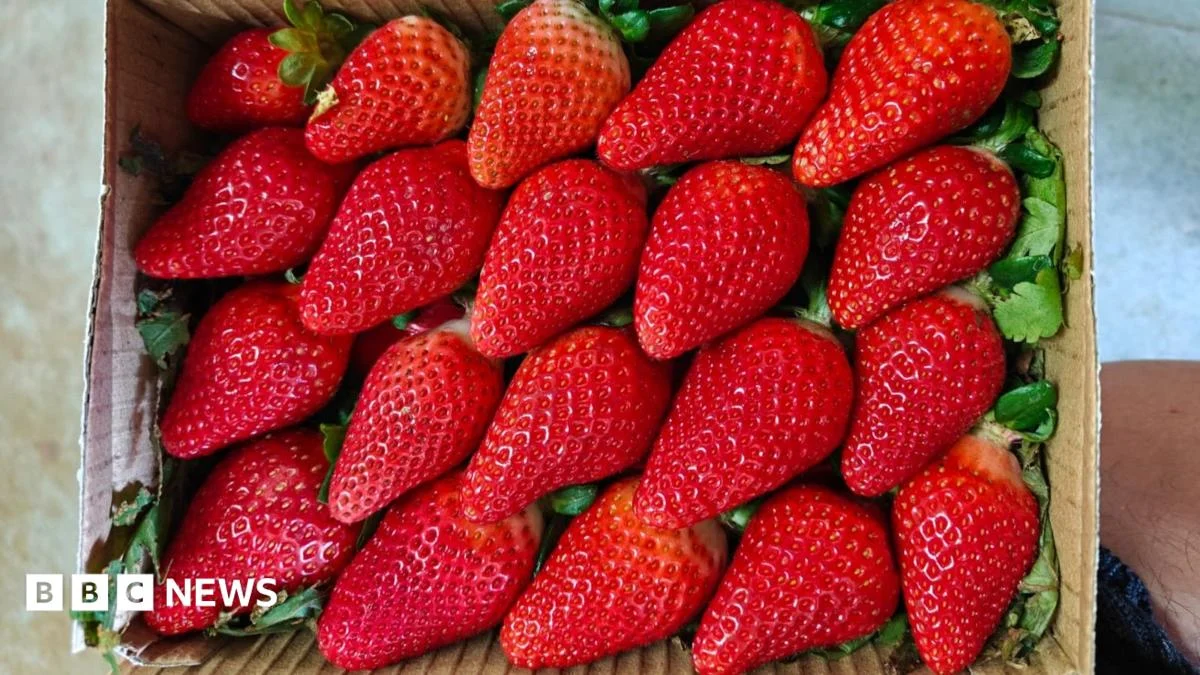
The unpredictable nature of the climate poses a significant threat to farmers’ livelihoods. "If you have a field full of strawberries and sudden heavy rains hit, the entire crop is ruined and we have to bear massive losses," explains Sheetal Danavle, who, alongside her husband, dedicates half of their three-acre farm to strawberry cultivation. The financial burden is compounded by the fact that strawberry plants, unlike many other crops, are not grown from seed but must be replaced every season. Farmers purchase young plants from specialized suppliers, an annual outlay that costs Danavle, on her relatively small farm, approximately $2,500 (£1,900). "If the season goes well, you can earn double your investment. But the climate makes it a huge gamble," she admits, highlighting the precarious balance between potential profit and devastating loss.
Thousands of farmers across the Mahabaleshwar region contribute to making strawberries one of western India’s most profitable horticultural crops. Yet, this thriving industry carries a significant vulnerability: an almost complete reliance on foreign varieties. Despite the domestic success in cultivation, no indigenous strawberry plant has been successfully developed in India. The industry sources its primary plant material from international breeders in California, Florida, Italy, and Spain. Developing a top-quality fruit cultivar is a meticulous and time-consuming process, often taking 10 to 15 years for breeders in the US and Europe, who then rigorously patent their unique varieties, safeguarding their intellectual property.
Nelson Sequeira, the founder and director of Tara Farms Fresh, a licensed strawberry propagator, details the complex supply chain. "We import the certified mother plant from the breeder abroad," he states. These mother plants undergo a stringent government quarantine upon arrival in India to prevent the introduction of diseases or pests. Once cleared, they are planted in specialized nurseries, where they become the "engine" for propagation. "That single mother plant will shoot out runners to yield an average of 20 daughter plants – with some advanced growers pushing that up to 30 or 40," Sequeira explains. This process is highly technical and precise. In his nurseries, plants are grown off the ground in large industrial pipes split lengthwise to form rounded gutter containers. Instead of traditional soil, these containers are filled with a specialized coco-peat substrate, derived entirely from coconut husk, which provides an ideal growing medium. A highly precise drip-irrigation and fogging system meticulously controls micro-climates, ensuring optimal growth conditions for the delicate young plants.
While propagators like Sequeira currently depend on foreign mother plants, a groundbreaking initiative at Mahatma Phule Krishi Vidyapeeth (MPKV), a prominent agricultural university in Maharashtra, promises to change this landscape. MPKV has forged a crucial partnership with the Bhabha Atomic Research Centre (BARC) on an ambitious breeding experiment. Researchers are employing controlled, low-dose gamma irradiation on plant tissues to induce stable genetic mutations. This innovative mutation breeding technique aims to accelerate the natural evolutionary process, creating new genetic variations more rapidly than conventional breeding methods. "The goal is to fast-track the development of India’s first indigenous, climate-resilient strawberry cultivar that matches the large fruit size and firm texture of foreign varieties while natively tolerating Indian heatwaves," says Dr. Darshan Shashank Kadam, assistant professor of Horticulture at MPKV. He acknowledges that this is a long-term endeavor, with results potentially emerging in 10 to 15 years. However, in the interim, MPKV is actively supporting farmers through other means. "We are developing scientific packages of practices for farmers. We have already standardised planting schedules, fertiliser recommendations and growth regulator applications specifically for Mahabaleshwar conditions," Dr. Kadam adds, providing immediate, actionable insights to improve current farming practices.
Beyond scientific breeding, large farms with substantial resources are investing heavily in advanced agricultural technology to mitigate climate risks and enhance productivity. Ketan Yashwant Sodha, founder and CEO of Berry Fresh Agrotech, embarked on his journey with traditional open-field farming but quickly grew frustrated by the consistent losses inflicted by erratic weather patterns. "For the past 10 years, it has consistently rained in India during our peak season – November, December, and the first week of January. When you are in an open field and your plantation is at its absolute peak, a single rain will ruin your entire crop," he recounts.
Driven by this frustration, Sodha began experimenting with hydroponics in 2022 – a form of covered cultivation that eliminates soil and allows for precise control over water, nutrients, light, and temperature. His initial foray was met with significant setbacks. "I suffered immense losses and failed multiple times," Sodha admits, emphasizing the unforgiving nature of hydroponics compared to soil-based farming. "The soil is forgiving; hydroponics does not forgive. If you make a mistake today, you will wake up tomorrow morning to a disaster – and the recovery time in hydroponics takes twice as long as soil." Yet, the hard-won lessons from these failures are now yielding impressive results. Berry Fresh Agrotech has trialed 19 different varieties, including rare Japanese cultivars, and is currently the sole entity in India experimenting with a specific Netherlands variety this season. Sodha’s team has refined their techniques to limit each plant to precisely 750ml of water per day, a practice he claims produces "rich, highly concentrated sugars and aromas instead of water-logged, bland fruits." Their sophisticated approach also involves regular "blood work" on the crops – laboratory testing of leaves and petioles to measure exact nutrient uptake, allowing for real-time adjustments to the water-borne nutrient supply. By utilizing a semi-open polyhouse system, they have transcended seasonal limitations, enabling year-round strawberry cultivation. "It’s not a seasonal fruit for us," Sodha proudly declares, signalling a paradigm shift for the industry. Now, with refined standard operating procedures and a comprehensive farm manual, Berry Fresh Agrotech is poised for significant expansion, actively seeking investors to scale up to a five-acre facility accommodating 200,000 plants.
Krishan Bhilare, whose family has farmed strawberries in Mahabaleshwar for generations, recalls the awe inspired by the size of the first American varieties planted in 1992. Today, Bhilare is part of a Farmer Producer Organisation (FPO) network that is embracing collective technological advancement. The FPO has strategically installed weather monitoring towers at four locations across their land. These towers, powered by artificial intelligence, analyze weather data to accurately predict rainfall, allowing farmers to delay costly chemical sprays and prevent them from being washed away, thus saving significant resources. The FPO is also pioneering vertical farming, constructing towers where strawberries are grown on a coco-peat substrate, stacked five layers deep. "By stacking five pots into a single vertical tower, we can scale our density from 25,000 plants to 125,000 plants per acre. We are effectively multiplying our production footprint by five times on the exact same piece of land," Bhilare explains, showcasing a revolutionary approach to maximizing land use and yield.
However, such significant investments in high-tech solutions remain either prohibitively expensive or an immense risk for small and marginal farmers. Sheetal Danavle’s own experience with hydroponics in 2017 underscores this reality. She and her husband experimented with the method, achieving "100% successful" results with entirely organic fruits. The system significantly reduced labor, eliminated the need for constant bending and pruning, and saved costs on medicines and field manure. Tragically, their promising venture was cut short by a massive cyclone that year, which "completely knocked down our entire hydroponic setup." The devastating loss left them without the courage or resources to rebuild.
Undeterred by this setback, Sheetal returned to traditional methods but with an innovative twist. Embracing the power of social media, she began posting videos demonstrating strawberry cultivation and inviting tourists to visit her farm. This agritourism model allows visitors to learn about farming, pick their own fruit, and purchase directly from the source. "They directly now buy from the farm. This has helped, cut the middle man, and make more profit. So, now I am an influencer and entrepreneur," she proudly states, illustrating the resilience and adaptive spirit of India’s small farmers who are finding new ways to thrive in a challenging environment.
India’s ambition to reduce its reliance on overseas strawberry varieties is a multifaceted endeavor, blending cutting-edge scientific research with technological innovation and entrepreneurial spirit. From the long-term goal of developing indigenous, climate-resilient cultivars through mutation breeding to the adoption of advanced hydroponic and vertical farming systems by larger players, and the innovative direct-to-consumer models by smaller farmers, the country is charting a course towards greater self-sufficiency and economic empowerment in its burgeoning strawberry sector. This collective effort promises not only to stabilize the livelihoods of thousands of farmers but also to secure India’s position as a significant and sustainable producer of this beloved fruit.



 atisusanti
 George Anjay
 Nakalama John

 Ramos Leo