George Anjay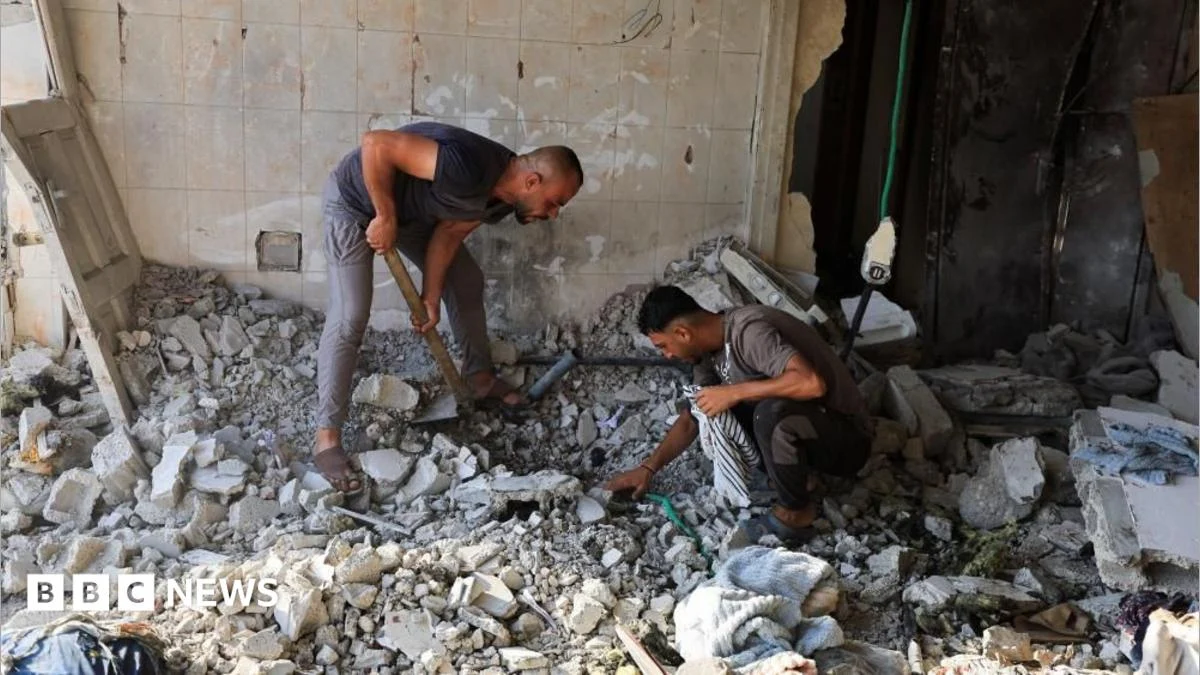
At least 13 people, including several children, have been killed in the latest strikes on Gaza, Palestinian officials have stated, casting a grim shadow over a nascent disarmament deal agreed upon by Hamas. The Gaza Civil Defence Authority reported that Israeli military aircraft carried out the devastating attacks across Gaza City, Khan Younis, and Deir el-Balah, marking the second successive night of intensified Israeli aerial operations on the besieged territory. This escalation comes just days after Hamas reportedly accepted a comprehensive disarmament plan, a proposed framework that would see the Palestinian militant group relinquish its weaponry to the newly established "Board of Peace," an initiative spearheaded by former US President Donald Trump.
A spokesperson for the Israel Defense Forces (IDF) asserted that the military was specifically targeting "military operatives" within Gaza, confirming the deaths of two Hamas militants. However, the grim reality on the ground, as reported by Palestinian health officials, paints a far more tragic picture, with the total fatalities rising significantly. The IDF’s statement, while acknowledging the deaths of militants, did not directly address the civilian casualties or the broader impact of the strikes.
Adding to the complexity and uncertainty surrounding the situation, Israeli Energy Minister Eli Cohen stated on Sunday that no agreement had been reached to halt the attacks on the Gaza Strip, a territory currently under an estimated 70% Israeli control. Cohen further articulated a stance that suggested a need for Israel to assume full control of the strip if Hamas did not fully disarm, a position that appears to diverge from the spirit of the Board of Peace plan, which reportedly includes provisions for an Israeli withdrawal from the territory, according to Reuters news agency.
The IDF, in a post on X (formerly Twitter) on Sunday, detailed its operations, claiming to have eliminated two senior Hamas commanders. One was identified as belonging to the elite Nukbha force, while the other was from the Maghazi Battalion. The IDF also reported the killing of an additional Hamas militant from the Jabalia Battalion in northern Gaza in a separate operation conducted last week. The stated justification for these targeted killings was that all three individuals were allegedly in the process of planning attacks against Israeli targets.
The devastating human cost of these operations was starkly illustrated by Palestinian health officials. They reported the deaths of two individuals, including a child, in a strike that impacted a residential building in Gaza City. Near Jabalia in northern Gaza, another individual was killed in a separate incident. The agony of families was palpable in Khan Younis, where a father, mother, and their nine-year-old son were tragically killed following a strike on their home. In Deir el-Balah, a man and a woman lost their lives when their apartment block was hit. These casualties add to a deeply concerning cumulative toll, with reports indicating that more than 1,100 Palestinians have been killed since a supposed ceasefire came into effect last October, a figure that tragically underscores the ongoing volatility and violence in the region.
The disarmament roadmap, a document that has yet to be fully implemented, outlines a multi-phased approach to demilitarization. Its core tenet states that "A process shall begin to inventory and store heavy weapons, military production sites, weapons depots, and tunnels." This crucial step, however, is explicitly conditional on Israel fulfilling its commitments under the initial ceasefire agreement, a detail that introduces a significant element of interdependence and potential for deadlock.
The precise mechanisms by which Hamas weaponry would be transferred to the Board of Peace remain somewhat ambiguous. However, prevailing understanding suggests that all heavy weapons and other military hardware would be meticulously moved into secure storage facilities. The management and oversight of these stored armaments are believed to fall under the purview of the Palestinian National Committee, a group comprised of independent technocrats to whom Hamas has reportedly agreed to cede power. This committee, a potentially pivotal entity in the transition, has been operating remotely from Cairo and has not yet established a physical presence within Gaza, a factor that could influence the timeline and efficacy of the disarmament process.
The extensive impact of the ongoing conflict on Gaza’s infrastructure is also a critical consideration. Satellite imagery analyzed by BBC Verify last November revealed that Israel had destroyed over 1,500 buildings in areas of Gaza that have remained under its control since the ceasefire. The actual scale of destruction is likely considerably higher, given that imagery was unavailable for certain localized areas. The sheer volume of debris generated by the conflict is staggering; according to United Nations estimates, approximately 60 million tonnes of debris have been produced since October 2023, a testament to the widespread devastation.
Hamas, a political and militant organization designated as a terrorist group by the United Kingdom government, has been the de facto governing authority of the Gaza Strip since 2007, a tenure marked by persistent conflict and a complex geopolitical landscape. The acceptance of a disarmament deal, however nascent and contested, represents a significant development in this long-standing and deeply entrenched conflict, though the immediate reality of continued strikes and civilian casualties casts a long and somber shadow over any prospects of lasting peace. The international community watches with a mixture of hope and trepidation as the fragile threads of this disarmament process attempt to weave a path towards de-escalation amidst the enduring tragedy of the Gaza Strip.




 Nakalama John
 Ramos Leo
 Nana Banana