George Anjay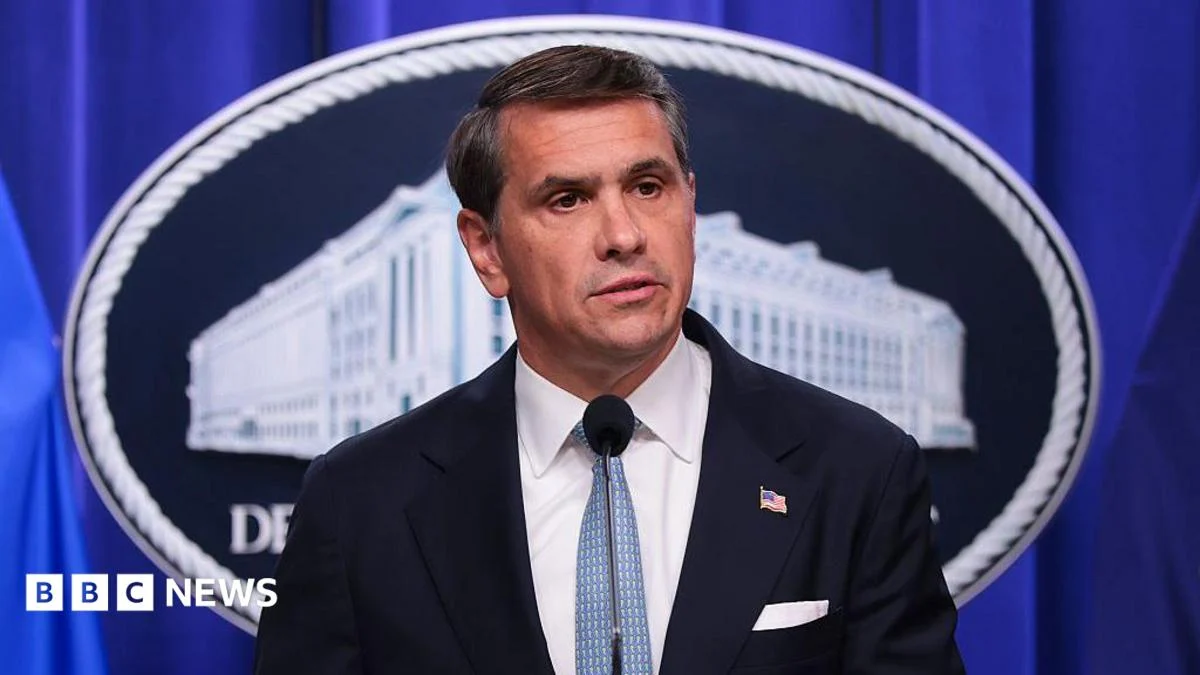
In a nail-biting confirmation that underscored deep divisions within the Republican party and highlighted the enduring influence of former President Donald Trump, Todd Blanche, Trump’s former personal attorney, has been narrowly confirmed as the nation’s top law enforcement official, the Attorney General. The razor-thin 50-49 vote, cast late last night, concluded a protracted and often acrimonious standoff between Senate Republicans and the Trump administration, a period during which Blanche had been serving as acting Attorney General since April. His confirmation marks a significant moment, solidifying Trump’s grip on key federal appointments and raising questions about the future independence of the Department of Justice.
The confirmation vote itself was a testament to the deep fissures within the Republican caucus. Two prominent Republican senators, Susan Collins of Maine and Lisa Murkowski of Alaska, ultimately joined all 48 Democrats in voting against Blanche’s nomination. Their dissent signaled significant concerns about Blanche’s qualifications and his perceived loyalty to Trump over the broader principles of justice. The deciding vote fell to Senator Bill Cassidy of Louisiana, a Republican whose decision was keenly observed in Washington D.C. circles, given the history of animosity and political maneuvering between Cassidy and Trump in recent years. Cassidy’s vote, therefore, carried immense symbolic weight, suggesting a complex calculation of political necessity and strategic maneuvering.
Several Republican senators had voiced considerable reservations regarding Blanche’s professional conduct, particularly his handling of the sensitive release of documents related to the Jeffrey Epstein scandal. More critically, significant alarm was raised concerning his instrumental role in the conceptualization and establishment of Trump’s ambitious, and ultimately controversial, $1.8 billion "anti-weaponisation" fund. This fund was purportedly designed to offer compensation to individuals who claimed to have suffered government persecution. However, critics, most notably Senator Murkowski, expressed profound fears that such a mechanism could be exploited to reward individuals who participated in the violent January 6, 2021, attack on the U.S. Capitol.
The backlash from Republican senators during Blanche’s confirmation hearings was palpable and immediate. Faced with mounting pressure and the very real threat of his nomination being derailed, Blanche ultimately offered a pledge to significantly curtail or even abandon the proposed "anti-weaponisation" fund. This concession, however, has left many observers questioning its true efficacy and legal standing. The ambiguity surrounding whether this commitment is legally binding or if Trump could later exert influence over Blanche, his former personal lawyer, to revive a similar initiative under a different guise remains a significant point of concern. The inherent tension between Blanche’s loyalty to his former client and his responsibilities as the nation’s chief law enforcement officer has been laid bare.
These lingering doubts about Blanche’s commitment to impartiality and his past affiliations were precisely why Senators Collins and Murkowski ultimately withheld their support. Senator Murkowski, in particular, articulated her lack of confidence in Blanche’s ability to "check the worst impulses of this administration." Her public announcement on Friday, stating her opposition to Blanche, explicitly cited her deep-seated concerns over the potential "politicisation" of the Department of Justice under his leadership. This sentiment reflects a broader unease among some Republicans about the increasing encroachment of partisan considerations into traditionally independent government institutions.
Following the closely contested vote, Blanche expressed his profound gratitude, stating, "I am deeply honored by the trust and confidence President Trump has placed in me." This statement, while expected, further underscores the perception that his appointment is seen as a victory for Trump and his allies, rather than a mandate for independent governance.
Senator Collins, while ultimately voting to confirm Blanche, also voiced her concerns about his involvement in settling a substantial $10 billion lawsuit between Trump and the Internal Revenue Service (IRS). Despite these reservations, Collins indicated that she ultimately trusted Blanche to provide the president with "candid legal advice," a statement that again highlights the fine line between professional duty and personal loyalty.
Prior to casting his pivotal vote, Senator Cassidy offered a detailed rationale for his decision. He asserted that he believed Blanche represented the best possible candidate that President Trump would put forward for the position, suggesting a pragmatic approach to a difficult political situation. "This is not a referendum on President Trump, it is a decision regarding Mr. Blanche, in very specific circumstances," Cassidy stated on Friday. "All considered, I will vote for Mr. Blanche." His remarks suggest a belief that confirming Blanche, despite his controversies, was a necessary step to avoid a potentially more disruptive outcome or to maintain a degree of Republican unity.
Cassidy further acknowledged the undeniable reality that Donald Trump remains the ultimate arbiter of the Justice Department’s direction. However, he also posited that Senate confirmation would bestow upon Blanche "greater leverage to push for things that should be pushed for." This suggests a hope that the formal title and Senate imprimatur might empower Blanche to advocate for certain policy objectives or reforms from within, even if those objectives are influenced by Trump’s agenda.
The context of Cassidy’s vote is particularly noteworthy. During Trump’s second impeachment trial in 2021, Cassidy voted to convict Trump on charges related to the January 6th Capitol riot. This vote, while not leading to conviction, placed Cassidy at odds with the former president. Following Trump’s return to the political arena, he actively supported a primary challenger against Cassidy, effectively forcing the Louisiana Republican into retirement from the Senate earlier this year. Cassidy’s vote to confirm Blanche, therefore, can be interpreted as a complex political gambit, perhaps aimed at rebuilding bridges with Trump or demonstrating a willingness to compromise for the sake of party unity, even after experiencing direct political retribution.
Todd Blanche’s path to the Attorney General’s office was not a sudden one. He had already been serving as deputy attorney general when he assumed the interim leadership role in April, following the dismissal of Pam Bondi. His prior experience within the Department of Justice, combined with his close association with Trump, positioned him as a formidable candidate in the eyes of the former president. However, his confirmation process has irrevocably exposed the deep-seated tensions and strategic calculations that continue to define the Republican party and its relationship with its former leader. The confirmation of Todd Blanche as Attorney General is not merely a personnel decision; it is a potent symbol of Donald Trump’s enduring influence and a stark indicator of the challenges facing the Department of Justice in navigating an increasingly polarized political landscape. The nation now watches to see how Blanche will balance his past allegiances with the demanding responsibilities of the nation’s chief law enforcement officer.



 Nakalama John
 Ramos Leo
 Nana Banana