
 Ramos Leo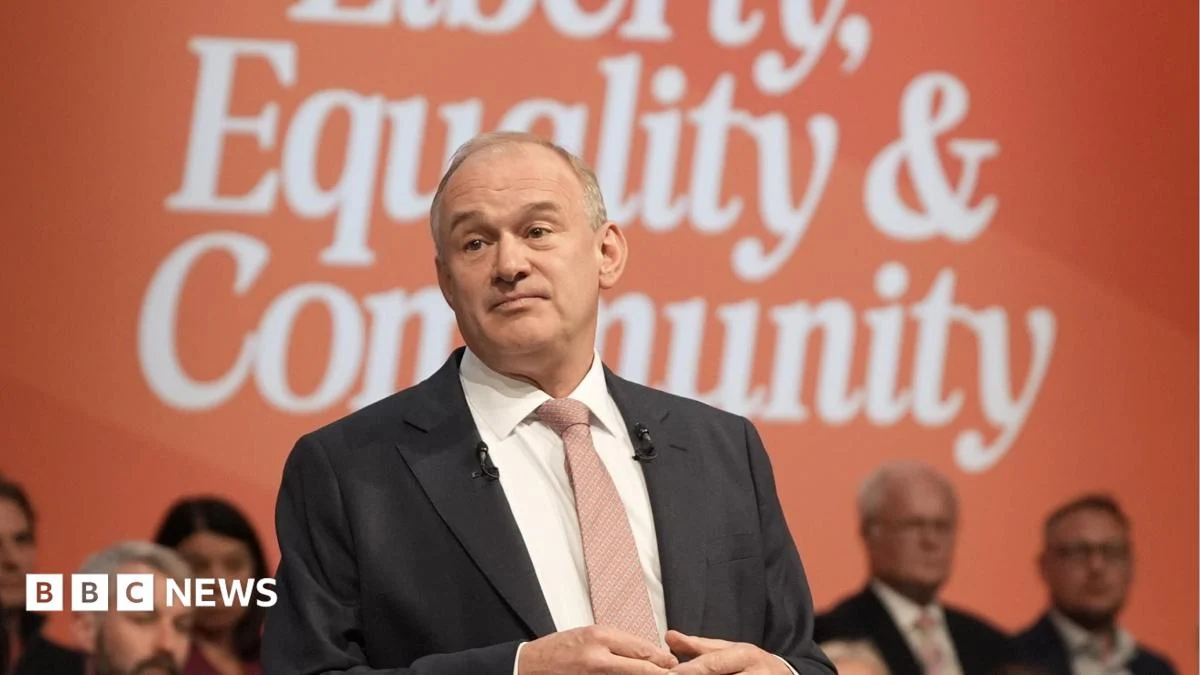
The primary focus of Davey’s address, mirroring his conference speech from the previous year, was firmly on Reform UK. This strategic targeting highlights the Liberal Democrats’ recognition of a shared battleground for disillusioned Conservative voters. However, the centrepiece of his highly anticipated speech, an announcement carefully held back for maximum impact, was a bold proposal for tax cuts worth billions of pounds, explicitly designed to appeal to Conservative-leaning voters. Crucially, these proposed cuts were not exclusively for lower-income earners but extended to those within the higher 40% tax bracket, a move calculated to broaden the party’s appeal beyond its traditional base.
A significant portion of this tax cut announcement – specifically, the policy to raise the amount individuals can earn before they begin paying income tax – bore a striking resemblance to a policy unveiled by Davey’s political adversary, Nigel Farage’s Reform UK, just weeks prior at their own conference. This overlap underscored the competitive landscape for centrist and right-of-centre voters. Yet, the critical dividing line Davey meticulously drew was over the proposed method of funding these substantial tax reductions. While Reform UK advocated for financing their tax cuts through a reduction in welfare spending, a measure often associated with austerity and a smaller state, the Lib Dem leader presented a starkly different vision. He asserted that his party would fund the cuts through the economic growth he confidently believes could be unlocked by the United Kingdom rejoining the European Union’s Single Market and a customs union.
By placing the European Union at the very core of his economic strategy and as the linchpin for funding proposed tax cuts, the Liberal Democrats couldn’t have crafted a more pronounced contrast with their political rivals. This move sharply differentiated them from both the staunchly Brexit-backing Reform UK and the Conservative Party, which remains committed to welfare spending reductions. It was a clear statement that the Liberal Democrats see their path to economic prosperity, and indeed their unique selling proposition, tied intrinsically to closer ties with Europe.
However, the ambitious plan to fund billions in tax cuts through EU re-engagement is not without its significant speculative elements and inherent risks. The Liberal Democrats’ internal projections optimistically suggest that a deal with the EU to rejoin the Single Market and a customs union could be negotiated within a year if the party were to assume power after the next general election. This timeline, however, is viewed with considerable scepticism by many political observers and economic experts, given the complex, protracted, and often fractious nature of past negotiations with the European Union.
Despite these political hurdles, the economic arguments for such a move are supported by several credible voices. Numerous economic experts, including the UK’s official budget forecaster, the Office for Budget Responsibility (OBR), have indeed indicated that the UK’s economy could experience significant growth benefits if it were to re-enter the Single Market. Their analyses often point to reduced trade barriers, increased foreign investment, and a boost to various sectors as potential advantages. Nevertheless, recent political history offers a potent cautionary tale: negotiating any comprehensive deal with the European Union has invariably proven to be far more arduous and time-consuming than party leaders initially anticipate, often fraught with unforeseen obstacles and compromises. Basing a multi-billion-pound tax cut on potential future economic growth, contingent on complex international negotiations, is inherently a risky fiscal strategy.
Furthermore, there is considerable uncertainty regarding the Liberal Democrats’ financial calculations. The independent and highly respected think tank, the Institute for Fiscal Studies (IFS), swiftly critiqued the policy. According to their assessment, the tax cut, as outlined in the party’s press release, would likely cost "much more" than the £17 billion the Liberal Democrats have publicly budgeted for. This discrepancy immediately raised questions about the party’s fiscal credibility and the robustness of their economic modelling. The party’s response was to clarify that the proposed tax cut would not be implemented until the fifth year after the next general election. This means that even if the Liberal Democrats were to win power and successfully navigate the intricate process of negotiating an EU deal, the promised tax cut could still be as many as eight years away, a timeline that might dampen immediate voter enthusiasm.
Despite these detailed financial and logistical considerations, the Liberal Democrat MPs who spoke to journalists after the speech appeared less preoccupied with the intricate details and more focused on the overarching message the announcement conveyed to the electorate. Sir Ed Davey had entered this conference facing a period of introspection and criticism regarding his leadership, with some MPs expressing their concerns privately, and others, more notably, voicing their worries about the party’s ambition and overall direction in public. These internal anxieties revolved around whether Davey was sufficiently articulating a compelling vision for the party’s future and its role in national politics.
For the time being, these internal concerns appear to have been largely assuaged by Davey’s decisive performance. "That was the speech a lot of us have been waiting for him to give," one previously sceptical MP reportedly conceded, indicating a renewed sense of purpose and confidence within the parliamentary party. While a small number of members remained quietly uncomfortable with the primary policy from the conference being a tax cut that disproportionately benefits the better-off, arguing it deviated from traditional Lib Dem social justice principles, their dissent was minor. One such member expressed a preference for the party to have focused on wooing younger voters by tackling the contentious issue of student loan repayments – a perennial "old bruise" for the Liberal Democrats, stemming from their broken promise during the coalition government.
Nevertheless, the overwhelming sentiment was positive. Overall, this speech, and indeed the entire conference, was exceptionally well received by the Lib Dem faithful, who departed Brighton with a palpable sense of invigorated purpose. The party is clearly in a phase of honing its messaging and refining its electoral strategy in anticipation of the upcoming general election. Their strategy is laser-focused on the 27 specific constituencies where the Liberal Democrats secured second place in the 2024 election. The vast majority of these target seats are currently held by the Conservatives, and Davey’s strategically designed tax cuts are explicitly aimed at appealing to these crucial, swing voters.
However, the political landscape remains challenging. The Conservative Party has already launched a pre-emptive attack, branding the Liberal Democrats as "Labour’s lapdog." This line of attack is partly fuelled by Davey’s most explicit answer this week on the question of post-election alliances: he categorically ruled out entering a coalition government with the Conservatives after the next general election. He extended the same unequivocal rejection to Reform UK. Yet, significantly, he has refrained from ruling out a potential pact or arrangement with the Labour Party. This calculated ambiguity leaves an opening for the Conservatives to relentlessly press their attack, portraying the Lib Dems as mere enablers for a Labour government. This narrative is expected to be a recurring theme from the Tories leading up to the election.
Despite these anticipated attacks, the Liberal Democrats leave their Brighton conference buoyed by a renewed sense of optimism and strategic clarity. Their sights are set not just on retaining their current record of 72 seats won at the last election, but on expanding their parliamentary presence by winning more. And what lies beyond that? "I’ve got no ceiling on our ambitions," Davey declared this week, echoing a sense of expansive possibility. Having already served in government once, in coalition with David Cameron’s Conservatives, Sir Ed Davey’s eyes are unequivocally fixed on another, more prominent, stint in office, leading a revitalised Liberal Democrat party.


 George Anjay
 Nakalama John

 atisusanti