
 Nana Banana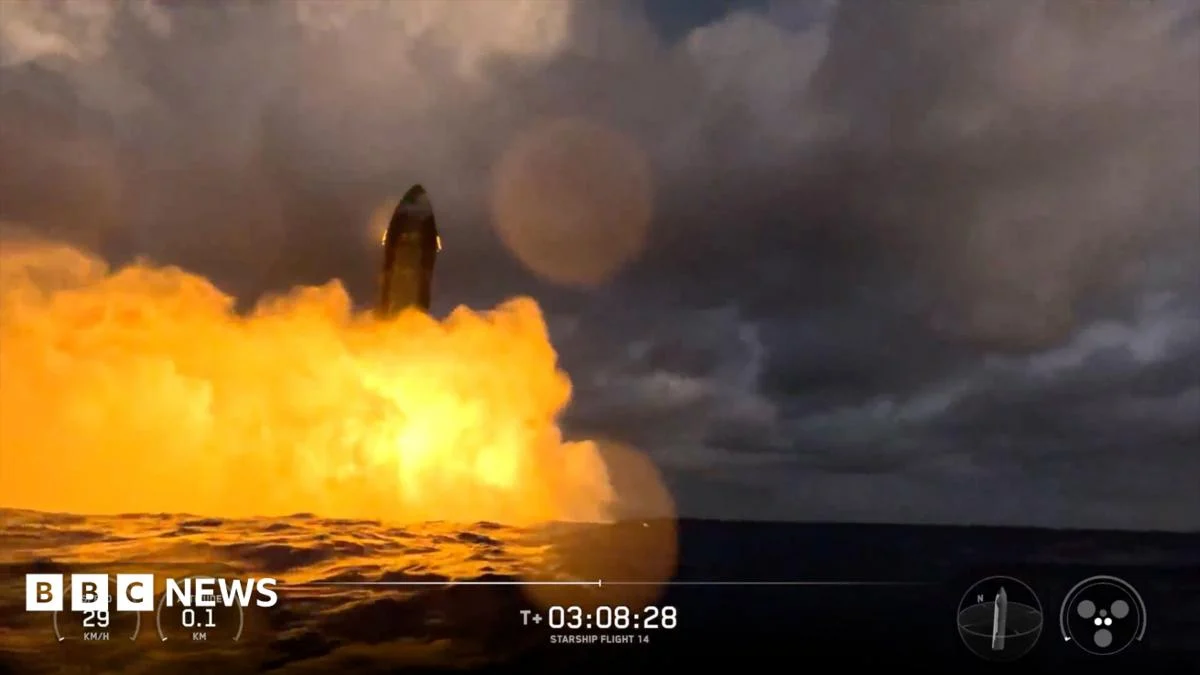
This particular flight test was pivotal, not only for demonstrating advanced flight dynamics and reusability concepts but also for a groundbreaking payload deployment. During its brief but impactful journey through space, the Starship successfully deployed 26 next-generation Starlink V3 satellites. This event, a first for the Starship program, heralds a new era for SpaceX’s burgeoning broadband internet constellation, showcasing the heavy-lift vehicle’s unparalleled capacity to rapidly expand the global Starlink network. The Starlink V3 satellites represent a significant upgrade, featuring enhanced throughput, more advanced inter-satellite laser links, and a greater capacity to serve users in remote and underserved areas, further solidifying Starlink’s position as a leading global internet provider. Their deployment by Starship underscores the vehicle’s potential to revolutionize satellite launches, moving beyond the capabilities of the Falcon 9 to deploy hundreds of satellites in a single mission, drastically accelerating constellation build-out.
The "fireball" observed during re-entry was a testament to the extreme conditions Starship endured as it plunged back into Earth’s atmosphere. Traveling at hypersonic speeds, the vehicle’s thermal protection system, comprising thousands of ceramic tiles, glowed incandescently as it battled against superheated plasma generated by atmospheric friction. This intense re-entry heating, a controlled and anticipated phenomenon for spacecraft returning from orbit, created a spectacular visual display across the sky, momentarily transforming the Starship into a brilliant, streaking meteor before its eventual gentle splashdown. While visually dramatic, the successful survival of re-entry and controlled landing in the ocean signifies a major engineering achievement, validating critical design elements for future crewed missions.
The mission’s objectives extended far beyond satellite deployment. This flight aimed to gather crucial data on Starship’s orbital maneuvering capabilities, its life support systems (though uncrewed for this test), and, critically, its ability to withstand the rigors of re-entry and execute a precise splashdown. The early termination, while not ideal, is a common aspect of iterative testing in complex aerospace development. SpaceX engineers will meticulously analyze every byte of telemetry from the three-hour flight, from the initial roar of the Super Heavy booster’s Raptor engines to the final moments of the Starship’s controlled descent. Data points on engine performance, structural integrity under stress, avionics functionality, and the integrity of the thermal protection system during peak heating will be invaluable in refining the design for subsequent flights.
Starship itself is a marvel of modern engineering, standing nearly 120 meters (394 feet) tall when stacked atop its Super Heavy booster. Its design is rooted in full reusability, a paradigm shift that promises to dramatically reduce the cost of space access. The Super Heavy first stage, powered by 33 Raptor engines, is designed to return to the launch site and perform a propulsive landing, ready for rapid reflight. The Starship upper stage, with its six Raptor engines, is intended to journey to orbit, deploy payloads, potentially refuel in space, and then return to Earth for a propulsive landing, either back at the launch site or at a designated landing pad. This radical reusability is key to SpaceX’s vision of making life multi-planetary, enabling frequent and affordable travel to the Moon, Mars, and beyond.
Previous integrated flight tests of Starship have progressively pushed the boundaries, each providing vital lessons. Early high-altitude test flights focused on the upper stage’s landing capabilities, showcasing daring "belly flop" maneuvers. Subsequent orbital test flights, while encountering various anomalies, successfully demonstrated key phases like stage separation, Starship’s journey into space, and initial re-entry attempts. This flight’s successful deployment of Starlink V3 satellites marks a functional demonstration of Starship’s payload bay and deployment mechanisms, a critical capability for its role as a satellite launcher and future space station logistics vehicle. The ability to deploy 26 advanced Starlink satellites in a single go illustrates the sheer scale of operations Starship is designed for, dwarfing the capacity of any other operational launch vehicle.
The implications of Starship’s continued development are profound. For NASA, Starship is the chosen Human Landing System (HLS) for the Artemis program, tasked with returning astronauts to the lunar surface for the first time in over 50 years. Its immense volume and payload capacity are essential for establishing a sustainable human presence on the Moon. For SpaceX, Starship is the cornerstone of its Mars colonization ambitions, envisioned as the transport system for large numbers of people and vast quantities of cargo needed to build a self-sustaining city on the Red Planet. Beyond these ambitious goals, Starship could revolutionize Earth-to-Earth travel, offering hypersonic point-to-point transportation across the globe, cutting travel times dramatically.
The development process has been characterized by rapid iteration and public testing, a hallmark of SpaceX’s engineering philosophy. Each flight, whether fully successful or experiencing anomalies, provides a wealth of data that fuels rapid design improvements. The "fireball" re-entry, while visually spectacular, represents the controlled return of a massive spacecraft from orbital velocity, a feat of engineering that few nations have mastered. The successful splashdown, despite the early mission termination, signifies a critical validation of Starship’s ability to survive the most challenging phase of orbital flight: atmospheric re-entry.
Looking ahead, the data gleaned from this flight will be instrumental in preparing for Starship’s next integrated test. Engineers will focus on optimizing the flight profile, enhancing the thermal protection system, and refining the software for even more precise orbital maneuvers and controlled landings. The successful deployment of Starlink satellites sets a new precedent, promising a future where Starship can rapidly populate Earth’s orbit with thousands of communication, observation, and navigation satellites. As Starship continues its journey through rigorous testing, each flight, with its inevitable challenges and triumphs, brings humanity closer to a future where space travel is routine and multi-planetary living is within reach. The dramatic fiery return to Earth is not merely an ending but a powerful, visually striking data point propelling the future of space exploration forward.




 George Anjay
 Ramos Leo

 Nakalama John
 atisusanti