George Anjay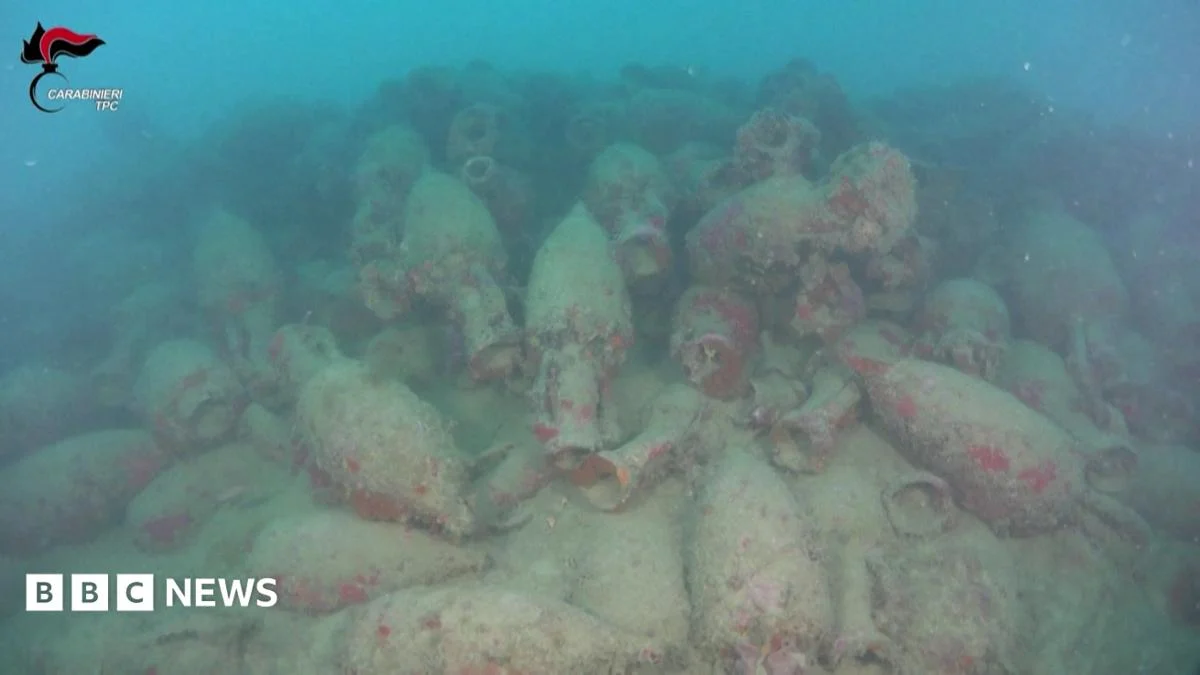
Italian divers have unearthed a remarkable ancient Roman shipwreck off the coast of Sicily, a discovery of profound historical significance believed to be over 2,000 years old. The vessel, lying in the azure depths, was found laden with a treasure trove of hundreds of remarkably well-preserved containers, known as amphorae, which were the workhorses of ancient maritime trade, meticulously employed for the transportation of vital commodities such as wine and the prized olive oil. Italy’s esteemed Minister of Culture, Alessandro Giuli, has unequivocally lauded this find, proclaiming it as "one of the most important underwater archaeological discoveries of recent years," a testament to its exceptional value in illuminating a crucial period of Roman history.
The serendipitous discovery was made by specialist police divers, operating at a depth of approximately 46 meters. Their precise location was pinpointed following a crucial tip-off from local fishermen, whose intimate knowledge of the seabed proved invaluable. Preliminary reports, emerging from local media outlets, indicate that the submerged wreckage spans an impressive 21 meters in length and six meters in width, suggesting a vessel of considerable size and capacity for its era. Scientific analysis, conducted by the culture ministry, firmly places the ship’s construction and likely sinking within the second or first century BC, a period of significant expansion and consolidation for the Roman Republic.
The narrative of this extraordinary find is deeply intertwined with the keen observation and adventurous spirit of fisherman and free-diver Giacomo De Mola. It was he who first stumbled upon the historic vessel while conducting a routine survey of the seabed in the vicinity of Mazara del Vallo, a coastal town on the westernmost tip of Sicily. In a heartfelt and evocative social media post, he recounted the sequence of events that led to this momentous discovery. His initial attention was drawn to an anomaly on his sonar scanner, an object that appeared to be a large, unusually shaped rock. Driven by a mixture of curiosity and instinct, he made the decision to descend and investigate further.
"I get closer. And my heart stops. It wasn’t a rock," De Mola articulated, his words conveying the palpable shock and awe of that moment. Instead of geological formations, he found himself gazing upon a breathtaking spectacle: hundreds upon hundreds of amphorae. These distinctive, tall ceramic jars, iconic artifacts of the ancient world, were meticulously stacked and preserved, a silent testament to the ship’s cargo. The amphorae, predominantly filled with the remnants of what were almost certainly wine, olive oil, or grain, offered a tangible link to the daily lives and economic activities of Romans millennia ago.
De Mola’s elation and sense of wonder were palpable as he described the experience. "This is, without a doubt, the most incredible discovery of my life," he declared, his voice imbued with a profound sense of privilege. "It’s hard to describe what it feels like to be among the first humans, in nearly 20 centuries, to see that place again." His words underscore the profound emotional resonance of connecting with such a distant past, of being the first to witness a scene that has lain undisturbed for two millennia.
His social media post was further enhanced by a captivating video, offering a visual glimpse into the underwater world of the wreck. The footage revealed the amphorae nestled amidst a vibrant marine ecosystem. Eels, snappers, and "countless marine life" had made their home among the ancient jars, a poignant illustration of how nature reclaims and integrates human creations into its own cycles. De Mola’s observation, "The sea never ceases to amaze us," resonated deeply, highlighting the ocean’s capacity to preserve history while simultaneously breathing new life into it.
He concluded his poignant reflection with words that encapsulate the true essence of the discovery: "This time we didn’t just find a wreck, we found a piece of our history." This sentiment elevates the find beyond a mere archaeological curiosity, positioning it as a vital portal to understanding the intricate tapestry of Roman civilization, its trade networks, its daily sustenance, and its enduring legacy.
The discovery of this Roman shipwreck off Sicily’s coast is not an isolated incident but rather a significant addition to a growing body of evidence that underscores the island’s strategic importance in the ancient Mediterranean maritime trade. Sicily, strategically positioned between Italy and North Africa, served as a crucial hub for Roman commerce, facilitating the movement of goods and people across the vast Roman Empire. The presence of such a well-preserved vessel, laden with its valuable cargo, provides invaluable insights into the scale and sophistication of Roman seafaring capabilities.
The amphorae themselves are of particular interest to archaeologists and historians. The shape, size, and markings on these ceramic containers often reveal details about their origin, their contents, and even the specific trade routes they traversed. By meticulously analyzing these amphorae, researchers can reconstruct detailed economic maps of the Roman world, understanding which regions specialized in producing certain goods and how these goods were distributed. The wine amphorae, for instance, might reveal the types of grapes cultivated and the winemaking techniques employed in different Roman provinces. Similarly, olive oil amphorae could shed light on the agricultural practices and the economic importance of olive cultivation.
The condition of the shipwreck, lying at a depth of 46 meters, suggests a relatively rapid sinking, which may have contributed to the excellent preservation of the cargo and the vessel’s structure. Factors such as low oxygen levels in the deep water, coupled with the protective embrace of sediment, can create an environment conducive to long-term preservation, shielding the artifacts from the ravages of time and marine organisms. This remarkable preservation allows archaeologists to study not only the contents of the ship but also its construction techniques, the materials used, and the craftsmanship of the Roman shipbuilders.
The identification of the specific type of vessel and its construction details can offer insights into the evolution of Roman shipbuilding technology. Were there innovations in hull design or rigging that made these ships more efficient or safer for long-distance voyages? The discovery of this shipwreck provides an opportunity to answer such questions and to further refine our understanding of Roman maritime engineering.
The role of fishermen in underwater discoveries cannot be overstated. Their daily engagement with the sea often leads them to encounter submerged artifacts and structures that might otherwise remain hidden. The tip-off from Giacomo De Mola and his fellow fishermen highlights the crucial partnership between local communities and archaeological institutions. This collaborative approach not only leads to significant discoveries but also fosters a sense of shared responsibility for the preservation of cultural heritage.
The declaration by Minister Alessandro Giuli that this is "one of the most important underwater archaeological discoveries of recent years" underscores the potential of this find to rewrite or enrich existing historical narratives. Such discoveries are not merely academic exercises; they connect us to our past in a tangible and profound way, offering a glimpse into the lives, endeavors, and achievements of those who came before us. The Roman Empire, with its vast influence on Western civilization, continues to fascinate and inform us, and discoveries like this shipwreck serve as vital reminders of its enduring legacy.
The ongoing analysis of the shipwreck and its contents will undoubtedly yield a wealth of information. Future research may involve detailed mapping of the wreck site, precise dating of the timber used in the ship’s construction, and scientific analysis of the residues found within the amphorae. The hope is that this meticulous study will not only confirm the initial assessments but also unveil new details about the ship’s journey, its crew, and the specific circumstances of its demise.
The story of this ancient Roman shipwreck off the coast of Sicily is a compelling narrative of human ingenuity, ancient commerce, and the enduring mysteries of the deep. It is a discovery that resonates across time, reminding us of the interconnectedness of past and present and the invaluable lessons that history, preserved in the silent depths, continues to offer. The artifacts recovered will likely find a place in museums, allowing the public to engage directly with this tangible piece of our shared human heritage, fostering a deeper appreciation for the rich tapestry of history that lies beneath the waves.




 Nakalama John
 Ramos Leo
 Nana Banana