Nana Banana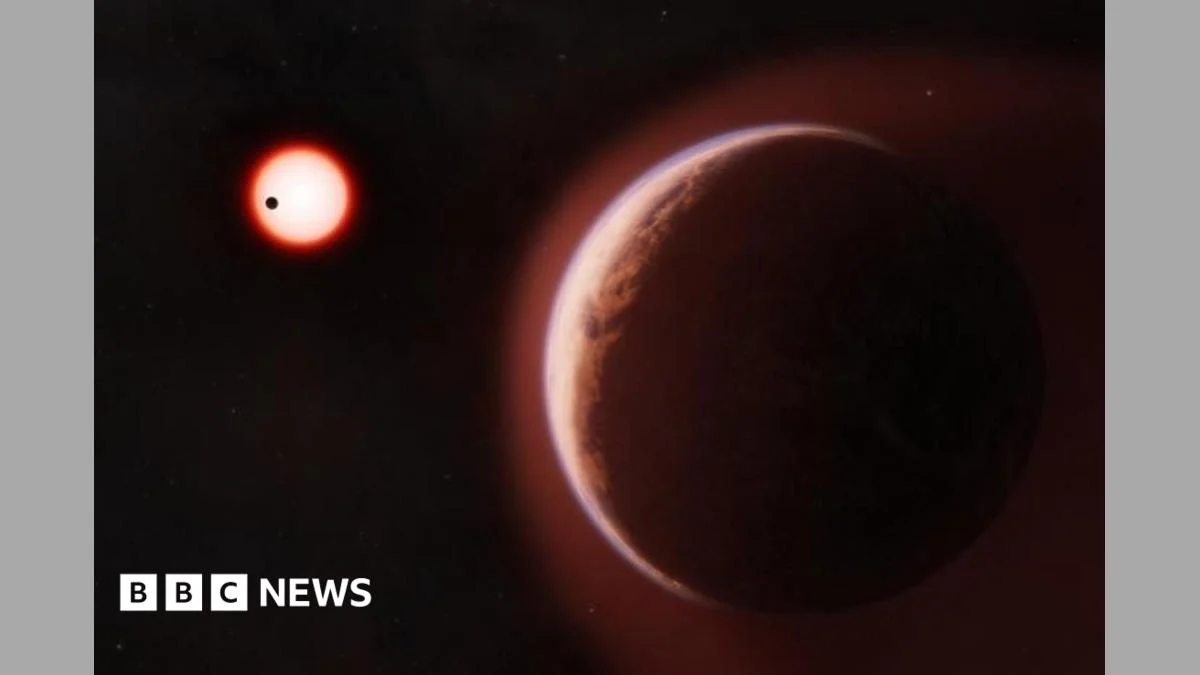
A landmark discovery has unveiled the first confirmed atmosphere surrounding an Earth-like, rocky exoplanet situated within the habitable zone of a distant star, marking a pivotal moment in humanity’s quest to understand life beyond our solar system. Researchers, whose findings were published in the prestigious journal Science, described this revelation as the strongest evidence yet that worlds capable of harboring conditions similar to Earth might exist in abundance across the cosmos. This monumental finding brings scientists a significant step closer to answering one of the most profound questions: Are we alone?
The planet at the heart of this groundbreaking research is LHS 1140b, located approximately 48 light-years from Earth. It orbits a red dwarf star, which is considerably smaller and cooler than our own Sun. Unlike the gas giants that dominate many exoplanet discoveries, LHS 1140b is classified as a super-Earth, a rocky world with a mass roughly 6.6 times that of Earth and a radius about 1.7 times larger. Its position within the star’s habitable zone, often referred to as the "Goldilocks zone," means it is at just the right distance for liquid water – a fundamental ingredient for life as we know it – to potentially exist on its surface.
The gas specifically detected in LHS 1140b’s atmosphere is helium. While helium, a noble gas, cannot directly support life, its presence is nonetheless a monumental scientific achievement. It provides tangible proof that rocky planets outside our solar system can retain gaseous envelopes. The detection of helium, likely residing in the planet’s upper atmosphere, opens the door to the possibility that other, heavier, and potentially life-sustaining gases like water vapor, carbon dioxide, or methane could be present in the lower atmospheric layers, yet to be observed.
Dr. Collin Cherubim of Harvard University, a lead author on the research, emphasized the profound implications of this discovery, describing it as "a big deal." He underscored the unprecedented nature of the finding, stating, "This is the first time anyone has found an atmosphere on a rocky planet in the habitable zone of another star." This statement highlights the distinction of LHS 1140b from the thousands of other exoplanets discovered, many of which are gas giants or icy worlds incapable of supporting surface life.
The concept of the "Goldilocks zone" is central to the search for extraterrestrial life. It defines the orbital region around a star where a planet’s temperature is neither too hot (where water would evaporate) nor too cold (where it would perpetually freeze), allowing for liquid water to persist. While hundreds of exoplanets have been identified within the habitable zones of their respective stars, only a fraction of these are small and rocky, like Earth. Even fewer of these rocky candidates have shown any signs of an atmosphere, making the detection around LHS 1140b particularly significant. An atmosphere is crucial for life, not only for providing breathable gases but also for regulating temperature, shielding from harmful radiation, and facilitating a stable water cycle.
The detection method typically involves transit spectroscopy. As the planet passes in front of its host star from Earth’s perspective, starlight filters through its atmosphere. Certain gases absorb specific wavelengths of light, leaving characteristic "fingerprints" in the stellar spectrum. By analyzing these subtle changes, scientists can infer the composition of the exoplanet’s atmosphere. The precise instruments and sophisticated analytical techniques required for such a feat underscore the rapid advancements in exoplanet research over the past two decades.
The host star, an M-dwarf (red dwarf), presents both opportunities and challenges for the potential habitability of LHS 1140b. Red dwarfs are the most common type of star in our galaxy, accounting for roughly 70% of the stellar population. They have incredibly long lifespans, potentially offering billions or even trillions of years for life to evolve. However, M-dwarfs are also known for their intense flare activity, especially in their youth, which can strip away planetary atmospheres or expose surfaces to harmful radiation. For a planet to be in the habitable zone of an M-dwarf, it must orbit much closer to its star than Earth does to the Sun. This close proximity can lead to tidal locking, where one side of the planet perpetually faces the star while the other remains in eternal darkness, potentially creating extreme temperature differences. However, a thick atmosphere could help distribute heat across the planet, mitigating these temperature extremes and expanding the potential for surface habitability. The substantial size and mass of LHS 1140b might also play a role in its ability to retain a stable atmosphere despite stellar activity.
Dr. David Charbonneau, also from Harvard and a key figure in exoplanet research, echoed Dr. Cherubim’s sentiments, emphasizing the broader context of the discovery. "People are generally interested in the big questions: Are we alone? Is there life beyond the Earth or beyond our solar system? To that end, this study reveals the first atmosphere discovered on a rocky planet in the habitable zone of a star outside of our solar system," he stated. This underscores that while the discovery of life itself remains elusive, each step, such as confirming an atmosphere on a potentially habitable rocky world, builds crucial foundational knowledge for future investigations.
The scientific community continues to scrutinize numerous other exoplanets in the ongoing search for life. K2-18b, a "sub-Neptune" exoplanet with a possible water-rich interior, previously garnered significant attention. In 2023, scientists reported tantalizing signs of dimethyl sulphide (DMS) in its atmosphere, a gas strongly linked to marine life on Earth. However, a NASA-led reanalysis in 2025 concluded that the signal was too weak to be definitively confirmed as DMS, and further research showed that the gas could form through non-biological processes. This highlights the rigorous and often cautious nature of scientific discovery, where initial exciting findings are subject to intense scrutiny and verification.
Similarly, the seven rocky worlds orbiting the TRAPPIST-1 system, another collection of M-dwarf planets, remain a compelling focus. NASA’s James Webb Space Telescope (JWST) has been instrumental in characterizing these worlds. While JWST observations ruled out an Earth-like atmosphere on TRAPPIST-1d, the data for TRAPPIST-1e, another planet in the system’s habitable zone, remain frustratingly inconclusive, underscoring the technical challenges of atmospheric characterization even with cutting-edge instruments.
The discovery of an atmosphere on LHS 1140b, therefore, stands out as a unique and definitive step forward. It provides a new prime target for intensive follow-up observations with powerful telescopes like the James Webb Space Telescope. Future studies will aim to probe deeper into LHS 1140b’s atmosphere, searching for heavier elements, water vapor, carbon dioxide, methane, and other potential biosignatures. The ability to detect even trace amounts of these gases would provide invaluable clues about the planet’s environmental conditions and its potential to harbor life. This unprecedented finding not only inspires hope but also directs future research efforts, guiding scientists toward worlds where the tantalizing possibility of life might just become a reality.




 Roy Suryo