Nana Banana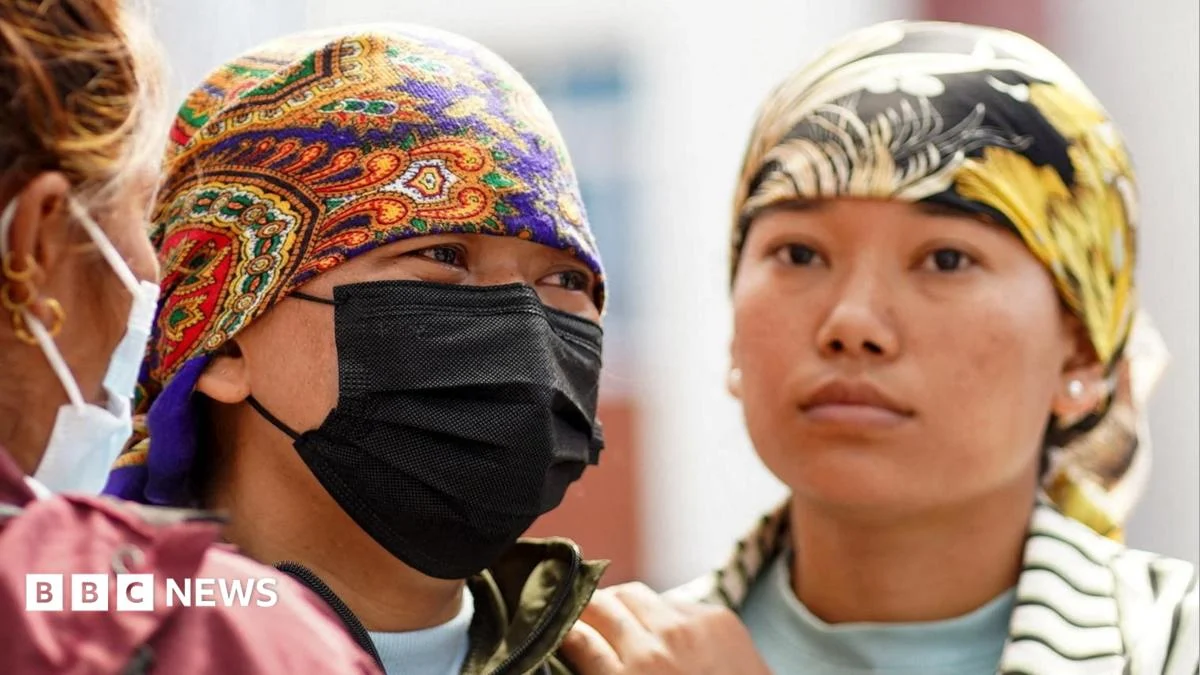
Survivors of the catastrophic flash floods that tore through Nepal’s border regions have begun to recount the harrowing moments they witnessed their dearest family members vanish into raging torrents of mud and debris. The scale of the disaster, which struck with terrifying speed on Wednesday, has left communities shattered, claiming at least 469 lives and leaving several hundred more people missing. The sheer force of the deluge was so immense that seismologists initially registered its impact as an earthquake, underscoring the unprecedented power unleashed upon the mountainous terrain. Entire villages, nestled precariously along riverbanks and valleys, were utterly obliterated, their existence erased in a matter of minutes.
As Thursday dawned, a grim tableau of destruction unfolded. Rescuers, comprising local authorities, military personnel, and volunteers, began the arduous task of sifting through the thick, viscous mud and tangled wreckage that now covered vast swathes of land. The landscape, once vibrant with homes and farmlands, was transformed into a desolate, brown wasteland, punctuated by the skeletal remains of buildings and uprooted trees. Nepalese authorities, grappling with the immensity of the tragedy, scrambled to coordinate the delivery of urgent aid and relief supplies to the hardest-hit, often remote, affected areas, battling against impassable roads and communication breakdowns.
Among the many who bore witness to unimaginable loss was Kalpana Malla, from Nepal’s Nuwakot district, a region particularly devastated by the sudden surge of water. Her voice, heavy with a grief that transcended words, conveyed the raw terror of the moment. "My family members were swept away by the flood in front of my eyes," she told the BBC, the memory etched permanently into her mind. The scene, she described, was a chaotic blur of water, mud, and screaming. Her father, her mother, her sister, and her sister’s innocent children – all were consumed by the relentless, churning monster that was the flash flood.
Kalpana recounted the terrifying speed with which the disaster unfolded, leaving no time for escape or even rational thought. "They could not escape the flood; there was no chance at all," she repeated, the finality of her words a stark testament to the flood’s merciless power. The water, a dark, roaring wall of earth and debris, had engulfed everything in its path. "This flood took everything," she said, her gaze distant, fixed on a horror only she could truly see. Yet, amidst the utter devastation, a glimmer of survival emerged. "My son and I climbed the rooftop of a house and survived but couldn’t explain how." It was a primal instinct, a desperate scramble for higher ground, executed in the heart of an unfolding nightmare.
Her son, Sugam Malla, a young man whose quick thinking saved his mother, offered a brief, understated account of his heroism. He remembered grabbing his mother’s hand, pulling her upwards, away from the rising tide of destruction, a small act of defiance against the overwhelming force of nature. But even in their survival, the shadow of loss loomed large. Sugam had given his phone to his sister earlier, a simple gesture to ensure they could stay in touch. Now, the mobile was no longer reachable. "I am worried she must be swept away," he confessed, the quiet dread in his voice echoing the fears of countless others. The unreachable phone, a symbol of modern connection, had become a chilling harbinger of separation and potential death.
The floods spared no one, indiscriminately destroying lives and livelihoods. Goma Pandit, another survivor, stood amidst the ruins of her life, her voice trembling as she enumerated her losses. "I have lost my buffaloes and all my other cattle," she lamented, the animals representing not just property but a vital source of income and sustenance for her family. Her farmland, meticulously tilled and nurtured, was now nothing more than a scarred, barren expanse. "My farmland is also swept away," she stated, the ground where her crops once grew now swallowed by the earth. "Ten sacks of mustard seeds, tons of corn and rice paddy are all gone. Nothing is left." The flood had not only taken her present but had stolen her future, stripping away years of hard work and the very foundation of her existence. For rural communities, such agricultural losses translate directly into hunger and prolonged hardship, pushing already vulnerable families to the brink.
Miles away from the immediate devastation, at Kathmandu’s TU Teaching Hospital, a different kind of anguish unfolded. The waiting room, usually a place of hope or routine medical care, had transformed into a somber vigil. Families of those missing in the floods gathered, their faces etched with anxiety, clutching phones, photographs, and the fragile threads of hope that their loved ones might still be alive. The air was thick with unspoken fears, punctuated by the hushed tones of worried conversations and the occasional muffled sob.
Among them was Ram Khumari Shrestha, her hand trembling slightly as she held up her phone, its screen displaying a smiling image. "This is my husband," she introduced him, her voice barely above a whisper. "He was off to Rasuwa as a part of his driving job." Rasuwa, a district bordering Tibet and a key transit point, had been directly in the path of the flood’s fury. "He was in contact with me until 8 pm yesterday," she explained, recalling the last mundane details of their conversation, now infused with tragic significance. The ordinary goodnight, the promise of a return, now felt like a cruel irony. "But I couldn’t call him this morning. The phone was switched off," she told the BBC, the simple act of a dead battery amplifying her growing dread into a chilling certainty. Each unanswered call was a tightening knot in her stomach, each passing minute stretching into an eternity of uncertainty.
Mani Shrestha Bishwa shared a similar ordeal, having spent the entire Wednesday night camped out at the hospital, his eyes weary from lack of sleep and constant worry. His missing loved ones represented a cross-section of his life: his younger brother, his cousin, his uncle, and a close friend. The widespread nature of their disappearance underscored the indiscriminate reach of the flood. "I last contacted them at 8:30 in the morning," he recalled, the memory of that last, fleeting connection now haunting him. He imagined their last moments, hoped they found safety, but the lack of news was a torment.
Trekking guide Sonam Dorjee, by a twist of fate, had narrowly missed the catastrophe that engulfed his home village of Rasiwa Syafru. He had departed at 08:00 local time, just an hour before the roaring wall of water descended. That hour, a seemingly insignificant span of time, had made all the difference between life and death. As he drove towards Kathmandu, a journey that usually offered scenic beauty, he heard something far more sinister. Dorjee recounted hearing the terrifying sound of floods gushing into their village, a sound unlike anything he had ever experienced. "It [sounded] like an earthquake," he told the BBC, trying to convey the deep, rumbling, destructive power that tore through his home.
The confirmation of his worst fears came with a photograph, shared by a distraught relative. "My house has collapsed… I have seen a photo," he stated, the image burned into his memory. But the loss of his home was secondary to the agonizing uncertainty surrounding his family. His sister, Dechen Tamang, was among the missing, along with her husband and several other family members. The thought of them being caught in that terrifying surge, unable to escape, gnawed at him. He described the flood as "sudden and devastating," a brutal force that left no time for preparation or warning.
Sonam’s immediate concern, beyond his own family, extended to the countless others who had survived but lost everything. "Many survivors are now left without homes," he emphasized, articulating the dire humanitarian crisis unfolding. "They need emergency rescue and evacuation, as well as food, temporary accommodation and medical support." The immediate aftermath demanded rapid response, not just for the missing, but for those who remained, shell-shocked and vulnerable.
Amidst the overwhelming despair, a sliver of hope, however fragile, persisted. Sonam Dorjee clung to it, praying for his sister’s safe return. "There is a 10% chance, we hope," he said, the percentage a stark indicator of the slim odds, yet enough to fuel a desperate vigil. His words echoed the sentiments of every family member waiting at the hospital, every survivor sifting through the mud, and every rescuer battling against the elements. The Nepal-Tibet floods had not only brought destruction but had laid bare the raw, enduring human spirit in the face of unimaginable tragedy. The path to recovery would be long and arduous, but the stories of survival, loss, and resilience would forever mark the memory of this devastating natural disaster.



 Roy Suryo

 George Anjay
 Nakalama John
 Ramos Leo