George Anjay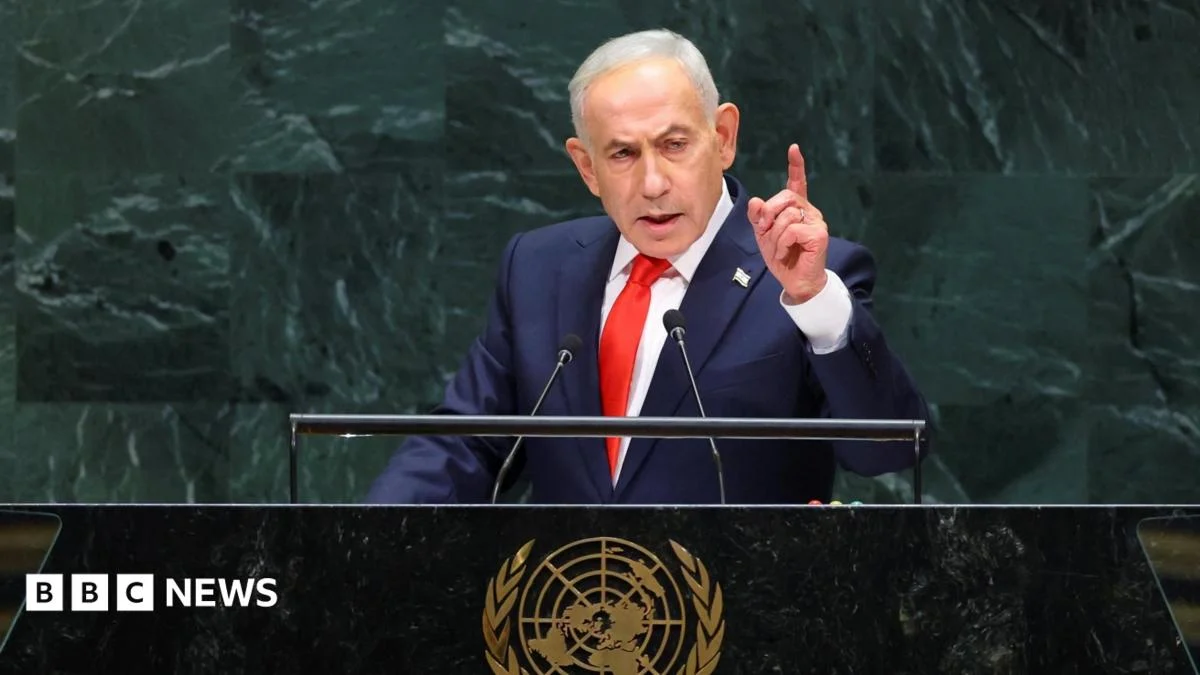
Israeli Prime Minister Benjamin Netanyahu fiercely defended his country’s military campaigns in Iran, Gaza, and across the Middle East during a combative address to the UN General Assembly, a speech punctuated by a significant walkout of delegates protesting his presence. Undeterred by the near-empty hall as he began his remarks, Netanyahu projected an unyielding stance, declaring, "We’re going to win. We have no other choice." His defiant tone extended to those who departed, as he provocatively stated, "If there are any other moral cowards who haven’t left the hall, please do so now." The Prime Minister explicitly rejected the grave accusations that Israel is perpetrating genocide in Gaza, a claim that has resonated globally and fueled much of the international condemnation.
Hours before Netanyahu’s pronouncements, Palestinian President Mahmoud Abbas, speaking via a prerecorded message after being denied a U.S. entry visa, painted a starkly different picture of the situation. Abbas detailed how Israeli policies, particularly the "illegal expansion of Jewish settlements in the occupied West Bank," pose a direct threat to "the very life and existence of the Palestinian people on their homeland." He articulated that these actions not only imperil Palestinian lives but also jeopardize the viability of the two-state solution, an internationally endorsed framework for peace. Abbas accused the Israeli military of subjecting Palestinians to "killing, destruction, starvation and attempts at displacement, as well as a genocidal war" in Gaza, underscoring the dire humanitarian crisis and the perceived systematic violence.
Netanyahu’s speech, delivered while he himself faces scrutiny from the International Criminal Court for alleged war crimes, was marked by scathing condemnations of nations and leaders who have dared to criticize his government’s actions. He directly challenged the notion of Israeli colonialism, remarking, "They accuse Israel, tiny Israel, of colonialism – some colonialism. And who’s accusing us? Among them are people in Britain and in France. For God’s sake, they invented the term." This rhetorical volley aimed to reframe historical narratives and deflect criticism by highlighting the colonial past of some of the nations now voicing concerns about Israel’s conduct.
His ire was also directed at Turkish President Recep Tayyip Erdogan, whom Netanyahu labeled a "tyrant" and accused of actively supporting the Palestinian armed group Hamas. This accusation escalates the already tense diplomatic relations between Turkey and Israel. Erdogan’s prior address to the UN, where he asserted that the injustices faced by Palestinians in Gaza and the West Bank "deeply offend the conscience of humanity," clearly served as a catalyst for Netanyahu’s sharp retort. The juxtaposition of their statements highlights the deep chasm in their perspectives on the ongoing conflict.
The Israeli Prime Minister also took aim at New York City’s left-wing mayor, Zohran Mamdani, whose prior vows to arrest Netanyahu, though later retracted due to jurisdictional limitations, clearly irked the Israeli leader. Netanyahu’s pointed remark, "Since you were elected mayor of this city, many Jews no longer feel safe in New York," sought to politicize the mayor’s stance and evoke fears within the Jewish community. Mamdani’s office responded swiftly, denouncing Netanyahu’s speech as an attempt to "repeat baseless lies meant to sanitize his genocide of Palestinians," thus directly countering the Prime Minister’s narrative and reiterating accusations of Israeli atrocities.
In a move that underscores the complex geopolitical alliances at play, Netanyahu extended his gratitude to former U.S. President Donald Trump for his "bold leadership," specifically referencing the joint U.S.-Israeli air strikes against Iran in February. This statement positions the U.S. and Israel as partners in confronting perceived threats, with Netanyahu declaring, "Israel and America acted together not only to protect ourselves, but to save civilization." This framing elevates the conflict to a broader civilizational struggle, seeking to garner international support by casting Israel’s actions as a defense of universal values.
The heightened tensions surrounding Netanyahu’s visit were palpable not only within the UN General Assembly but also on the streets of New York City. A number of individuals protesting Netanyahu’s presence and Israeli policies were detained by law enforcement. Among those detained were prominent figures such as Oscar-winning actress Susan Sarandon and Emmy-winning actress Hannah Einbinder, illustrating the broad spectrum of public sentiment and the deep divisions the conflict engenders. Their detention, alongside other protestors, highlights the significant opposition to Netanyahu’s policies and the international scrutiny he faces.
The events at the UN General Assembly, characterized by a defiant Prime Minister, a mass walkout, and starkly opposing narratives from Israeli and Palestinian leadership, underscored the intractable nature of the Israeli-Palestinian conflict. Netanyahu’s robust defense of military action, coupled with his aggressive rhetoric towards critics, painted a picture of an Israeli government determined to pursue its objectives regardless of international pressure. Conversely, Abbas’s plea for an end to Israeli policies and his condemnation of the violence in Gaza served as a powerful reminder of the Palestinian struggle for self-determination and an appeal to the global community to uphold international law and humanitarian principles. The dual narratives presented at the UN provided a stark illustration of the deep-seated grievances and the immense challenges that lie ahead in the pursuit of a lasting peace in the region. The international community’s response, or lack thereof, to these opposing claims will undoubtedly shape the future trajectory of the conflict.


 Nakalama John
 atisusanti
 Ramos Leo
 Roy Suryo