George Anjay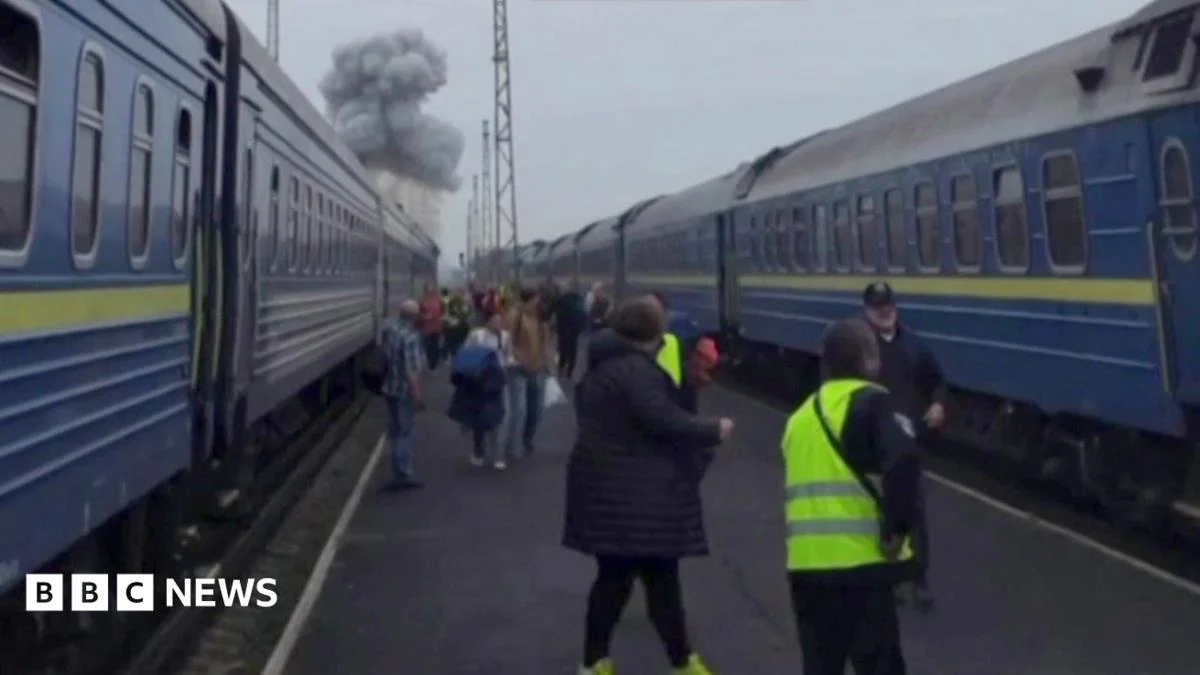
A Russian drone strike targeted a train near the Ukraine-Poland border mere moments after former UK Prime Minister Boris Johnson and a contingent of high-ranking European security officials had passed through the same area. The attack, which occurred at Yahodyn, struck the engine of a Ukrainian train, but thankfully, no casualties were reported. Ukrainian authorities confirmed that all passengers had been safely evacuated from the train prior to the strike.
The diplomatic entourage, which included prominent figures such as the UK’s National Security Adviser Jonathan Powell, had been traveling back from a crucial conference in Kyiv. They had traversed the very same railway line on a separate train, their departure predating the drone attack by a narrow margin. Russia, in its official statement, claimed to have targeted "railway infrastructure" in western Ukraine. However, Ukraine’s state railway company, Ukrzaliznytsia, strongly suggested that the "target of this drone could have been the diplomatic train," highlighting the precision and timing of the attack.
Ukrzaliznytsia further elaborated that the diplomatic train had "left the station earlier than expected because of the timetable change… due to constant threats of Russian strikes." This suggests a deliberate maneuver to avoid potential attacks, a strategy that was narrowly, yet dramatically, circumvented by the Russian strike. The railway authority also revealed that an evacuation order for the passengers on the targeted train had been issued "just 15 minutes" before the Russian jet-propelled drone descended. Adding to the high-profile nature of the incident, former CIA Director David Petraeus was also reported to have been on board another train at Yahodyn station at the time of the drone strike, underscoring the presence of significant international figures in the vicinity.
Both Ukrainian and Polish authorities confirmed that the Russian drone had impacted the ground approximately 2 kilometers from the Polish border, indicating a calculated strike close to a NATO member state. Former Swedish Prime Minister Carl Bildt, who had also participated in the Kyiv conference, recounted his experience to the BBC. Passengers on his train were initially instructed to prepare for evacuation after their train came to an unexpected halt. However, after a period of anxious waiting, they received confirmation that the situation was "clear" and were permitted to continue their journey. Bildt’s train subsequently arrived safely at Poland’s border station in Dorohusk. While some reports initially suggested that Bildt was on the same train as Boris Johnson, the former UK prime minister has not officially confirmed these details.
Boris Johnson himself took to X, formerly Twitter, to condemn the attack. He questioned the "warped logic" behind what he described as Putin’s decision to "blow up a stationary Ukrainian locomotive on the Polish border this morning." Johnson characterized the incident as emblematic of the "kind of random and senseless attack Ukrainians are enduring every day – even on civilian railways." He issued an urgent plea to Kyiv’s allies to provide Ukraine with the "air defences they need" to counter such aggressions.
This incident occurs against a backdrop of repeated appeals from Ukraine to its international partners, particularly the United States, for increased provision of interceptors and air defense systems. Ukraine faces daily Russian assaults, which have increasingly incorporated fast-moving ballistic missiles and sophisticated jet-propelled drones, posing a significant threat to civilian infrastructure and lives.
The recent strike on the train near the Polish border appears to be part of a broader escalation in Russia’s war against Ukraine, with a discernible pattern of targeting trains, railway depots, petrol stations, and border crossings. Earlier in the week, two individuals were killed when Russian drones struck a border crossing between Ukraine and Moldova, a grim development reported by Ukrainian President Volodymyr Zelensky. This followed another tragic incident where a female train conductor lost her life in a Russian drone attack on a passenger train in southern Ukraine. At the beginning of the month, six employees of Ukrzaliznytsia were killed when a depot in Kyiv was struck. In January, President Zelensky vehemently condemned a Russian attack on a crowded passenger train in the northeastern Kharkiv region, which resulted in five fatalities, describing it as an act of "terrorism."
These relentless Russian attacks have inflicted significant damage on Ukraine’s extensive railway network, which serves as the primary mode of transportation for millions of Ukrainians. The suspension of all air travel since the commencement of Russia’s full-scale invasion in February 2022 has rendered the railway system even more critical for both domestic and international transit.
Beyond Ukraine’s borders, European nations are also attributing a series of suspicious incidents on their territories to Russia. Last week, Germany explicitly stated that Russia was responsible for a drone attack at Leipzig’s airport in August, a claim vehemently denied by Moscow as "absurd." Furthermore, a number of unexplained fires have been reported at defense facilities across Europe, stretching from Italy to Estonia, with several of the affected countries directly implicating Russia in these incidents. The proximity of the train strike to the Polish border, coupled with the presence of high-profile Western officials, underscores the heightened tensions and the perceived reach of Russian aggression into areas that were previously considered relatively secure. The incident serves as a stark reminder of the ongoing threats to civilian infrastructure and the urgent need for enhanced security measures and robust air defense capabilities for Ukraine and its neighboring allies.




 Nakalama John
 Ramos Leo
 Nana Banana