George Anjay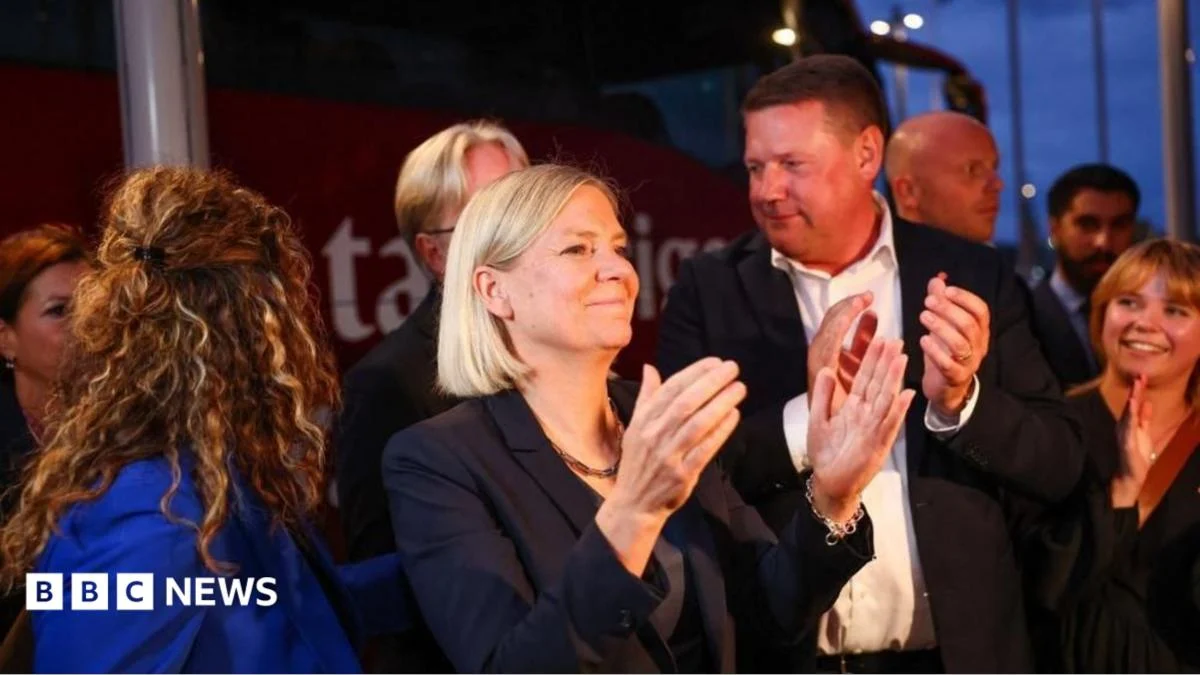
Sweden’s political landscape finds itself at a precarious crossroads following Sunday’s general election, with projections indicating an almost exact tie between the nation’s two dominant party blocs. This electoral deadlock, a recurring theme in Swedish politics characterized by its multi-party system and a history of coalition and minority governments, now places the nation in a period of intense negotiation and uncertainty. The two major political blocs, one comprising four parties on the right and the other four on the left, are poised for a period of intricate power-sharing discussions, with the potential for either a stable coalition or a fragile minority government to emerge.
At the heart of the left-leaning bloc stands the Social Democrats, a party that has exerted a formidable influence on Swedish politics since the conclusion of World War Two. For decades, they have been the architects of the Swedish welfare state, shaping social policies and driving economic development. However, the electoral landscape has been dramatically reshaped by the ascendance of the Sweden Democrats (SD). This party, with its origins rooted in neo-Nazi sympathizers in the 1980s, endured years of political ostracization. Yet, in a significant electoral shift in 2022, the Sweden Democrats emerged as the country’s second-largest party. Their surge was fueled by a potent campaign that capitalized on public anxieties surrounding escalating violent crime and growing concerns about immigration, resonating with a segment of the electorate feeling overlooked by the established political order.
Prime Minister Magdalena Andersson, the leader of the Social Democrats, articulated the stark choice confronting the Swedish electorate as she cast her vote on Sunday. Her message was a clear dichotomy: "Should we have a government entirely dominated by the Sweden Democrats, something that has never happened in Sweden before? Or should we have a government led by me, which will steer Sweden in a new spirit of co-operation?" This framing highlights the fundamental ideological divide and the potential for a radical departure from Sweden’s post-war political consensus should the right-wing bloc, heavily influenced by the Sweden Democrats, gain outright control. Andersson’s appeal for a "new spirit of co-operation" suggests a desire to bridge divides and foster a more inclusive form of governance, a sentiment that will be crucial in the upcoming negotiations.
On the opposing side, Ulf Kristersson, the leader of the Moderate Party and the de facto leader of the right-wing bloc, emphasized the importance of continuity and the continuation of their policy agenda. "I think there is a genuine enthusiasm for us being able to continue our important work," Kristersson stated, his words carrying the weight of a leader seeking a mandate to build upon their existing platform. He made these remarks after casting his ballot in his home municipality of Strangnas, a move that underscored his connection to the local communities he aims to represent at a national level. Kristersson’s focus on continuing "important work" points towards a desire to implement their proposed reforms, particularly in areas such as fiscal policy and law and order.
The election campaign itself was dominated by a trifecta of critical issues that deeply resonated with the Swedish populace. National security, a concern amplified by the evolving geopolitical climate and Sweden’s recent aspirations to join NATO, occupied a prominent position. The persistent challenge of gang crime, a visible and often brutal reality in many Swedish cities, generated widespread public fear and demands for stronger law enforcement and social intervention. Furthermore, the sustainability and future of Sweden’s vaunted welfare state, a cornerstone of its social contract, was a central theme, with debates raging over how to fund and adapt these generous social programs to meet the demands of an aging population and a changing economy.
The implications of this near-tie are far-reaching. A government led by the Social Democrats would likely continue to champion social democratic principles, focusing on public services, environmental protection, and social equality. However, their ability to govern effectively would depend on securing the support of smaller left-leaning parties and potentially navigating the complex dynamics of a minority government. Conversely, a right-wing government, likely spearheaded by the Moderate Party, would signal a shift towards more market-oriented policies, tax reductions, and a tougher stance on crime and immigration. The significant influence of the Sweden Democrats within this bloc raises questions about the direction of social policy, foreign relations, and the very identity of Sweden.
The historical context of Sweden’s political system is crucial to understanding the current situation. The nation has long embraced a proportional representation system, which inherently leads to a multitude of parties in parliament. This electoral architecture has fostered a culture of consensus-building and compromise, but it also means that single-party majorities are exceedingly rare. Coalitions are the norm, and minority governments, reliant on ad-hoc support from other parties, are not uncommon. This election result, therefore, is not entirely unprecedented in its outcome of a closely contested race, but the composition of the blocs and the rise of the Sweden Democrats add a unique and potentially disruptive dimension.
The Sweden Democrats’ journey from a fringe far-right group to a mainstream political force represents a significant ideological shift in Swedish society. Their success challenges the long-held post-war consensus on multiculturalism and open immigration, a consensus that has defined Sweden’s social fabric for decades. Their platform, which emphasizes national identity, stricter immigration controls, and a more punitive approach to crime, has clearly found fertile ground among voters who feel alienated by globalization and societal changes. The extent to which the other parties in the right-wing bloc are willing to accommodate the Sweden Democrats’ agenda will be a key determinant of the stability and direction of any future government.
For the Social Democrats, the outcome represents a moment of reckoning. Despite their historical dominance, they have struggled to maintain their broad appeal in recent years, facing challenges from both the left and the right. Prime Minister Andersson’s appeal for "co-operation" can be interpreted as an olive branch, a recognition that a purely partisan approach may not be viable in this fractured political environment. The challenge for her and her party will be to forge alliances and find common ground with other parties, potentially including some from the center-right, to form a government that can address the nation’s pressing issues.
Ulf Kristersson, on the other hand, faces the challenge of uniting a potentially fractious right-wing coalition. While the desire to govern is strong, the ideological differences between the Moderate Party, the Christian Democrats, the Centre Party, and the Sweden Democrats are substantial. Navigating these differences, particularly on issues such as climate policy, social welfare, and the integration of immigrants, will require considerable political skill and a willingness to compromise. The Sweden Democrats’ demand for a significant role in policy-making, especially in areas like immigration and justice, will be a key point of contention.
The protracted period of coalition negotiations that is now likely to ensue will test the resilience of Sweden’s democratic institutions. The public will be watching closely as party leaders engage in behind-the-scenes discussions, horse-trading, and the delicate art of compromise. The outcome of these negotiations will not only determine who forms the next government but also the broad direction of Swedish policy for years to come, impacting everything from economic growth and social welfare to national security and Sweden’s role on the international stage. The projections of a tied vote have set the stage for a pivotal moment in Swedish political history, one that will be defined by the choices made in the coming days and weeks. The nation’s ability to navigate this period of uncertainty and forge a path forward will be a testament to the enduring strength of its democratic traditions.



 Nana Banana
 Nakalama John
 atisusanti
 Ramos Leo