George Anjay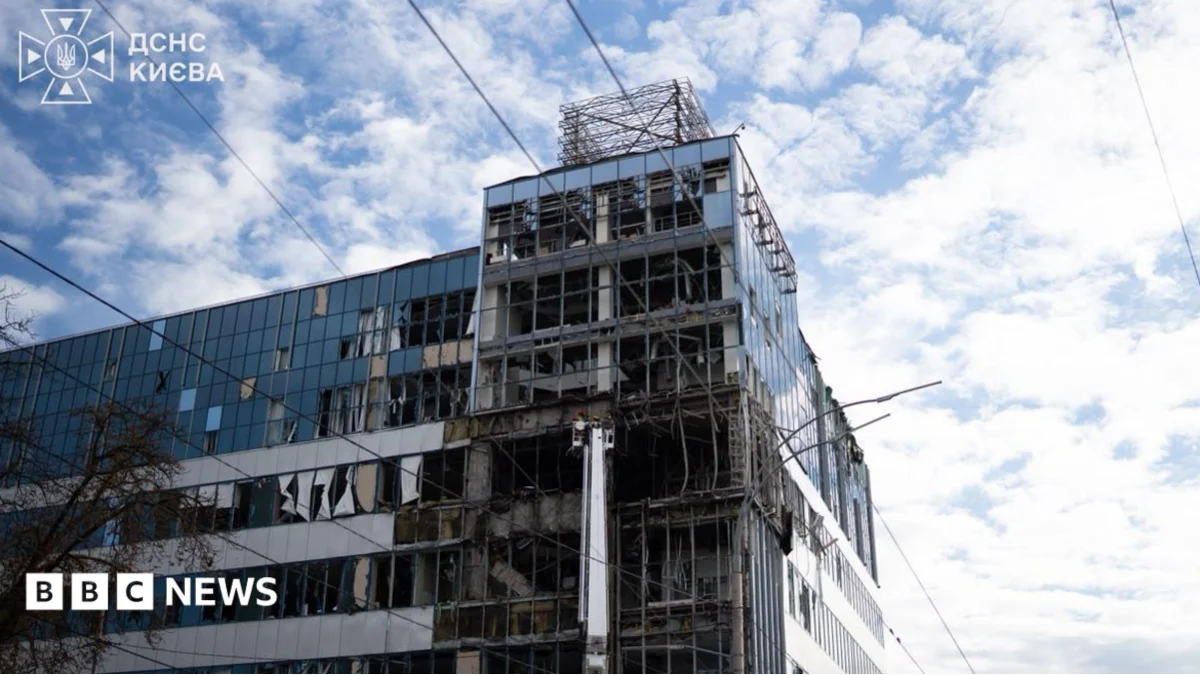
President Volodymyr Zelensky has declared that Russia has significantly broadened its attack strategy, now deliberately targeting Ukraine’s data centres and internet providers with the explicit aim of causing maximum disruption to the daily lives of ordinary citizens. "All this affects people’s ability to stay connected, study, work," Zelensky stated, highlighting the profound impact these strikes are having on the fabric of Ukrainian society.
The recent escalation was starkly illustrated on Friday when a Russian drone struck a business centre in the capital, Kyiv, resulting in four fatalities and significant damage to a data centre housed within. In a separate, devastating incident on the same day, another attack claimed the life of a 14-year-old boy, who the Israeli foreign ministry confirmed was an Israeli citizen. Russia, in its official confirmation of the strike, asserted that the targeted data centre was being utilized by Ukrainian military intelligence. The repercussions of these attacks were widespread, with approximately 100,000 households in Kyiv and the surrounding region experiencing internet outages on Wednesday alone due to the strikes. In response to the mounting damage and the threat to their operations, some Ukrainian firms have already initiated the process of migrating their data from compromised servers to facilities located abroad, seeking greater security and continuity.
The impact of these attacks extends beyond the capital. In the north-western city of Lutsk, electronic information boards at public transport stops were rendered inoperable on Friday, as confirmed by local officials. The city council attributed this disruption directly to "damage caused by a Russian attack on data centres in Kyiv," underscoring the interconnected nature of Ukraine’s digital infrastructure and the far-reaching consequences of Moscow’s actions.
In a pointed social media post on Friday, Zelensky articulated his grave concerns, writing, "The Russians are constantly expanding their escalation operation: American and other businesses, data centres, internet providers – for Russia, all ordinary life is simply a target." He emphasized the urgent need for a robust global response, stating, "It is important that the world responds to all of this and that Russia feels the response to its terror."
Later on Friday, President Zelensky announced that "additional decisions" had been made during a high-level meeting with Ukraine’s top defence and security officials. These measures are specifically designed to bolster the protection of the country’s data centres and other critical communications facilities, aiming to ensure their uninterrupted operation. Ukraine’s Foreign Minister, Andrii Sybiha, echoed these concerns, asserting that Russia’s targeting of data centres is a calculated attempt to disrupt the flow of "life-saving information." Sybiha stressed the vital role of these facilities, stating, "Rapid alerts about missile and drone threats are essential – they save lives. This is critical civilian infrastructure… It is not a military target. It is essential to keeping everyday life functioning."
While acknowledging the potential for localized disruptions, Serhii Beskrestnov, Zelensky’s top adviser on defence technologies, admitted on Thursday that "there may be local disruptions" following Russian attacks. He also cautioned that the cost of internet services could potentially increase to cover the expenses associated with repairs. However, Beskrestnov also provided reassurance, emphasizing that Ukraine’s internet network is characterized by a high degree of decentralization, which means the country "will not be left without internet access."
The specific data centre hit by Russia on Friday was operated by Datagroup. The company reported that its specialists were actively assessing the damage sustained during the daytime attack, but crucially, confirmed that "all services continue to operate from backup sites." The broader impact of the Russian overnight attacks on Friday was severe, with Kyiv Mayor Vitaliy Klitschko reporting late in the evening that seven people had been killed and 59 injured. The Russian Ministry of Defence subsequently confirmed its strike on the Datagroup site, reiterating its claim that it was being used by the Ukrainian military’s intelligence services. Verified footage circulating online, shared by the BBC, clearly depicts the damaged Inkom business centre that housed Datagroup. Furthermore, the Russian defence ministry disclosed that over the preceding days, its forces had systematically targeted a number of data processing and telecommunications centres across Ukraine, naming New-Telco, United DC, Kyivstar, and Parkovyi among them.
This intensified focus on digital infrastructure follows a recent surge in Moscow’s strikes on Ukraine’s energy and railway networks. These attacks appear designed to inflict maximum damage as winter approaches, aiming to cripple essential services and sow further discord. In a reciprocal strategy, Ukraine’s military has been actively targeting Russian oil refineries and logistics hubs, arguing that these facilities are instrumental in financing Russia’s ongoing war effort. Since launching its full-scale invasion in 2022, Russia currently exercises control over approximately 20% of Ukrainian territory.
In a significant development on Friday, Russian President Vladimir Putin, speaking to reporters, indicated that Moscow would "give careful thought" to the possibility of resuming direct peace negotiations with Kyiv. This statement followed a "massive" Ukrainian attack on the capital, Moscow, and other recent strikes. Putin suggested that such talks were "possible," but crucially stressed that Ukraine "must feel our retaliatory strikes," and that all decisions would be guided by "the Russian Federation’s interests." Earlier, President Zelensky had expressed his readiness for trilateral talks, which would also include the United States. However, Kyiv and its European allies have consistently accused Putin of rejecting peace negotiations, asserting that his true objective is territorial expansion. During his press briefing, Putin also reiterated his long-standing assertion that Moscow has "no plans" and "no reason" to attack Europe, a statement bearing chilling resemblance to his previous pronouncements about Ukraine before the 2022 invasion.
In a separate, positive development for Ukraine, the European Union agreed to release €6.6 billion in financial aid, as announced by the bloc’s top diplomat, Kaja Kallas. She characterized this as "good news for Ukraine and bad news for Russia." This allocation includes €900 million for the EU’s Military Assistance Mission for Ukraine and a €1 billion fund designated for the joint procurement of equipment. Kallas emphasized that "Moscow’s hybrid attacks try to intimidate Europe into scaling back its support for Ukraine. Europe is doing the opposite."
Meanwhile, Polish prosecutors have initiated an investigation into what they described as an arson attack on a Starlink satellite station in Wola Krobowska on Wednesday. The national prosecutor’s office stated that "there is a reasonable suspicion… that the perpetrators acted on the orders of the Russian special services." Moscow has not yet commented on these allegations. The targeted station plays a crucial role in transmitting internet traffic through Poland to various countries, including Ukraine, utilizing SpaceX systems and Starlink terminals for connectivity. In recent weeks, several European NATO members have issued warnings regarding potential Russian hybrid attacks aimed at testing their resolve in supporting Ukraine, claims that Moscow consistently denies. Earlier this month, Germany attributed an attempted drone attack on Leipzig/Halle Airport to Russia, while France has implemented a plan to safeguard its critical infrastructure and defence industry sites.



 Roy Suryo
 Nakalama John
 atisusanti
 Ramos Leo