
 George Anjay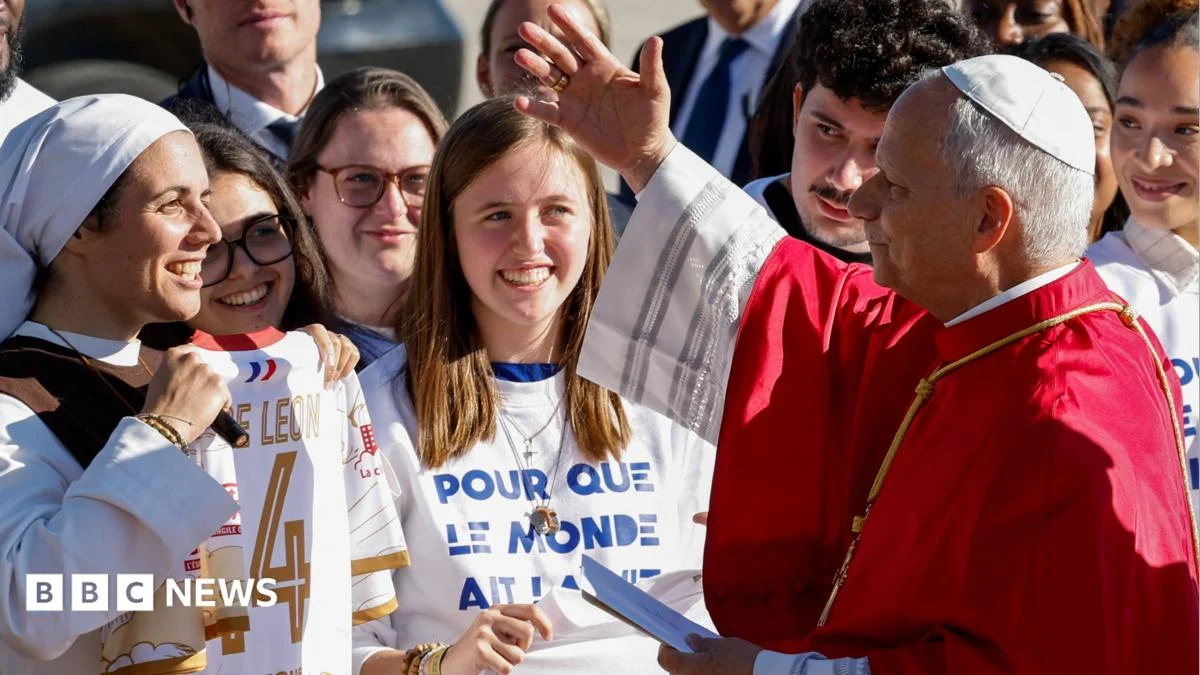
Pope Leo XIV embarks on a four-day visit to France on Friday, with the highpoint being a giant Mass attended by more than half a million people in central Paris. For Saturday’s afternoon celebration, an altar has been built on the Place de la Concorde and a large area around the Champs-Élysées sealed off by police. Some 600,000 Catholic faithful are expected to cram the avenue up to the Arc de Triomphe and beyond, a testament to an enthusiasm that the Church attributes to a growing spiritual thirst among the French and other Europeans, a sentiment echoed by Cardinal François Bustillo, Bishop of Ajaccio, who observes, "France has indeed secularised, but there is a void where God and values used to be. People are searching for something. Maybe they go to India or Tibet or the Amazon. And now the Pope comes here from Rome, bringing a reminder to people of their own roots. It was John-Paul II who awoke the East. Now Leo XIV will awake the West."
President Emmanuel Macron greeted Pope Leo XIV at Orly airport on Friday morning, marking the commencement of a visit that signifies a significant moment for the Catholic Church in France. The two leaders are scheduled to hold talks at the Élysée Palace later in the day, focusing on critical contemporary issues such as geopolitical challenges and the burgeoning field of artificial intelligence (AI). President Macron will also participate in a joint speech with the Pope in Metz, underscoring the importance of dialogue between religious and secular leadership. However, in a move largely designed to uphold France’s stringent principle of the separation of state and religion, President Macron will not be attending any of the Pope’s Masses. Instead, the monumental Mass on the Champs-Élysées will be graced by the presence of his wife, Brigitte Macron, and Prime Minister Sébastien Lecornu. The event is also expected to draw a significant contingent of political figures, including several candidates vying for the presidency in the upcoming election, such as Marine Le Pen of the nationalist right, centrists Edouard Philippe and Gabriel Attal, and conservative Bruno Retailleau, signaling the broad interest in the Pope’s presence and the issues he represents.
Despite the official cordiality, reports have emerged of underlying tensions between the Macron administration and the Vatican delegation responsible for arranging the visit. The President is said to have expressed frustration over his desire for a more ceremonial aspect to the Pope’s itinerary, suggesting a divergence in expectations regarding the public presentation of the papal visit.
The Pope’s itinerary extends beyond the capital, with a significant stop planned for Metz in northeastern France on Monday. Here, Pope Leo XIV will pay a poignant tribute to Robert Schuman, a pivotal figure often hailed as one of the founding fathers of the European Union. Schuman, a devout Catholic, is currently a candidate for beatification, adding a layer of historical and spiritual significance to this part of the visit. The Pope’s engagements also include a compassionate meeting with a group of migrants in Paris, addressing the contemporary humanitarian challenges faced by displaced populations. Furthermore, in Lourdes, a town renowned for its religious significance, Pope Leo XIV will meet with victims of sexual abuse perpetrated by members of the Catholic clergy, a somber but crucial step in the Church’s ongoing efforts toward accountability and healing.
Pope Leo XIV, born Robert Prevost in Chicago in 1955, carries a personal connection to France through his paternal grandmother, who was born in Le Havre, Normandy, in 1894. Her family name, Prevost, which her mother also bore, was adopted by her and her Italian husband when they married in the United States, weaving a thread of French heritage into the Pope’s lineage. This personal link further enriches the significance of his visit to France.
France’s relationship with the Catholic Church of Rome is deeply complex and historically layered. For centuries, France was known as the "Eldest Daughter of the Church," a title stemming from a commonly held, though historically inaccurate, belief that it was the first kingdom to convert to Christianity. In reality, nations like Armenia, Georgia, and Ethiopia predated France in their adoption of Christianity. The historical narrative also includes the period in the 14th Century when the papacy resided in exile in Avignon, southern France. Over subsequent centuries, French military power periodically influenced Italian politics, where popes wielded not only spiritual authority but also secular power as rulers. The tumultuous era of Napoleon Bonaparte saw two popes held captive, illustrating the volatile interplay between French state power and the Vatican.
In more recent times, France has continued to be a destination for papal visits. Popes John Paul II made several trips between 1980 and 2004, and Pope Francis visited three times, though notably he avoided Paris, opting instead for cities like Strasbourg, Marseille, and Corsica. These visits reflect a continued, albeit evolving, engagement between the papacy and the French nation.
The contemporary landscape of religion in France, however, mirrors the broader secularization trend across Europe. Today, less than half of the French population identifies as Catholic. The number of regular worshippers has seen a dramatic decline, falling from 35% of the population in 1960 to less than 5% currently. The number of priests has also diminished significantly, shrinking by two-thirds from 25,000 in 1990 to fewer than 9,000 today.
Despite these statistics, recent years have presented subtle yet encouraging signs of a resurgent interest in religious tradition. The number of adult baptisms has more than doubled in the past five years, reaching 10,000 in 2025. This trend suggests a renewed spiritual searching among some segments of the population, providing a backdrop for Pope Leo XIV’s message of hope and spiritual grounding. The Pope’s visit, therefore, is not merely a diplomatic or ceremonial event, but a significant moment for spiritual reflection and engagement in a nation grappling with its secular identity and seeking to reconnect with its historical and spiritual roots.

 Nakalama John
 atisusanti
 Ramos Leo
 Roy Suryo
 Nana Banana