Nana Banana
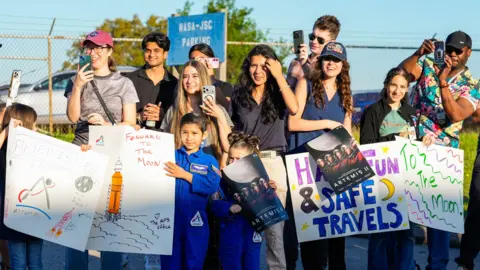
A palpable hum of anticipation, thick as the humid Florida air, settled over the Space Coast as the clock ticked down to the launch of Artemis II. From the serene shores of Merritt Island to the bustling beaches of Cocoa, hundreds of thousands converged, their gazes fixed on the towering spectacle of NASA’s Space Launch System (SLS) rocket. "People going up to the Moon is kind of cool," declared eight-year-old Isiah, encapsulating the childlike wonder that permeated the colossal gathering. He was one of an estimated 400,000 individuals expected to cram every available vantage point – causeways, beaches, motel balconies, and makeshift viewing platforms – for the launch attempt tonight.
These eager spectators were poised to witness history in the making: four astronauts blasting into space on a daring mission to fly around the Moon, potentially journeying further from Earth than any human has ever travelled before. While NASA’s ambitious 10-day test flight will not culminate in a lunar landing, the crew is slated to observe views of the lunar landscapes that have, until now, remained unseen by human eyes. The mission serves as a critical stepping stone in humanity’s renewed quest to establish a sustained presence on Earth’s closest celestial neighbour.
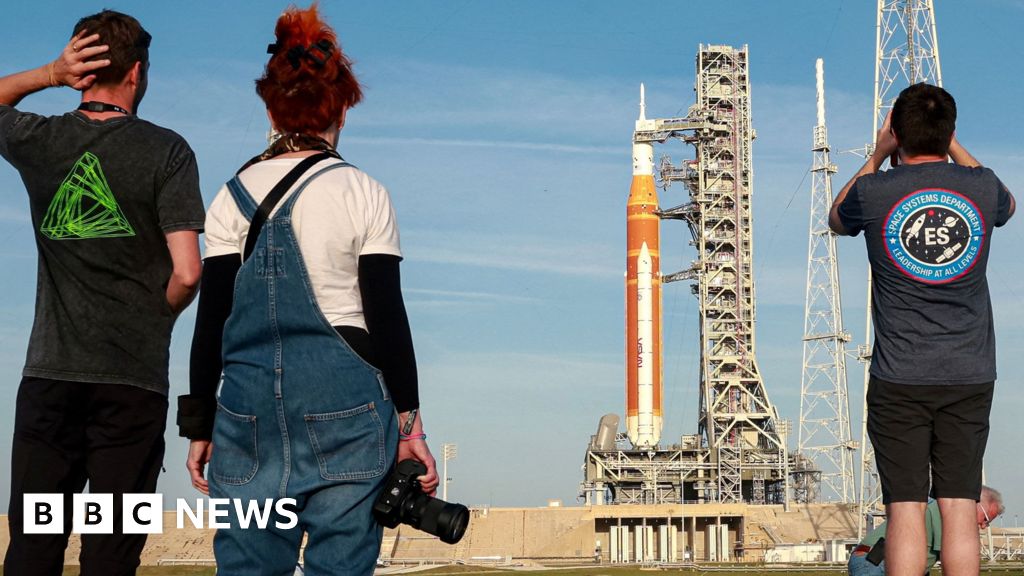
The pilgrimage to the Space Coast drew enthusiasts from across the globe. Amanda Garcia, who journeyed over 1,000 miles from New Mexico, voiced the collective excitement. "I’m pretty excited about it," she shared, her voice barely audible above the growing murmur of the crowd. "I came out here to see it, and I heard it’s gonna be a great show. A lot of people are going to be here." Her sentiment was echoed by families setting up telescopes in parking lots, seasoned space veterans recalling Apollo launches, and newcomers simply eager to soak in the atmosphere of a truly monumental event.
Beyond the secure perimeter of the Kennedy Space Center launch site, the entire region transformed into a vibrant festival of space exploration. Along the tranquil lagoons and sun-drenched beaches of Titusville and Cocoa Beach, local businesses capitalized on the unprecedented influx. Bars advertised "moonshots" cocktails, hotels issued advisories warning guests of extensive traffic delays when navigating to and from prime viewing spots, and every storefront seemed to boast Artemis-themed merchandise. Local officials, overwhelmed yet invigorated, spoke of a "historic influx" of tourists, projecting an economic impact of approximately $160 million (£121 million) for the region. Intricate traffic management plans were meticulously rolled out for a night when the glow of highway lights would fiercely compete with the floodlit launch towers and the cheerful flicker of countless camper van barbecues.
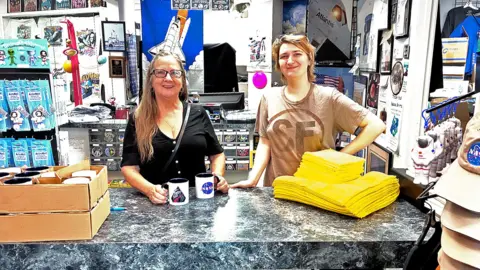
A mere mile or so from the concrete pads where Artemis II would soon ignite the night sky, Brenda Mulberry, the spirited owner of Space Shirts, busily tended to her shop. For four decades, she has been a purveyor of NASA T-shirts and souvenirs, a constant presence through the ebb and flow of space exploration. Her small shop on Merritt Island, a treasure trove of space memorabilia, brimmed with racks of orange, blue, and black T-shirts depicting hand-drawn rockets, intricate mission patches, and evocative moonscapes. While her store typically thrives on regular launch days, this particular event felt different, she explained, a tremor of excitement in her voice. "We’ve wanted to go back to the Moon since the ’70s. People are excited. People are beyond excited," she affirmed, a wide smile spreading across her face. Brenda had prudently stocked up, anticipating the biggest surge of customers she had ever witnessed. With a twinkle in her eye and a hearty laugh, she declared her ultimate ambition: "I want to have the first T-shirt shop on the Moon. Because if you’ve been there, you get the T-shirt, right?" Her playful ambition perfectly captured the audacious spirit of the Artemis program itself.
Future Artemis missions are designed to achieve what hasn’t been done since 1972: land humans on the Moon. But this time, the goal is far grander than simply planting flags. It aims to establish a permanent Moon base, strategically designed to exploit its natural resources and, crucially, to serve as a vital springboard for humanity’s ultimate journey to Mars. This long-term vision imbues Artemis II with profound significance, not just as a test flight, but as a symbolic rekindling of humanity’s pioneering spirit.
Artemis II’s mission commander, Reid Wiseman, articulated this generational impact. He expressed his fervent hope that the monumental effort to return to the Moon would ignite the imaginations of a new generation. "In our lifetime, we’ve looked at the Moon knowing that people had been there. And now in the Artemis generation, kids will walk out and look at the Moon going, we are there. We are there now, and we are going further into our solar system." His words resonated deeply, connecting the current mission to the boundless aspirations of future explorers. The four astronauts, a diverse and highly skilled crew, had undergone years of grueling training, forging an unbreakable bond and a shared commitment to the mission’s success and its inspirational potential.
As nightfall approached, all attention irrevocably turned to Launch Pad 39B – the same historic stretch of concrete from which the United States’ Apollo programme first launched men to the Moon in 1969. Standing sentinel on the pad was NASA’s Space Launch System (SLS) rocket, a magnificent testament to human engineering. At an imposing 98 metres (321 feet) tall, the white and orange giant represents the heaviest and most powerful rocket the agency has ever launched. Perched atop this colossal vehicle was Orion, a capsule roughly the size of a small van, where the four astronauts would spend the next 10 days in close proximity, their lives entrusted to its advanced systems. This mission marks the first time the Orion capsule will be put through its paces with a human crew onboard, a crucial validation before future lunar landings.

If all systems held and the weather cooperated, the rocket was scheduled to launch between 18:24-20:24 local time (23:24-01:24 BST) on Wednesday. The four intrepid astronauts had strapped into Orion approximately four hours prior to launch, a period of quiet focus before the roaring ascent. Up front, on the left-hand side, sat Commander Reid Wiseman, his extensive experience a calming presence. Beside him was Pilot Victor Glover, who would become the first African American to journey around the Moon. Behind them were Mission Specialists Christina Koch, the first woman to embark on a lunar mission, and Jeremy Hansen, a Canadian fighter pilot turned astronaut, for whom this would be his inaugural trip into space. This diverse crew symbolized a new era of space exploration, one that seeks to include all of humanity in its grand ambitions.
After achieving initial Earth orbit, Orion would spend its first day conducting critical manual flying exercises and rigorously testing its life support systems, preparing for the rigours of deep space. On Day 2, a powerful trans-lunar injection burn would propel the spacecraft onto a free-return trajectory – an ingenious orbital path designed to naturally loop it around the Moon and back towards Earth, with only minor correction burns needed to fine-tune the course.
Each day of the mission was meticulously planned, involving different tests and challenges for the crew, pushing both the hardware and human endurance to their limits. Day 6 loomed as a particularly significant milestone, as Orion was scheduled to fly around the far side of the Moon. During this phase, all radio contact with Earth would be lost for approximately 40 minutes, leaving flight controllers in suspense, unaware of the precise happenings onboard the capsule. Orion would be travelling at an altitude of about 4,000–6,000 miles above the lunar surface and was projected to slightly exceed Apollo 13’s record distance of approximately 250,000 miles (400,000 km) from Earth, depending on the exact trajectory, setting a new benchmark for human deep-space travel.
In the days that followed, Orion would be naturally pulled back towards Earth by the same free-return trajectory that carried it out, with small course adjustment burns ensuring the capsule intersected Earth’s atmosphere at precisely the correct angle. On the final day, the crew would brace themselves for what is arguably the most brutal part of the trip: re-entry into Earth’s atmosphere at a blistering speed of approximately 25,000 mph (40,000 km/h). During this harrowing phase, Orion’s advanced heat shield would once again face temperatures hot enough to char rock, a fiery crucible designed to protect its precious human cargo.
Following the inaugural uncrewed test flight, Artemis I, engineers discovered that chunks of the heat shield’s ablative coating had cracked and broken away during a two-stage "skip" re-entry manoeuvre. This intricate procedure involved the capsule dipping into the upper atmosphere, briefly climbing again, then plunging back in to optimally manage the intense heat, extreme G-forces, and ensure pinpoint splashdown accuracy. For Artemis II, engineers opted to retain this two-step re-entry, but critically altered the angle and timing, reducing the duration Orion spent in the initial, gentler dip. Modelling suggested this revised approach would mitigate the heating and structural loads that led to the earlier charring. However, this mission would be the very first time this modified descent profile was flown with a human crew onboard, adding an element of heightened scrutiny and inherent risk.
If Artemis II achieved its objectives and proved a resounding success, the next time the Space Coast filled up with such an extraordinary throng, it would be for another test flight – another monumental step closer to people actually walking on the Moon again, more than half a century after humanity’s last footprints graced its dusty surface. And somewhere amidst the marsh grass and the gleaming launch pads, amidst the cheers and the tears, there would almost certainly be someone proudly sporting one of Brenda Mulberry’s iconic Space Shirts, already dreaming of the day when her familiar logo appeared not just on Florida cotton, but in a photograph taken by a human explorer, standing triumphant on the Moon.




 George Anjay
 Nakalama John
 atisusanti
 Ramos Leo