Nana Banana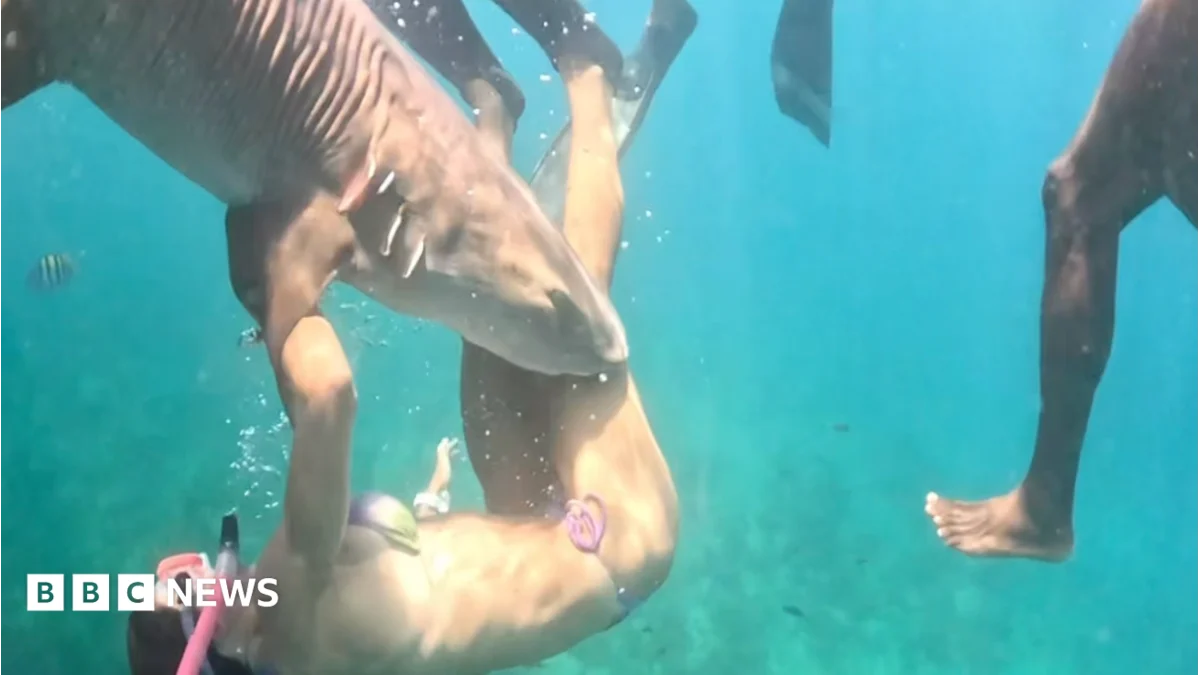
This perilous intersection was vividly demonstrated in April when Tayane Dalazen, a 37-year-old Brazilian lawyer and burgeoning social media personality, found herself in a terrifying confrontation with a nurse shark off the Brazilian coast. Her experience began with an unusual observation: "I knew something was different because the sharks were on the surface," Dalazen recounted, noting the unusually high concentration of animals. It was only later, she says, that she understood the unsettling context: "I discovered [the tour organisers] were feeding the sharks so that they would interact with the tourists." This practice, while aimed at guaranteeing an "authentic" wildlife encounter, fundamentally alters natural shark behavior and can create a false sense of security for participants.
Amidst this manufactured interaction, Dalazen suddenly felt an immense, crushing sensation on her leg. "When the shark bit me, the pain was very strong," she recalled, describing the moment a nurse shark, measuring over seven feet (two metres) long, clamped its powerful jaws around her thigh. Despite the intense pain and the shock of being held underwater for several terrifying seconds, Dalazen maintained remarkable composure. "I stayed calm because I knew I couldn’t fight the animal," she explained. Eventually, the shark released its grip, allowing her to escape, but the encounter left her with deep lacerations and a profound sense of fear. The experience, she stated, was "very frightening."
Following the incident, Dalazen posted footage of the shark bite online, where it rapidly went viral, accumulating tens of millions of views. While she insists she "wasn’t there for social media" and did not intentionally touch or provoke the shark, she candidly admits to being too close to the animals. Her story serves as a stark warning, revealing the inherent risks when humans intentionally bridge the natural distance between themselves and apex predators, often encouraged by the lure of a spectacular, shareable moment.
While individual incidents of sharks biting humans remain incredibly rare in the grand scheme of marine interactions, there’s an alarming pattern emerging among a specific demographic. In less than a year, at least three social media influencers have been bitten by sharks, often with their cameras rolling. Scientists and marine conservationists are expressing growing concern over the proliferation of social media videos showcasing individuals swimming dangerously close to sharks, touching them, or even attempting to ride them. This escalating trend, driven by the quest for viral content, is pushing the boundaries of safe and ethical wildlife interaction.
Kristian Parton, a prominent shark scientist and host of the popular ‘Shark Bytes’ YouTube channel, articulates this mounting worry: "I’m seeing these videos every single week now and it’s way more than it ever used to be," he states, predicting a grim outcome. "We’re going to see people ending up in really serious incidents with sharks." His observations are corroborated by recent events. Last July, a fishing influencer narrowly avoided losing his leg after being attacked by a reef shark while spearfishing, an encounter that was, predictably, captured on camera. Similarly, in December, a Chinese content creator suffered a shark bite in the Maldives, an incident also recorded for online consumption. These highly publicised events, often filmed and shared by the victims themselves, paradoxically fuel the very behaviour that leads to such dangers.
Researchers at the International Shark Attack File (ISAF), a global database tracking human-shark interactions, have also reported a significant increase over the past three years in the number of people bitten while attempting to film or photograph sharks. This trend is further supported by a recent study focusing on "swim with wildlife" expeditions, which concluded that influencers and professional photographers were the most likely participants to disregard crucial safety instructions. The allure of the "perfect shot" often overrides common sense and established safety protocols, putting both humans and animals at risk.
The consequences of such recklessness can be catastrophic. In a particularly grim incident in February last year, a tourist in the Caribbean tragically had both hands bitten off while attempting to photograph a bull shark from the shallow waters, according to local authorities. Just two months later, in Israel, a snorkeler carrying a "selfie stick" was reportedly killed by sharks while trying to capture photographs. While the overall risk of an unprovoked shark attack remains extremely low – with approximately 70 bites per year globally, a figure that has remained broadly stable for the past three decades – these incidents highlight the critical distinction between unprovoked encounters and those where human actions, such as seeking proximity for media, directly contribute to the interaction. When humans actively intrude upon a shark’s space, particularly in a manner perceived as a threat or a food source, the likelihood of a defensive or exploratory bite increases dramatically.
The types of sharks involved in these incidents vary, but even species typically considered less aggressive can inflict serious harm. While Tayane Dalazen was bitten by a nurse shark – often described as a more docile species known for its bottom-dwelling habits – some influencers have been filmed deliberately touching far more formidable predators, including tiger sharks and even great whites. "We’re talking about a true apex predator, a very large wild animal," Kristian Parton emphasizes, drawing a vivid analogy: "You wouldn’t walk into the Serengeti and try and put your hand on the face of a lion." Sharks often employ defensive or "exploratory" bites when their personal space is invaded or when they are investigating an unfamiliar object. These are not necessarily predatory attacks, but rather a means of communication or investigation, which, given the shark’s powerful jaws, can still result in severe injuries.
Beyond the immediate danger to humans, these close-up interactions pose significant ethical and ecological problems for the sharks themselves. Human presence, especially persistent or invasive contact, can cause considerable stress to these sensitive animals. Scientific studies have demonstrated that approaching or touching a shark can lead to elevated levels of stress hormones, known as glucocorticoids. Chronically high levels of these hormones can have detrimental long-term effects, including a weakened immune system, increased mortality rates, and even aborted offspring. "If you’re approaching the shark and stressing it out, whether it be in a nursery habitat, a breeding ground, or a feeding area, you’re depriving that shark of an area that’s important to it to survive," Parton explains, stressing that "that’s definitely a problem." Such disruptions can have cascading effects on shark populations and the delicate balance of marine ecosystems.
One of the most prominent figures in the realm of shark content creation is Ocean Ramsey, a 38-year-old former model who garnered international fame in 2019 after viral images depicted her swimming alongside one of the largest great white sharks ever recorded. Ramsey frequently posts footage of herself touching sharks and holding onto their dorsal fins, actions that often draw both awe and criticism. From a boat in Hawaii, where she operates "Dive with Ocean" shark tours for paying customers, Ramsey articulated her philosophy to the BBC.
She maintains that her "intent with all of my content has never been to gain views, it’s to gain protection for sharks." Ramsey asserts that her work is rooted in conservation, claiming contributions to "research articles, data collection… all of my work stems down to education." She vehemently denies that her close proximity to sharks, or even touching them, causes them harm. "Most of my work and what I share is respecting and observing from a distance," she insists, adding that she observes their behaviour and that "they choose to interact with me. They always make the first approach."
However, scientists like Parton raise serious questions about the potential for such highly visible content to mislead the public. They argue that videos showing individuals in intimate contact with sharks, regardless of the stated intent, can inadvertently encourage others with less experience or understanding to take similar, dangerous risks. When confronted with this concern, Ramsey shifts the responsibility to the audience. "You’ve got to give the general public some accountability," she argues. "I think most people are observing what I’m sharing with an educational message and they’re not going out to just replicate that." This perspective underscores a fundamental divide in the conversation: the expert view of inherent risk versus the content creator’s belief in responsible public interpretation.
The growing trend of influencers seeking extreme shark encounters for online content presents a complex challenge, balancing the pursuit of captivating media with the paramount need for wildlife conservation and human safety. While the vast majority of shark encounters are harmless, the increasing number of incidents involving individuals intentionally seeking proximity for social media underscores a dangerous cultural shift. Prioritizing viral views over the well-being of apex predators and the safety of humans creates a perilous feedback loop, where extraordinary risks are taken for fleeting digital fame. Ultimately, a greater emphasis on respect, education, and maintaining a safe, ethical distance from these magnificent wild animals is crucial to prevent further harm and ensure the long-term health of both marine life and those who seek to appreciate it.



 George Anjay
 Nakalama John
 atisusanti
 Ramos Leo