
 George Anjay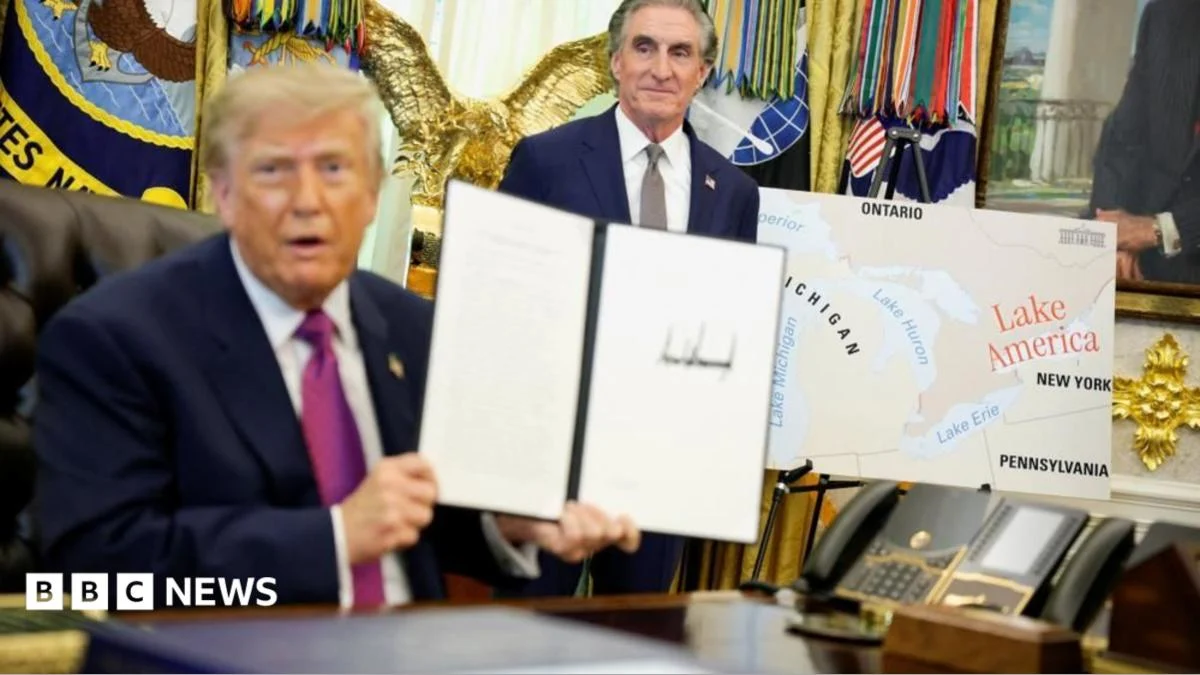
US President Donald Trump has signed an executive order seeking to rename Lake Ontario to Lake America, a move that escalates the ongoing and increasingly acrimonious trade dispute between the United States and Canada. The dramatic proclamation, made with characteristic fanfare from the Oval Office, signifies a new, symbolic front in the economic warfare that has seen bilateral relations plummet to historic lows. The order, declared "official, effective immediately," follows weeks of escalating rhetoric and tit-for-tat trade actions, with Trump asserting his administration has "filed all the necessary papers, documents" to effect the change.
The catalyst for this latest geopolitical maneuver appears to be the collapse of trade talks between the two North American neighbors late last week, a breakdown that led to the United States imposing steep new 50% tariffs on approximately $20 billion (C$28 billion) worth of Canadian goods. Canada, predictably, has vowed to retaliate with "dollar for dollar" counter-tariffs, slated to be implemented next month, promising a further deepening of the economic chasm. Trump, who has a well-documented history of leveraging social media to broadcast his policy pronouncements and grievances, had repeatedly foreshadowed this particular action, hinting at the renaming of the lake – one of the five iconic Great Lakes that form a vital natural border between the two nations – amidst the escalating trade conflict.
The decision to rename a shared body of international water, particularly one with such deep historical and indigenous roots, has been met with swift and resolute condemnation from Canadian officials. Prime Minister Mark Carney, in a pointed social media post that preceded Trump’s official announcement, underscored the profound historical significance of the name "Lake Ontario." He emphasized that the name can be traced back more than 400 years, predating not only the formation of the Canadian Confederation but also the very inception of the United States through its Declaration of Independence. Carney’s message resonated with a clear message of defiance, stating, "We know that the United States is changing. Their trade relations, their foreign policy, their national monuments, their hydronyms," before firmly asserting, "Canadian women and men also know that things must be called by their name, and this lake is called Lake Ontario – today and forever."
This is not the first time President Trump has sought to unilaterally alter the nomenclature of significant geographical features. Upon entering the White House in 2025, he issued a similar executive order that declared the Gulf of Mexico to be renamed the Gulf of America. That audacious move was met with outright rejection from Mexico, which argued vehemently that a single nation cannot unilaterally rename a shared body of international water. The repercussions of that renaming order were far-reaching, leading to a protracted legal dispute between Mexico and the tech giant Google. The company, in an effort to navigate the complex geopolitical landscape and cater to its diverse user base, implemented a bifurcated naming convention within its widely used Maps application. Consequently, Google Maps users within the United States saw the designation "Gulf of America," while those in Mexico continued to view the traditional "Gulf of Mexico." Users in other countries were presented with a more nuanced display: "Gulf of Mexico (Gulf of America)."
The controversy surrounding the "Gulf of America" also extended to journalistic freedom. The White House at that time took the unprecedented step of blocking Associated Press reporters from accessing presidential events as a punitive measure against the news agency for its refusal to adopt the name "Gulf of America" in its coverage. This censorship sparked a significant legal battle, with the AP suing the Trump administration in response, a legal contest that remains ongoing and unresolved.
The current situation with Lake Ontario highlights a critical geopolitical reality: there is no universally recognized international body tasked with standardizing the names of international waters. While a US president undoubtedly possesses broad discretion in how their country officially recognizes domestic landmarks and geographical features, other sovereign nations are not legally bound to adopt or acknowledge such unilateral changes, particularly when they pertain to shared international territories.
In the case of Lake Ontario, President Trump’s executive order directs the US Department of the Interior to update the Geographic Names Information Service – the official repository for domestic geographic names within the United States – to reflect the newly decreed name change. However, Canada remains steadfast in its refusal to recognize this alteration. Canadian officials have uniformly dismissed the idea, with Premier of Nova Scotia Tim Houston bluntly stating on Thursday, "We’re into some real foolishness now. It’s Lake Ontario, buddy." Similarly, Industry Minister Melanie Joly reaffirmed Canada’s position earlier in the week, declaring, "We’ll always call it Lake Ontario."
The names of four of the five Great Lakes – Ontario, Huron, Michigan, and Erie – possess origins rooted in indigenous languages, reflecting the deep historical and cultural tapestry of the North American continent. Lake Superior, by contrast, derives its name from an anglicized French term. Lake Ontario, the smallest of the Great Lakes by surface area, holds particular significance as it directly borders both the Canadian province of Ontario and the US state of New York, underscoring its shared identity.
Speaking from the Oval Office as he signed the executive order, President Trump downplayed the direct message to Canada, instead framing it as a consequence of what he perceives as Canada’s long-standing exploitation of the United States in trade matters. "America’s northern neighbor ‘has been ripping us off for a long time on trade’," Trump stated, reiterating a common theme in his trade rhetoric. He asserted that the idea of renaming the lake had been percolating in his mind "for a long time."
With a characteristic sweep of his pronouncements, Trump mused aloud about the broader implications of such a rebranding, saying, "So if you think about it, we have a gulf and we have a lake. Now, all we need is an ocean. So maybe we’ll have to change the name of the Atlantic and or the Pacific. Maybe we’ll change them both." This hyperbolic suggestion underscores the president’s penchant for grand gestures and his willingness to use symbolic actions to exert pressure in diplomatic and economic disputes.
The current trade dispute has undoubtedly pushed US-Canada relations to their nadir, marked by a barrage of insults and accusations exchanged between the Trump administration and Canadian officials over the past week. However, amidst the escalating tensions, a glimmer of hope for a potential de-escalation and a return to the negotiating table emerged on Thursday. Canadian US Trade Minister Dominic LeBlanc posted on X, formerly Twitter, that the United States had rescinded some of its demands concerning French language labeling requirements. He further confirmed that "measures to promote French language and Canadian culture will not be subject to future US trade actions." LeBlanc expressed an optimistic outlook, stating, "We look forward to further constructive US clarifications on their other positions, which would create the possibility of a mutually beneficial trade agreement that respects Canadian sovereignty."
Despite this tentative sign of potential progress, the trade talks themselves experienced a dramatic collapse at the eleventh hour late Friday night, with both sides leveling accusations of last-minute demands that torpedoed a tentatively agreed-upon deal. The renaming of Lake Ontario to Lake America, therefore, serves as a potent and highly visible symbol of the deep-seated animosity and distrust that currently define the relationship between these two close allies and trading partners, a relationship that now faces the uncertain prospect of navigating a landscape reshaped by presidential decree and national pride.



 Roy Suryo

 Nakalama John
 atisusanti
 Ramos Leo
