Nana Banana
The Earth’s climate is teetering on the edge, further out of balance than at any point in recorded human history, the United Nations’ weather agency, the World Meteorological Organization (WMO), has starkly warned. This alarming declaration comes as the planet continues to absorb an unprecedented amount of heat energy, driven primarily by the relentless accumulation of greenhouse gases like carbon dioxide in the atmosphere. The WMO’s report highlights a record "energy imbalance," where the Earth is trapping significantly more energy than it can radiate back into space, leading to a cascade of profound environmental changes. This imbalance was particularly evident last year, as the global ocean reached new record temperatures and the planet’s vital ice caps continued their accelerated melt. The scientific community now braces for the impending arrival of El Niño, a natural warming phase expected to emerge later this year, which scientists fear could push global temperatures to unprecedented new highs, exacerbating an already critical situation.

This impending shift has prompted an urgent call to action from UN Secretary-General António Guterres, who reiterated his plea for nations worldwide to transition away from fossil fuels and embrace renewable energy sources. Such a monumental shift, he argued, is not merely an environmental imperative but a foundational requirement to "deliver climate security, energy security and national security." In a characteristically forceful video address, Guterres delivered a grave warning: "Planet Earth is being pushed beyond its limits. Every key climate indicator is flashing red." His words underscore the growing consensus among experts that the planet is undergoing rapid and fundamental changes that demand immediate and decisive global cooperation.
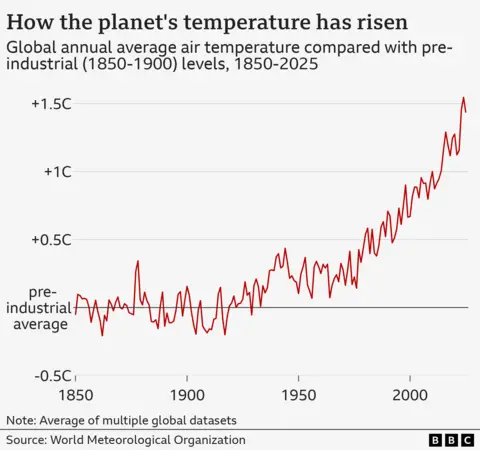
The WMO’s findings paint a grim picture of accelerating warming trends. The organization revealed that the last 11 years now stand as the Earth’s 11 warmest years in meteorological records dating back to 1850. Specifically, in 2025, the global average air temperature soared to approximately 1.43°C above "pre-industrial" levels – a benchmark period before humans began large-scale industrial activities and the widespread burning of fossil fuels. This figure brings the world dangerously close to the 1.5°C threshold that nations committed to limiting warming to under the Paris Agreement, a target many scientists now view as increasingly precarious. While 2025 was still ranked as one of the three warmest years on record, the underlying trend indicates a clear and accelerating warming trajectory, despite some year-to-year fluctuations. Many scientists now believe that the rate of warming itself is picking up pace, broadly aligning with, or even exceeding, the upper bounds of long-term climate predictions.

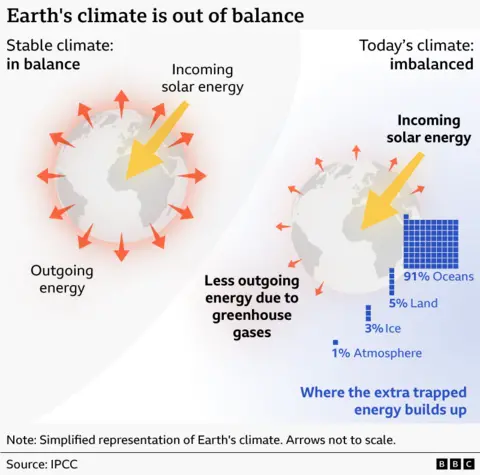
Beyond surface air temperatures, the WMO report points to a wealth of other irrefutable evidence demonstrating the rapid and unprecedented pace of climate change. Perhaps the most comprehensive and alarming metric is the Earth’s "energy imbalance" – the amount of extra heat energy being absorbed and retained by the planet. This imbalance is the fundamental driver of climate change, and it reached a new zenith last year. Greenhouse gases, primarily carbon dioxide from the combustion of fossil fuels, trap heat within the atmosphere, preventing it from escaping into space. This trapped energy then distributes itself across various components of the Earth system.
A significant portion of this excess energy warms the atmosphere and the landmasses, but the majority, over 90%, is absorbed by the oceans. The world’s glaciers, crucial reservoirs of freshwater, experienced one of their five worst years on record during 2024/25, according to provisional data. Simultaneously, sea ice extent at both the Arctic and Antarctic poles remained at or near record lows throughout most of 2025. The melting of these vast ice bodies contributes directly to global sea-level rise and disrupts delicate polar ecosystems, impacting species like polar bears and penguins that rely on stable ice habitats. The loss of sea ice also creates a feedback loop, as darker ocean water absorbs more solar radiation than reflective ice, further accelerating warming.
The oceans, with their immense heat capacity, act as a massive buffer, absorbing the bulk of the planet’s excess heat. This absorption, however, comes at a steep cost. The heat stored in the upper 2 kilometers (1.2 miles) of the global ocean reached an unprecedented high last year. Over the past two decades alone, this upper ocean layer has been warming more than twice as quickly as it did during the late 20th Century. This oceanic warming has profound consequences: it leads to thermal expansion, a major contributor to sea-level rise; it fuels more intense tropical storms and hurricanes by providing greater energy; it causes widespread coral bleaching events, threatening vital marine biodiversity and food security; and it alters ocean currents, impacting weather patterns far beyond coastal regions.
Prof. Celeste Saulo, Secretary-General of the WMO, articulated the gravity of the situation, stating, "Human activities are increasingly disrupting the natural equilibrium and we will live with these consequences for hundreds and thousands of years." Her words emphasize the long-term, potentially irreversible nature of some of the changes now being set in motion, raising concerns about potential tipping points beyond which natural systems may undergo abrupt and catastrophic shifts.
The report also highlights the immediate and tangible impacts of rising temperatures on human societies and natural ecosystems today. These higher temperatures are intensifying many types of extreme weather events, making heatwaves more frequent and severe, exacerbating droughts, contributing to more intense rainfall and flooding, and increasing the risk and spread of devastating wildfires. Furthermore, warming climates are aiding the geographical expansion and increased incidence of vector-borne diseases such as dengue fever, malaria, and Lyme disease, posing new public health challenges. A rapid analysis by scientists at the World Weather Attribution group, released on Friday, underscored this point, concluding that the intensity of recent heatwaves would have been "virtually impossible" without human-caused climate change, providing a direct causal link between anthropogenic emissions and extreme events.
Adding another layer of urgency to the climate outlook, researchers are closely monitoring the Pacific Ocean for signs of an impending El Niño phase. Long-term forecasts strongly suggest that this natural warming phenomenon, characterized by unusually warm ocean temperatures in the equatorial Pacific, could form in the second half of 2026. El Niño events typically last for 9-12 months but can sometimes extend for years, influencing weather patterns across the globe, often leading to hotter, drier conditions in some regions and increased rainfall in others. The concern among scientists is that an El Niño – occurring on top of the background human-caused warming trend – could deliver a powerful double blow, pushing global temperatures to new record heights well into 2027. "If we transition to El Niño, we will see an increase in global temperature again, and potentially to new records," warned Dr. John Kennedy of the WMO. This prospect underscores the critical need for robust climate action now, to mitigate the combined effects of human-induced warming and natural climate variability. The world stands at a critical juncture, with every indicator urging a decisive and collective shift towards a sustainable future to avert the most catastrophic consequences of a rapidly changing climate.



 George Anjay
 Nakalama John
 atisusanti
 Ramos Leo